

Best Fish Bag for Tournament Fishing: Gear That Wins at the Scales
A single ounce is the difference between a podium finish and a long drive home. You've seen it happen. A trophy catch hits the deck, but by the weigh-in, it's lost its edge. Heat kills weight. Dehydration costs money. You need gear that fights back. Cheap bags leak in your truck. Flimsy zippers fail when the pressure is high. Finding the best fish bag for tournament fishing isn't about aesthetics or brand prestige. It's about tactical weight preservation and industrial-grade durability.
We understand the field. We know the frustration of gear that quits before you do. This guide teaches you how to select a tournament bag that preserves every ounce through superior ice retention and rugged construction. We'll examine the technical specifications like insulation density and material strength that separate professional tools from retail junk. It's time to stop losing at the scales because of gear failure. You'll learn how to maintain peak fish quality and ensure your equipment survives the most demanding conditions.
Key Takeaways
- Every ounce counts. Learn how heat and dehydration strip weight from your catch before you even reach the dock.
- Stop guessing. Identify the best fish bag for tournament fishing by comparing simple carry bags against high-performance preservation systems.
- Prioritize industrial-grade materials. Only 18oz vinyl and heat-sealed seams provide the leak-proof durability needed for professional use.
- Master the pro ice strategy. Proper pre-chilling and specific ice-to-fish ratios guarantee the thermal regulation required to win at the scales.
- Choose an optimized footprint. Discover why an 18 inch by 36 inch insulated bag is the tactical size for most serious tournament species.
Why Your Tournament Strategy Starts with the Right Fish Bag
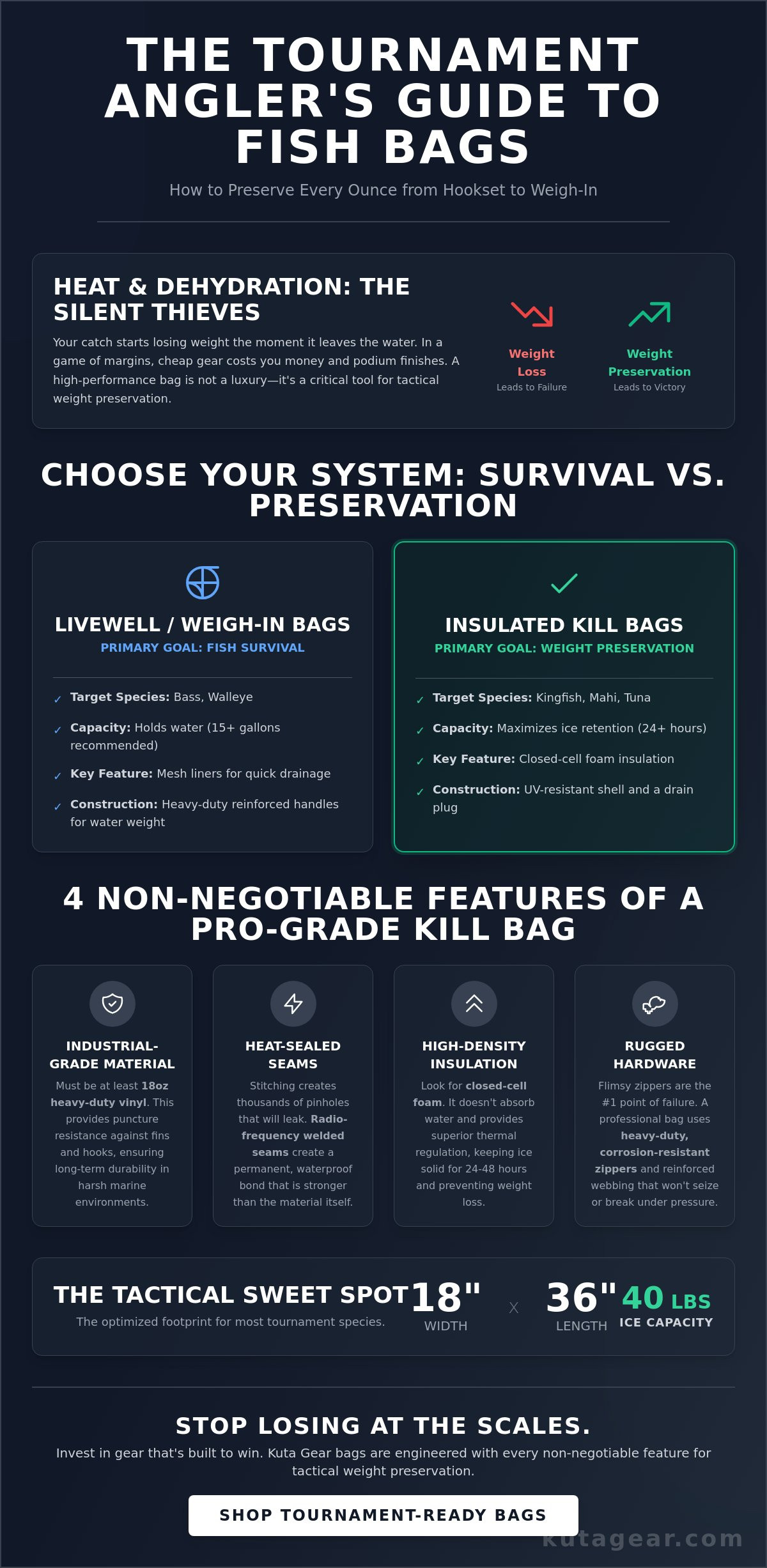
Tournament success is a game of margins. You invest in the best electronics, high-end rods, and precision tackle. Don't compromise everything at the finish line. Every ounce counts when you stand before the officials. Heat and dehydration are silent thieves that strip weight from your catch the moment it leaves the water. In the competitive world of sport fishing, your storage solution is either an asset or a liability. There is a massive gap between a basic carry bag and a true preservation system. One just holds the fish; the other protects your investment.
Professional anglers prioritize thermal regulation over flashy aesthetics. They understand that a bag must meet strict tournament regulations regarding size and safety. A bag that leaks fluids on the dock or fails to maintain temperature isn't just a nuisance. It's a risk to your standing. Finding the best fish bag for tournament fishing means looking for gear designed for industrial-strength performance. You need a tool that locks in moisture and keeps core temperatures stable from the hookset to the scales.
The High Cost of Cheap Gear
Cheap gear is a gamble you will eventually lose. Zipper failures are the primary nightmare on tournament day. You're fighting a seized slide while the weigh-in clock is ticking. It's a failure of design and materials. Retail bags often use thin fabrics that can't withstand the environment. Fins and terminal tackle puncture low-end liners with ease. This leads to leaks in your boat or truck. Replacing a flimsy bag every season is a drain on your capital. Professional gear utilizes 18oz vinyl as a baseline. It's built to survive the salt, the sun, and the rough handling of a high-stakes day. Rugged construction isn't a luxury. It's a requirement for anyone serious about the podium.
Freshness and the Scales
Freshness is a direct reflection of density. As a fish warms up, it loses fluids and mass. Immediate cooling is the only way to stop this process. A high-performance bag acts as a portable cold-storage unit. It prevents skin degradation and the dreaded "red-eye" look that signals a poorly handled catch. Presentation matters to the judges, but the scale is the ultimate decider. Effective blood-lining and rapid chilling keep the fish in peak condition. The best fish bag for tournament fishing must handle significant ice loads, often up to 40 lbs, without failing. It keeps ice solid for hours. This ensures your catch stays heavy and your hard work pays off when it matters most.
Weigh-In Bags vs. Kill Bags: Which Tournament Style Are You Fishing?
Tournament fishing is a brutal environment. Gear fails. You need equipment that doesn't quit. Categorize your storage by the goal: survival or weight retention. You can't use a live-well bag for a tuna tournament. You shouldn't use a heavy kill bag for a quick bass walk to the scales. The best fish bag for tournament fishing matches the specific demands of your target species. There are two primary categories. Weigh-in bags focus on survival. Kill bags focus on preservation.
Freshwater Weigh-In Bags
Bass and Walleye tournaments demand live fish. These bags are built to hold water, not just ice. Capacity is critical. Industry standards often recommend a capacity of at least 15 gallons for weigh-in bags. You need enough oxygenated water to keep the catch kicking. Professional bags often include mesh liners. These allow for quick drainage at the scales. It saves time. It reduces stress on the fish. Handles must be reinforced with heavy-duty webbing. Ten gallons of water plus a limit of fish is heavy. Don't trust a cheap strap with your tournament standing. Some tournament regulations even require specific bags provided by the committee to ensure survival rates. Check your local regulations before you buy.
Offshore Tournament Kill Bags
Offshore is a different game. You aren't keeping the catch alive. You're keeping it cold. Pelagic species like Kingfish or Mahi need space and thermal stability. Insulation is the priority here. Look for closed-cell foam. It doesn't absorb water. It keeps the heat out for 24 hours or more. UV resistance is mandatory for open decks. The sun will bake a cheap bag in hours. You need easy-clean liners. Blood and slime shouldn't stain your gear forever. Drain plugs are a major advantage. They let you refresh the brine without dumping the whole load. Selecting the best fish bag for tournament fishing is about balancing this thermal capacity with portability.
Dimensions matter for your boat's layout. An 18" x 36" footprint is the tactical standard. It fits in most cockpits. It's easy to move from the deck to the truck. While some bags reach 60 inches for trophy pelagics, the 36-inch model is the sweet spot for most competitive anglers. It holds up to 40 lbs of ice. It holds your limit. It doesn't waste space. If you need a reliable insulated fish bag for your next event, prioritize technical specs over brand hype. Focus on 18oz vinyl and heat-sealed seams. These features win at the scales.
4 Non-Negotiable Features of the Best Tournament Fish Bags
Most bags are retail junk. They look fine on a store shelf but fail on a hot deck. You don't need a fashion statement. You need a tool of utility. The best fish bag for tournament fishing is defined by its construction, not its brand name. If the gear can't survive a saltwater environment or a 90-degree afternoon, it doesn't belong on your boat. Professional anglers look for specific technical markers that guarantee performance. These features ensure your catch stays at its maximum weight until the final buzzer.
Commercial-grade 18oz vinyl is the baseline for durability. This material resists sun rot and the abrasive texture of scales and fins. It doesn't puncture easily. Cheap bags use thin polyester that tears the first time a terminal tackle hook snags the liner. Beyond the fabric, look at the seams. Every stitch is a hole. Stitched seams eventually leak blood, slime, and meltwater into your boat. Heat-sealed seams are different. They fuse the material into a monolithic barrier. They don't leak. Period. You also need oversized, corrosion-resistant zippers. Saltwater destroys standard hardware in weeks. A seized zipper on tournament morning is a self-inflicted wound.
Insulation That Actually Holds Ice
Insulation quality determines your success at the scales. The science is simple. You need closed-cell foam. Unlike cheap open-cell alternatives, closed-cell foam does not absorb water. It maintains its thermal properties even when compressed or wet. Thickness directly correlates to ice longevity. A bag with half-inch high-density foam can maintain a constant internal temperature even in 90-degree heat. This prevents the fish core from warming. It stops the dehydration process that steals ounces from your total. When you choose the best fish bag for tournament fishing, you are buying a portable cold-storage vault.
Ergonomics and Transport
A full bag is heavy. A 36-inch bag loaded with fish and 40 lbs of ice requires serious support. Professional designs utilize wrap-around handles. These straps don't just pull on the sides of the bag. They cradle the weight from the bottom. This prevents the handles from ripping out during long pier walks or transitions from the boat to the truck. Integrated drainage systems are also essential. They allow you to drain warm meltwater without opening the main zipper and losing your cold air. When the day is done, look for foldable designs. Space is a premium. Your gear should store flat in a locker until the next event.
Tournament Day Ice Strategy: Maximizing Catch Weight
You have the gear. Now you need the method. Ice is not just a cooling agent. It is a tactical tool for weight preservation. Even the best fish bag for tournament fishing fails if your ice management is sloppy. Pro anglers don't just throw a few bags of cubes on top of their catch and hope for the best. They follow a systematic approach to ensure that every ounce of fish density remains locked in until the moment it hits the official scales. Heat is the enemy. Stability is the goal.
Pre-chilling your bag is the first professional secret. Never put ice into a hot bag that has been sitting in the sun. The internal liner will immediately sap the energy from your ice to cool itself down. This wastes your cooling potential before you've even landed a fish. Load your bag with a "sacrificial" layer of ice an hour before you head out. Dump the meltwater right before you start fishing. This ensures the closed-cell foam is already at a stable, low temperature. It extends your ice retention for 24 hours or more. Aim for a 2:1 ice-to-fish ratio. If you expect a 20 lb limit, you need at least 40 lbs of ice. It sounds heavy because it is. Winning isn't light work.
The Slurry Method for Pelagics
Crushed ice is good, but a saltwater slurry is better. This is the fastest way to drop the core temperature of a large fish. By mixing clean saltwater with crushed ice, you create a sub-zero brine. This liquid medium surrounds the entire catch. It provides 100 percent surface area contact. Air pockets in a standard ice pile allow for hot spots. A slurry eliminates them. This method also protects the skin and meat quality. It prevents the "ice burn" that occurs when dry ice sits directly against the scales. Rapid chilling stops the metabolic breakdown that leads to weight loss. It keeps the fish firm and heavy.
Managing Ice During the Run Back
The run back to the dock is where many anglers lose their edge. High speeds and vibration can shift your ice and open gaps. Minimize your zipper openings. Every time you check the catch, you let out the "cold zone" and invite in 90-degree air. Use the integrated drainage system to remove warm meltwater without opening the main compartment. Standing water is an insulator for heat, not cold. If you are serious about your results, you need gear built for this level of precision. Get the 18" x 36" Insulated Fish Bag to ensure your ice strategy actually works when the money is on the line. Check your seals and zippers before the final run. A secure bag is a winning bag.
Kuta Gear 18x36: The Tactical Choice for Serious Tournament Anglers
Tournament success requires a specific set of tools. You don't bring a knife to a gunfight. You shouldn't bring a retail-grade cooler to a professional weigh-in. The Kuta Gear 18" x 36" model is the best fish bag for tournament fishing because it prioritizes weight retention over marketing fluff. It is built for the salt, the truck, and the scales. We designed this bag to handle the abuse of a full season without leaking or failing. It is a tool for professionals who demand reliability. It is gear for those who know that second place is just the first loser.
The 18" x 36" footprint is optimized for the most common tournament species. At only 5.2 lbs, the bag won't weigh you down before the catch. Yet, it possesses the capacity to hold 40 lbs of ice. This is industrial-strength insulation in a portable format. We outpace big-box retail bags by focusing on technical manufacturing instead of prestige. Our direct-to-angler model provides professional gear without the corporate markup. You get a better product because we don't pay for massive retail margins. We pay for better vinyl and stronger zippers. It is a simple calculation of value.
Why We Build for Durability
Durability is our baseline. We use heavy-duty vinyl that resists punctures from fins and terminal tackle. It stands up to intense UV damage on open decks during the hottest months. The carry points are reinforced for maximum weight capacity. These handles wrap around the entire bag to support the load from the bottom. This isn't just a carry bag. It is a preservation system. It is a no-nonsense design that prioritizes function over aesthetics. We stripped away the useless features that add cost but no utility. This is gear built for a specific working environment. It works because it has to.
Get Ready for the 2026 Tournament Season
The 2026 season is moving fast. Don't get stuck on a backorder list with a corporate brand that can't manage its inventory. As of June 4, 2026, our white 36" insulated bags are in stock and ready for immediate deployment. This gear transitions seamlessly from the boat deck to the tournament stage. It is versatile enough for offshore pelagics or hauling a heavy limit to the scales. You need to be prepared before the first cast. Secure your Kuta Gear 18x36 fish bag today and stop leaving your results to chance. Build your strategy on gear that doesn't quit. Win at the scales with tactical precision.
Secure Your Standing at the Final Scales
Tournament fishing leaves no room for gear that quits. You've seen the technical markers that separate a true preservation system from a retail carry bag. Success comes down to thermal regulation and industrial durability. Every ounce you preserve is an ounce that counts toward the podium. Finding the best fish bag for tournament fishing means choosing a tool that handles the heat, the salt, and the weight without failing. You need a rugged 18x36 design built specifically for professional marine use.
Our bags utilize industrial-grade insulation to maintain core temperatures in the harshest environments. We skip the corporate markup to deliver direct-to-angler value. We offer national US shipping to get you ready before the first cast of the season. Don't let a flimsy zipper or a leaking seam cost you the win. It is time to prioritize performance over aesthetics. Get the gear that works as hard as you do.
Upgrade your tournament setup with the Kuta Gear 18x36 Insulated Fish Bag. Focus on the hunt. We'll handle the weight.
Frequently Asked Questions
What is the best size fish bag for most tournaments?
An 18 inch by 36 inch footprint is the tactical standard for most competitive anglers. It offers enough capacity for a full limit while remaining portable on small boat decks. Larger 60 inch bags exist for trophy pelagics, but they often waste space and ice. A 36 inch model fits in your truck bed and boat lockers with ease. It is the optimized choice for the majority of regional tournament species.
Can I use a fish bag instead of a hard cooler for offshore tournaments?
You can and should use a high performance bag over a hard cooler. Insulated bags take up less deck space when empty. They also conform to the shape of your catch. This eliminates the air pockets found in rigid coolers. Better surface area contact means faster cooling. When looking for the best fish bag for tournament fishing, prioritize closed cell foam insulation. It provides the thermal stability needed for long offshore days.
How do I prevent my tournament fish bag from smelling?
Rinse your bag with fresh water and mild dish soap immediately after the weigh in. Bacteria from slime and blood cause the odor. You must scrub the heat sealed seams where residue can hide. Leave the bag open and upside down in a shaded, well ventilated area to dry completely. Never store a damp bag. Moisture trapped inside will lead to mold and permanent odors that ruin your gear.
Are insulated fish bags really leak-proof?
Only bags with heat sealed seams are truly leak proof. Stitched seams create thousands of tiny holes in the vinyl. These holes eventually weep fluids into your boat or vehicle. Professional gear uses high frequency welding to fuse the material into one solid piece. This prevents leaks from blood or meltwater. Check your drain plug and zipper seals regularly to maintain a watertight barrier throughout the season.
How long will ice last in a high-quality tournament kill bag?
High quality bags will hold ice for 24 to 48 hours in standard conditions. This performance depends on the thickness of the closed cell foam and your pre chilling strategy. Using a 2 to 1 ice to fish ratio is critical for longevity. If you minimize zipper openings and keep the bag out of direct sunlight, your ice will remain solid. Finding the best fish bag for tournament fishing requires checking these insulation specs before you buy.
What is the difference between a weigh-in bag and a kill bag?
A weigh in bag is designed for short term live transport of fish like Bass or Walleye. It holds oxygenated water to keep the catch alive for the walk to the scales. A kill bag is a heavily insulated preservation system. It uses ice or slurries to drop the core temperature of the fish. Kill bags are built for durability and weight retention over long periods. They are not intended for live release.
Do I need a mesh liner for my tournament bag?
Mesh liners are essential for live release tournaments. They allow you to lift the fish out while the water drains instantly. This speeds up the weigh in process and reduces stress on the fish. For kill bags, a mesh liner is unnecessary. You want your catch submerged in ice or a brine slurry for maximum weight preservation. Focus on easy clean vinyl liners for bags intended for dead weight tournaments.
How do I repair a puncture in my vinyl fish bag?
Use a commercial PVC repair kit or a heavy duty vinyl adhesive patch. Clean the area around the puncture with alcohol to remove slime and oils. Apply the adhesive and patch according to the instructions. Ensure the patch extends at least an inch beyond the hole in all directions. Let it cure completely before the next trip. Regular inspections help you catch small snags before they become major leaks.

Also in Contact

Portable Fish Storage for Pier Fishing: The Rugged Guide to Catch Preservation

The Best Way to Chill Fish Quickly After Catch: A Professional Guide
