

Portable Fish Storage for Pier Fishing: The Rugged Guide to Catch Preservation
Your heavy plastic cooler is a liability on a crowded pier. It's bulky. It's heavy. It's a relic of a time before high-performance materials changed the game. Dragging fifty pounds of rotomolded plastic over a mile of sun-scorched concrete isn't just exhausting; it's inefficient. You need portable fish storage for pier fishing that prioritizes mobility without sacrificing the cold chain. We understand the frustration of watching expensive ice melt into a warm puddle while your catch degrades under the midday sun. You need gear that's built for the grind.
This guide cuts through the hype to deliver industrial-grade solutions for catch preservation. You'll learn how to maintain ice-cold temperatures all day using lightweight, rugged storage designed for the trek. We'll cover the technical advantages of high-performance insulated bags and explain why closed-cell foam beats traditional air-filled plastic. We're here to help you reclaim your mobility and keep your gear mobile. It's time to stop lugging dead weight and start fishing with purpose.
Key Takeaways
- Stop dragging dead weight; learn why lightweight kill bags outperform rigid plastic coolers for long treks over concrete.
- Master the technical requirements for portable fish storage for pier fishing, focusing on puncture-resistant PVC and industrial insulation.
- Protect your catch by using the slurry method to drop core temperatures instantly and stop meat degradation before it starts.
- Compare the efficiency of 5-gallon buckets against industrial-grade bags to see why professional gear is non-negotiable for serious anglers.
- Find out why the 18" x 36" insulated bag is the specific size standard for preserving the most common pier species.
What is Portable Fish Storage for Pier Fishing?
Portable fish storage for pier fishing isn't a luxury. It's a necessity for anyone serious about meat quality. We define this gear as specialized, industrial-grade equipment engineered for shore-based mobility. It's the bridge between catching a fish and eating a world-class meal. Most anglers fail because they treat preservation as an afterthought. They think a plastic box or a mesh bag is enough. They're wrong. Catch preservation starts the second that fish hits the deck. You need a system that handles three core components: insulation thickness, skin durability, and seal integrity. We're talking about heavy-duty PVC skins that resist hooks and fins. We're talking about thermally insulating materials that outperform cheap foam. This isn't a "lunch bag." It's an industrial tool built for the salt.
The Kill Bag vs. The Traditional Cooler
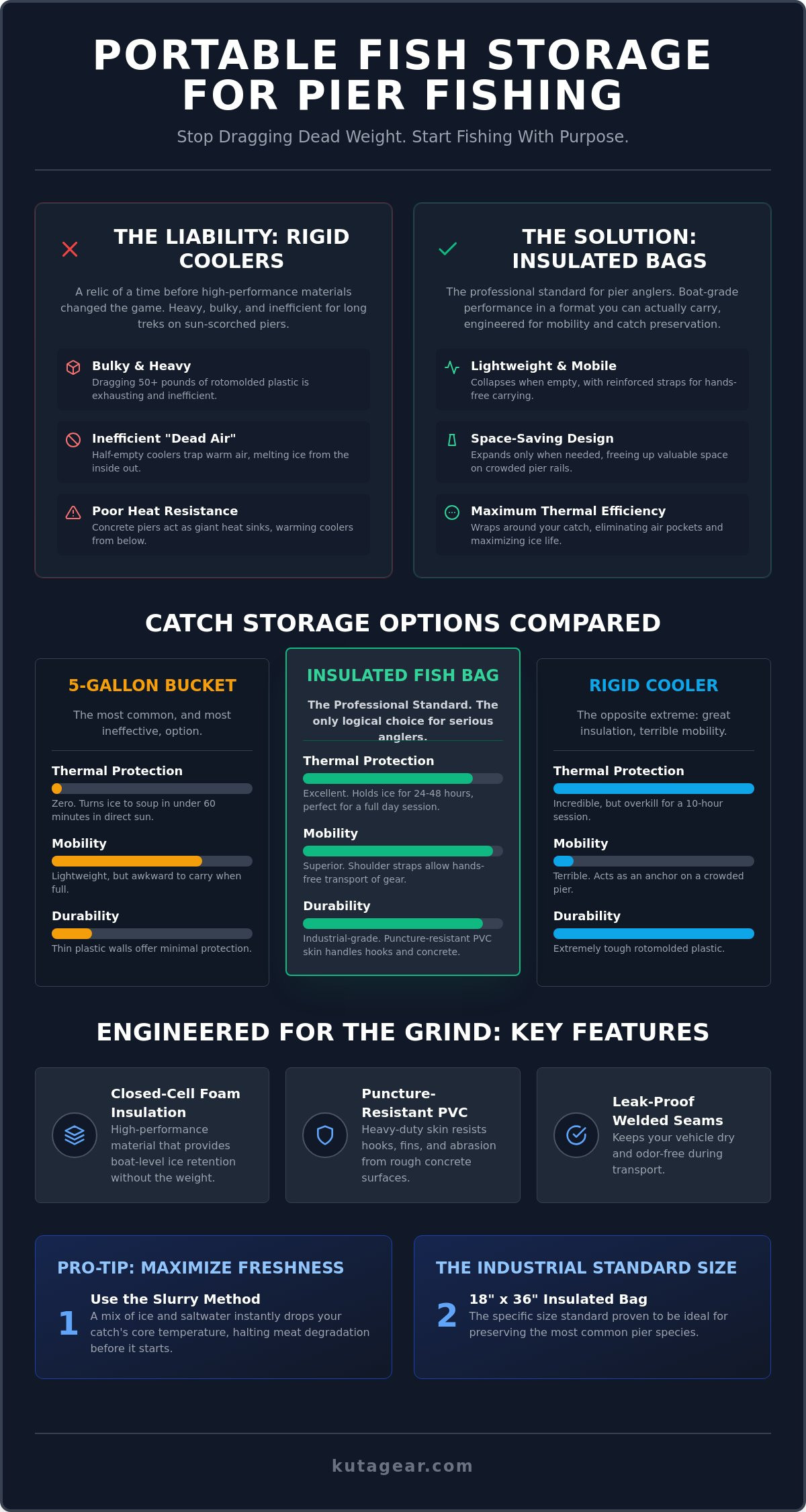
Traditional coolers are rigid. They are heavy. They take up too much space on a crowded pier rail. A soft-sided kill bag is the superior choice for mobility. It collapses when empty. It expands only when you need it. Space is a premium on the pier. You don't need a massive plastic box crowding your casting lane. There's also the "dead air" problem. A half-empty rigid cooler is a trap. It holds pockets of warm air that melt your ice from the inside out. Soft bags wrap around your catch. They eliminate that air. They provide a better insulation-to-weight ratio than any rotomolded box. You get boat-level performance without the boat-sized footprint. It's a smarter way to haul your limit.
Why Pier Anglers Need Specialized Gear
Piers are brutal environments. The concrete acts as a giant heat sink. It's a thermal battery that radiates warmth from below, even if your gear is in the shade. Standard coolers can't handle that constant thermal assault. They fail from the bottom up. Then there's the logistics of the "long walk." You catch a limit at the T-head. Now you have a mile-long trek back to the parking lot. Lugging a 50-pound plastic box is a nightmare. It's inefficient. A portable fish storage for pier fishing solution with reinforced handles makes that trek manageable. Finally, consider your vehicle. A cheap bag leaks. It leaves your trunk smelling like old bait. You need a leak-proof seal that holds. You need gear that works as hard as you do and stays bone-dry during transport.
Comparing Catch Storage Options: Bags, Buckets, and Boxes
The 5-gallon bucket is the most common sight on any pier. It is also the most ineffective. It offers zero thermal protection. Direct sunlight penetrates the thin plastic walls and turns your ice into lukewarm soup within sixty minutes. Your catch deserves better. Rigid rotomolded coolers are the opposite extreme. They offer incredible ice retention but terrible mobility. They are heavy. They are bulky. They act as anchors on a crowded pier. You don't need seventy-two hours of ice retention for a ten-hour session. You need a middle ground that prioritizes the logistics of the shore.
The insulated fish bag is the professional standard for portable fish storage for pier fishing. It provides boat-grade performance in a format you can actually carry. In direct sun conditions, a high-quality bag will hold ice for twenty-four to forty-eight hours. That is more than enough for any pier session. It beats the bucket on temperature and beats the box on weight. It is the only logical choice for an angler who moves frequently to find the bite.
Performance Metrics for Pier Storage
Ice retention matters, but only within the context of your session. You need eight to twelve hours of rock-solid cold to maintain meat quality. Following established fish preservation guidelines ensures your meat stays firm and safe for the table. Durability is the next metric. Piers are made of rough, abrasive concrete. Your gear will be dragged. It will be scraped. Cheap materials shred on impact. You need puncture-resistant skins that can handle the grind. Cleaning is the final hurdle. Fish slime is corrosive and develops odors quickly. A smooth, non-porous interior allows for a quick spray-down at the end of the day, keeping your gear ready for the next tide.
The Mobility Factor: Carrying Your Catch
Mobility wins on the pier. A bag with reinforced shoulder straps allows you to keep your hands free for rods and tackle. You can't sling a rotomolded cooler over your shoulder. Ergonomic handle placement is critical when the bag is loaded with fifty pounds of fish and ice. These bags also integrate perfectly with pier carts. They lay flat. They stack. They don't rattle around like empty plastic boxes. If you want to maximize your time on the water, you need an efficient storage solution that moves with you. This setup allows for rapid relocation when the school moves, ensuring you never miss a window of activity because your gear is too heavy to haul.
Engineering for the Grind: Durability and Insulation Standards
Concrete is a gear killer. It acts like sandpaper on cheap equipment. You need a reinforced PVC outer skin to survive this environment. It's built to resist punctures from sharp dorsal fins and stray hooks. Standard vinyl won't cut it. UV-resistant coatings are equally critical. They prevent the sun from turning your bag brittle and cracking the exterior. This is where high-performance gear separates itself from disposable alternatives. If the material can't handle a full day of direct exposure, it's not fit for the pier. Reliable portable fish storage for pier fishing requires materials that don't surrender to the elements.
Insulation quality is about cell structure. Closed-cell foam is the industrial standard. It doesn't absorb water. It doesn't collapse under the weight of a heavy catch. Standard "lunch bag" liners use open-cell foam. That material is a liability. It traps moisture and creates a breeding ground for bacteria. High-grade foam maintains its thermal barrier even when the bag is compressed. You also need to look at the seams. Stitched seams leak. They're a failure point. Heat-welded seams fuse the material into a single, waterproof unit. This keeps the cold slurry inside the bag and off your clothes during the long walk back to the truck.
The Importance of Marine-Grade Hardware
Salt destroys standard metal. It's relentless. Oversized, salt-resistant zippers are a non-negotiable requirement for pier fishing. If the zipper seizes, the bag is trash. You need hardware that operates smoothly after weeks of salt spray exposure. Heavy-duty webbing is just as vital. It prevents strap failure during a heavy haul. Cheap straps snap when you're carrying a limit of fish and twenty pounds of ice. Every component must be non-corrosive to survive the professional grind of the salt environment.
Sizing Your Bag for the Catch
An 18" x 36" footprint is the industrial sweet spot. It's large enough for slot-sized redfish and Spanish mackerel but remains manageable on a crowded rail. You need to manage your ice-to-fish ratio carefully. Aim for a 2:1 ratio for maximum retention during extreme heat. If you're fishing a shorter morning tide, a 1:1 ratio is often sufficient. High-performance bags utilize a minimum of half-inch thick closed-cell insulation to maintain rock-solid ice retention for twenty-four hours. This sizing ensures you have enough room for the catch without carrying unnecessary bulk that slows you down.
Pier Fishing Catch Care: Maximizing Freshness on Concrete
Freshness isn't accidental. It's a result of discipline. On a pier, the clock starts the moment the fish leaves the water. You're fighting high ambient temperatures and radiating concrete heat. You need a system. The professional process is simple: bleed, chill, and store. This isn't just about taste. It's about safety. Oily species like mackerel and jacks are prone to rapid histamine buildup if left in the sun. This leads to scombroid poisoning. Avoid the risk. Use high-performance portable fish storage for pier fishing to lock in quality immediately. Don't let a good day of fishing end with a bad meal.
Ice management is the backbone of this system. Stop buying bags of crushed ice from the gas station. It has too much surface area. It melts in hours. Block ice is the industrial choice for long pier days. It lasts longer. It provides a stable thermal core. If you can't find blocks, freeze half-gallon water jugs. They work. Sun management is your next layer of defense. Even the best insulated bag performs better in the shade. Tuck your bag under your pier cart. Use the cart's frame to break the direct line of sight from the sun. Every degree you save extends your ice life and protects your investment.
Bleeding and Brining for Better Meat Quality
Bleed your fish immediately. Cut the gills. Let the blood drain away from the meat. This produces a cleaner, whiter fillet. Once bled, move the fish into a saltwater slurry. This is a mix of ice and clean seawater. The slurry creates total contact with the fish's skin. It drops the core temperature faster than air-cooling ever could. It's a sub-freezing bath that stops cellular breakdown instantly. Keep the bag closed. Every time you unzip to show off your catch, you break the thermal seal. Stay disciplined. The reward is a restaurant-quality meal at the end of the day.
Transporting Your Catch Safely
The job isn't done until the fish is in the fridge. Secure your bag in your vehicle. Use tie-downs or bungees to prevent sliding. A heavy bag of fish and ice is a projectile in a sudden stop. It can also strain the seams if it's constantly shifting. Drain the excess melt-water before you leave the pier. Use the integrated drain plug to shed weight without making a mess in the parking lot. Proper maintenance ensures your gear stays ready for the next tide. To keep your equipment in top shape, refer to our guide on cleaning your kill bag for professional-grade results. If you are serious about your catch, invest in a rugged insulated fish bag that handles the grind of the pier environment.
Kuta Gear 18" x 36": The Industrial Standard for Pier Anglers
The Kuta Gear 18" x 36" bag is the definitive answer to the mobility problem. It is the industrial standard. Most brands design for the luxury boat market. They charge for the logo. We design for the grind. This is a rugged, value-driven alternative to overpriced marine gear. It's built for the angler who walks a mile before making the first cast. The 18" x 36" dimensions aren't random. They are calculated. This footprint accommodates the most common pier species while maintaining a slim profile. It fits perfectly in a standard pier cart. It doesn't hang over the edges. It doesn't create drag. It is the most efficient portable fish storage for pier fishing available today. We don't do fluff. We do performance.
Rugged Utility Meets High Performance
Kuta Gear products carry an industrial-strength pedigree. We don't build for showrooms. We build for the salt. Our "More Bag, Less Money" philosophy is a direct challenge to the industry. You shouldn't have to choose between quality and your budget. This bag uses the same technical materials found in high-end offshore gear. The reinforced PVC skin handles the abrasive concrete of the T-head without shredding. The closed-cell insulation thrives in high-heat shore environments. It ignores the radiating heat from the pier deck. It keeps your ice solid and your catch firm. Reliability is our baseline. We prioritize function over aesthetics every single time. It is a tool, not a trophy.
Ready for the Next Haul
The mission doesn't end when you leave the rail. You need gear that cleans up fast. The non-porous interior of the Kuta Gear bag sheds slime and salt with a simple rinse. It dries quickly. It folds flat for storage in a garage or truck bed. No bulky plastic boxes taking up space in your home. We understand the urgency of the season. When the run is on, you can't wait weeks for a backordered cooler. We focus on immediate availability and fast shipping to get you back on the water. Get your gear. Get to the pier. Stay mobile and keep your catch ice-cold. If you're ready to upgrade your setup, Get the 18" x 36" Insulated Fish Bag from Kuta Gear and see the difference that industrial design makes.
Own the Rail and Protect Your Catch
Pier fishing is a mobility game. If you can't move, you can't find the fish. We've established why rigid coolers and cheap buckets fail on the concrete. They're heavy. They're inefficient. High-performance kill bags provide the insulation you need without the dead weight. Success on the pier requires discipline. Bleed your fish. Use a saltwater slurry. Lock in that freshness with gear built for the grind. Choosing the right portable fish storage for pier fishing is the difference between a wasted limit and a professional-grade harvest.
It's time to stop settling for gear that can't handle the salt. Upgrade your pier game with the Kuta Gear 18" x 36" Insulated Fish Bag. This is industrial-grade 18" x 36" construction engineered for extreme marine environments. It's the same gear trusted by seasoned anglers for maximum ice retention. Don't let your hard work go to waste in a warm bucket. Grab your bag and hit the pier with confidence. We'll see you on the rail.
Frequently Asked Questions
How long will ice last in an insulated fish bag on a hot pier?
Ice typically lasts 24 to 48 hours in a high-grade insulated bag, even on sun-baked concrete. This duration depends on your ice-to-fish ratio and how often you break the thermal seal. Closed-cell foam insulation creates a barrier that standard coolers can't match in direct sunlight. It's designed to keep your catch at sub-freezing temperatures for the duration of any standard pier session.
Can I use a fish bag for pier fishing without a cart?
Yes, you can easily use a fish bag without a cart. These bags feature reinforced shoulder straps designed for heavy-duty hauls. This mobility is the primary advantage of portable fish storage for pier fishing over rigid boxes. You can sling the bag over your shoulder and keep your hands free for your rods and tackle. It makes the long walk from the T-head manageable and efficient.
Will the fish bag leak in the back of my truck or SUV?
A professional-grade bag won't leak if it utilizes heat-welded seams and heavy-duty zippers. These construction methods fuse the material into a single waterproof unit. You don't have to worry about fish slime or bloody slurry ruining your vehicle's interior. Just ensure the drain plug is tightened before you load it into your truck or SUV. It's built for clean transport after a long day of fishing.
What size fish bag is best for general pier fishing?
The 18" x 36" size is the industrial sweet spot for most pier anglers. It provides enough length for common species like Spanish mackerel, bluefish, and slot-sized redfish. This footprint remains compact enough to fit into most pier carts without hanging over the sides. It offers the best balance of storage capacity and mobility for the shore-based environment. It's the standard for serious catch preservation.
How do I clean my insulated bag to prevent fish smells?
Clean your bag immediately after every session using fresh water and a mild, non-abrasive soap. The non-porous interior liner is designed to shed slime and scales quickly. Scrub the corners where bacteria can hide. Leave the bag unzipped and propped open to air dry completely before storing it. This simple routine prevents odors from setting into the material and keeps your gear ready for the next haul.
Is a soft-sided fish bag durable enough for concrete piers?
Yes, provided the bag is constructed with a heavy-duty, reinforced PVC outer skin. This material is engineered to resist the abrasive nature of concrete and the sharp fins of your catch. It handles the grind of being dragged or set down on rough surfaces without puncturing. Cheap vinyl bags will fail, but industrial-grade portable fish storage for pier fishing is built to survive the harshest environments.
Should I use block ice or cubed ice in my portable storage?
Block ice is the superior choice for long days in the sun. It has less surface area than cubed ice, which significantly slows the melting process. You can use cubed ice to create a rapid-cooling slurry, but a solid block should serve as your thermal core. This combination provides the fastest cooling and the longest temperature retention for your catch. It's the most efficient way to manage your cold chain.
Can I use the Kuta Gear bag for species other than fish?
The Kuta Gear bag is a versatile tool for any outdoor application requiring thermal regulation. While designed for catch preservation, its rugged construction makes it ideal for hauling ice, drinks, or even cold groceries in high-heat environments. The industrial materials don't care what you put inside. It's built for performance and reliability regardless of the specific use case. It's a hardworking partner for any adventure.

Also in Contact

The Best Way to Chill Fish Quickly After Catch: A Professional Guide

Insulated Fish Kill Bags: The 2026 Buying Guide for Serious Anglers
