

How to Get Fish Smell Out of a Kill Bag: The Pro Deodorizing Protocol
Scrubbing your gear with standard dish soap is a losing battle. You think it's clean, but the bacteria are already hiding deep in the industrial seams. If your truck smells like a rotting pier every time you head home, your current routine is failing. Learning how to get fish smell out of kill bag requires more than a quick rinse; it demands a systematic, field-tested approach that targets the root cause of the stench without compromising your gear.
We know the frustration of an expensive 18" x 36" Insulated Fish Bag that carries a permanent odor. You want a bag that performs like new and stays odorless between trips. This guide delivers a rugged cleaning protocol designed for the real world. You'll learn how to execute a pH-balanced attack that kills bacteria and preserves your liner's integrity. We are breaking down the exact steps to turn a stinking liability back into a high-performance asset. It's fast, it's repeatable, and it actually works.
Key Takeaways
- Stop fighting a losing battle against surface slime. Learn why fish biofilm requires a chemical breakdown to truly neutralize the stench.
- Master the professional 5-step deep clean protocol that moves from high-pressure rinsing to industrial-grade degreasing.
- Discover the best household and professional agents to use when you need to know how to get fish smell out of kill bag without damaging the insulated liner.
- Prevent future mold and odor buildup by mastering proper airflow and storage techniques that keep your gear field-ready.
- See why rugged, smooth-surface liners make the difference between a bag that traps odors and one that stays clean for years.
Why Your Kill Bag Stinks (It Is Not Just the Fish)
A clean-looking bag can still reek. That is the reality of fish slime. It is not just a surface mess. It is a biological structure designed to stick. Standard dish soap breaks surface tension. It does not touch the deeper problem. You need to understand the science of the stench before you can master how to get fish smell out of kill bag. If you ignore the biology, you are just masking the smell for a few hours. The rot will return.
Fish slime is a complex protein-based biofilm. Blood and oils are opportunistic. They penetrate microscopic abrasions in the liner every time you toss a heavy catch inside. Once these fluids settle, they become a breeding ground. Bacteria thrive in the dark, damp insulation layers if your seams leak. This is why a quick spray-down at the dock is never enough. You are fighting a war against microscopic invaders that have dug into your gear.
The Role of Bacterial Biofilm
Biofilm acts as a protective layer for odor-causing microbes. Think of it as a biological shield. This layer is stubborn and glues itself to your liner. You might scrub the scales away, but the biofilm remains. This is where the real odor lives. Bacteria within this layer digest fish proteins to produce the chemical compound trimethylamine, which is the primary source of that rotting, ammonia-like stench. Clean to the eye does not mean clean to the nose. If you don't use a solution that breaks down this protein shield, the bacteria will continue to multiply in the heat of your truck bed.
Seams: The Danger Zone for Odors
Stitching creates entry points for fluids into the insulation. Every stitch is a hole. Blood and slime use these paths to reach the foam core. Once inside, it stays dark and damp. It becomes a petri dish. Heat accelerates bacterial growth inside the bag's walls. This is why heavy-duty construction requires deeper cleaning than cheap dry bags. An 18" x 36" Insulated Fish Bag is built for durability, but those same rugged materials can trap odors if not treated correctly. You aren't just cleaning a surface. You are maintaining an industrial tool. If the seams are compromised and the bacteria take hold in the insulation, the bag becomes a permanent liability. A professional protocol is the only way to ensure your gear stays as field-ready as the day you bought it.
The 5-Step Deep Clean Protocol for Insulated Bags
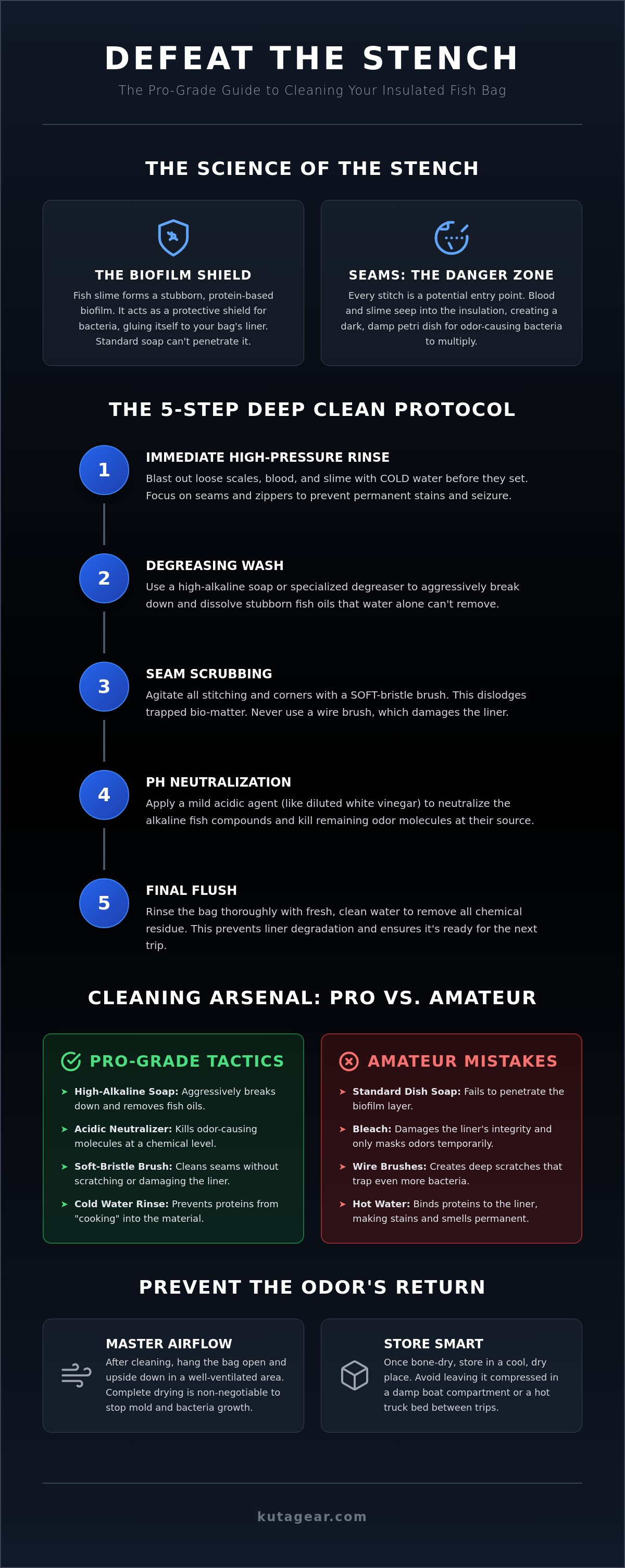
Cleaning a professional-grade bag isn't a suggestion. It's maintenance. If you want to know how to get fish smell out of kill bag, you have to follow a sequence. A quick spray at the boat ramp won't cut it. You need a system that addresses the oils, the proteins, and the bacteria hiding in the corners. This protocol is field-tested. It works every time.
- Immediate high-pressure rinse: Blast out loose scales, blood, and slime before they bond to the liner.
- Degreasing wash: Use a high-alkaline soap to aggressively break down stubborn fish oils.
- Seam scrubbing: Agitate the stitching with a soft-bristle brush to reach trapped bio-matter.
- pH Neutralization: Apply an acidic agent to kill the remaining scent molecules at a molecular level.
- Final flush: Use fresh water to remove all chemical residue and prevent liner degradation.
Pre-Rinse: The Golden Hour
Timing is everything. You must rinse the bag before the blood dries. Once it hardens, it becomes a permanent stain and a permanent odor source. Use cold water only. Hot water is a mistake. It "cooks" the proteins directly into the microscopic abrasions of the liner. Focus your spray on the zipper teeth. Salt and slime accumulate there. If you don't clear the teeth, the zipper will seize. It's that simple. Our 18" x 36" Insulated Fish Bag is built to take a beating, but even the toughest gear needs a proper reset after a heavy haul.
Mechanical Scrubbing Techniques
Large 18x36 bags are rigid. Unlike cheap, thin dry bags, you can't just flip these inside out to reach the bottom. You have to get in there manually. Use a "seam-first" approach. Start at the top and work your way down the stitching. A soft-bristle brush is mandatory. Never use wire. Wire brushes create deep scratches that hold even more bacteria. Focus heavily on the bottom corners where fluids pool. Using an acidic solution during this stage helps to neutralize the odor compounds left behind by the alkaline fish oils. Scrub hard, rinse thoroughly, and don't stop until the water runs clear. If the water is cloudy, the bag is still dirty.
Best Deodorizing Agents: DIY Hacks vs. Pro Chemicals
Bleach is for amateurs. It kills bacteria, but it also kills your gear. High concentrations of bleach will degrade the PVC coating and rot the heavy-duty stitching over time. If you want to know how to get fish smell out of kill bag without turning your bag into a leaky mess, you need a smarter chemical approach. You have two paths: common household acids or professional-grade biological digesters. Both have their place in a rugged maintenance routine.
- Vinegar: A natural acid that neutralizes the alkaline amines responsible for the fishy stench.
- Baking Soda: A mild abrasive that provides mechanical scrubbing power and absorbs lingering scents.
- Enzymatic Cleaners: The gold standard. These contain live enzymes that eat organic blood and slime.
- Marine-Specific Cleaners: Formulated to tackle the unique combination of salt crystals and fish biofilm.
The Vinegar and Baking Soda Myth
Stop mixing vinegar and baking soda together in a bucket. It looks impressive because it bubbles, but the chemical reaction creates nothing but carbon dioxide and salty water. You are neutralizing the cleaning power of both. Use them sequentially instead. Start with a vinegar rinse to tackle the smell. Follow it with a baking soda paste for a deep scrub in the corners. This sequence is key for proper fish handling and cleaning of your equipment. The acidic vinegar breaks down the amines. The alkaline baking soda lifts the remaining oils. It is a one-two punch that works.
Why Enzymatic Cleaners Win
Enzymatic cleaners are the professional choice for a reason. They don't just mask the smell. They digest the problem. These cleaners contain specialized enzymes that target the proteins found in fish blood and slime. This is critical for the deep seams of an 18" x 36" Insulated Fish Bag. The liquid penetrates the stitching where your brush can't reach. It "eats" the organic matter that causes the rot. For extreme cases, let the cleaner soak for 30 to 60 minutes. This gives the enzymes time to work through the biofilm. Always check the label. Ensure the product is safe for food-contact surfaces. You are storing fish you intend to eat. Don't trade a fishy smell for toxic chemical residue. Pro chemicals deliver pro results. They keep your gear in the field and out of the trash.
Drying and Storage: Preventing the Return of the Odor
The deep clean was only half the battle. If you pack away a damp bag, you've wasted your time. Moisture is the enemy. A damp insulated bag is a literal petri dish for anaerobic bacteria. You need total airflow to the bottom corners to finish the job correctly. This is the final, critical stage of how to get fish smell out of kill bag. If you skip this, the stench will be back before your next trip. It's about industrial maintenance, not just tidying up for the sake of it.
- Moisture Control: Bacteria require water to replicate. No water means no smell.
- Airflow: Stagnant air is a breeding ground. Keep the bag propped wide.
- UV Sanitization: Use the sun as a tool, but don't let it destroy your liner.
- Open-Zip Storage: Never seal a bag until you are ready to put fish in it.
The Proper Way to Air Dry
Propping the bag open is non-negotiable. Don't rely on the bag's own rigidity to keep the interior exposed. Use a length of PVC pipe or a specialized heavy-duty hanger to keep the walls separated. Most amateurs make the mistake of drying the bag upside down. This is a trap. Gravity pulls moisture into the top seams and zipper tape where it cannot evaporate easily. It sits. It rots. Keep the bag upright and open in a well-ventilated area. Use the 'white towel test' before storage. Wipe the deep interior corners with a clean white towel. If you see even a hint of dampness or gray residue, it is not ready. It needs more time. A bone-dry bag is the only way to guarantee an odorless vehicle on the drive home.
Managing UV Exposure
The 'Sunlight Strategy' is a double-edged sword. UV rays are powerful natural disinfectants. They destroy remaining biological loads on contact. However, UV rays also break down the chemical bonds in your PVC liner over time. Excessive exposure leads to cracking and brittleness. Limit direct sun exposure to 30 minutes max. This is enough time to sanitize the surface without causing structural damage. Once the bag is dehydrated, move it immediately. Store it in a cool, dark, dry place. Never store a kill bag zipped shut. Trapped air turns stale. It creates a micro-climate for mildew. Your gear should be ready for the next haul, not rotting in the garage.
You need gear that handles the elements and the cleanup without failing. Our 18" x 36" Insulated Fish Bag features a smooth-surface liner designed specifically for rapid drying and long-term durability in harsh environments.
The Kuta Gear Standard: Built to Stay Fresh
Design is the first line of defense. If your gear is built with porous materials and excessive stitching, you will always struggle with how to get fish smell out of kill bag. We built the Kuta Gear 18" x 36" Insulated Fish Bag to solve the problem at the source. It is not just about holding ice. It is about surviving the cleanup. We use heavy-duty, smooth-surface liners that refuse to bond with fish biofilm. This is rugged construction designed for a fast spray-down. We stripped away the unnecessary features that trap salt and slime. This is a minimalist approach to maximum utility. It is built to perform in the harshest environments on the planet, from the intense heat of Hawaii to the rugged coastlines of the mainland.
High-Performance Liners
Porosity is the enemy of a fresh truck. Most bags use cheap liners that absorb oils. Once those oils penetrate the material, the smell is permanent. Our liners are non-porous. They create a total barrier against blood and slime. This industrial strength stands up to the pro-grade enzymatic cleaners we discussed earlier. You can scrub without fear of delamination or material failure. The insulation stays dry because the liner stays intact. Even after years of heavy use, the interior remains smooth and easy to wipe down. This is the standard required for the intense Hawaii sun. It is now the standard for every serious angler nationwide who values performance over prestige. We don't build for the showroom. We build for the haul.
Maintenance-First Design
Access is everything during the deep clean. The 18" x 36" footprint is optimized for the field. It is large enough for a heavy haul but sized for easy reach into the bottom corners. We used rugged zippers that resist corrosion and mechanical failure. They don't have the tight, hidden tracks that trap salt and scales. Our minimalist seam design means fewer places for anaerobic bacteria to hide. When you follow our deep clean protocol, the water flows out freely. Nothing gets trapped in the folds. You want gear that works hard and resets fast. This is that gear. Stop fighting your equipment and start using a system designed for the reality of the catch. It is time to invest in a tool that respects your time and your vehicle. Upgrade to a Kuta Gear 18x36 Insulated Fish Bag and experience the difference of a professional-grade build.
Maintain the Standard of Your Gear
A stinking bag is a sign of a failed maintenance routine. You now have the protocol to stop the rot. Remember that biofilm is a biological shield. Standard soap won't cut it. You must use a pH-balanced attack and ensure total airflow during the drying phase. Mastering how to get fish smell out of kill bag is the only way to keep your vehicle from smelling like a wharf. It's about industrial reliability. It's about staying prepared for the next haul.
Your gear should work as hard as you do. Don't settle for porous liners that trap odors forever. Our heavy-duty 18" x 36" construction is engineered for extreme ice retention. It features a rugged, easy-clean liner that resets in minutes. It is time to stop fighting the stench and start using a tool built for the reality of the catch. High-performance fishing requires high-performance maintenance.
Get the 18" x 36" Insulated Fish Bag Built for Pro Anglers
Clear the slime. Kill the bacteria. Get back on the water with gear that stays fresh and ready for the next big haul.
Frequently Asked Questions
Can I put my fish kill bag in the washing machine?
Never put an insulated kill bag in a washing machine. The mechanical agitation will tear the heavy-duty liner and crush the internal insulation foam. You'll end up with a bag that leaks and fails to hold ice. Stick to the manual deep clean protocol. Use a hose and a soft brush in the driveway to preserve the structural integrity of your gear.
Is bleach safe to use on my insulated fish bag?
Bleach is not recommended for regular maintenance of your insulated fish bag. It is a harsh oxidizer that degrades PVC coatings and rots nylon stitching over time. While it kills bacteria, it creates structural liabilities. Use enzymatic cleaners or a vinegar solution instead. These alternatives provide a safe way for how to get fish smell out of kill bag without compromising the lifespan of your investment.
How often should I deep clean my kill bag?
You should rinse your bag after every single use and perform a deep clean whenever a lingering odor persists. Don't wait for the stench to become unbearable. Blood and slime are easier to remove before they bond to the liner. A consistent routine prevents biofilm buildup. If you haul a heavy catch, the deep clean protocol is mandatory to keep your gear field-ready.
What is the fastest way to get fish smell out of my truck?
The fastest way to clear the stench is to remove the source and ventilate the cabin. If your bag is clean but the truck still reeks, check for spills on the upholstery. Use an odor neutralizer specifically designed for organic matter. Keep your windows down to ensure constant airflow. Most importantly, don't store a damp bag in a closed vehicle; that is how the odor-producing bacteria multiply rapidly.
Can I use a pressure washer to clean my fish bag?
Yes, a pressure washer is effective for removing stubborn scales and dried slime. Keep the nozzle at a safe distance to avoid piercing the liner. Use the wide-fan setting rather than a concentrated pinpoint stream. This high-pressure approach is perfect for clearing debris from zipper teeth and deep corners where manual scrubbing might miss the mark.
Will lemon juice help remove fish odors from the liner?
Lemon juice is a functional acidic alternative to white vinegar. It contains citric acid which helps neutralize the alkaline trimethylamine responsible for the fishy smell. Apply it directly to the liner or mix it with water for a final rinse. It provides a fresh scent while breaking down the chemical bonds of the odor. It is a solid DIY hack for field maintenance.
What do I do if the smell is inside the insulation layer?
If the smell has reached the insulation, you need a prolonged enzymatic soak. Fill the bag with a solution of water and biological digesters. Let it sit for at least an hour to allow the enzymes to penetrate the seams and reach the foam core. If the insulation is saturated with rot due to a major puncture, the bag may be a total loss. Prevention is the only real cure.
Does freezing the bag kill the odor-causing bacteria?
Freezing does not kill odor-causing bacteria. It only makes them dormant. Once the bag thaws and reaches ambient temperature, the bacteria will resume digesting proteins and producing gas. You cannot freeze your way out of a cleaning problem. Heat and chemical neutralization are the only effective methods for eliminating the biological load inside your gear.

Also in Contact

Portable Fish Storage for Pier Fishing: The Rugged Guide to Catch Preservation

The Best Way to Chill Fish Quickly After Catch: A Professional Guide
