

The Best Way to Chill Fish Quickly After Catch: A Professional Guide
Your trophy catch starts rotting the second it hits the deck. It's a brutal reality of the ocean. You spend hours hunting, thousands on fuel, and hundreds on gear; then you watch your snapper fillets turn to mush because of poor temperature control. You know the frustration of opening a standard cooler at the dock only to find a lukewarm mess and "fishy" smelling meat. It's a waste of a good day and a waste of high quality protein.
Finding the best way to chill fish quickly after catch isn't just about dumping ice in a plastic box. It's a race against enzymatic breakdown. We're here to show you industrial strength methods to lock in market-fresh firmness. You'll learn how rapid thermal transfer keeps your catch at or below the FDA recommended 40 degrees Fahrenheit, even when deck temperatures climb above 90 degrees.
This guide breaks down the science of heat transfer and why the ice slurry technique beats dry ice every time. We'll also look at why heavy, bulky coolers aren't your only option for professional grade storage. From maximizing your 30 percent fillet yield to choosing durable, space saving gear that stands up to salt and sun, we've got you covered. Stop settling for soft meat. Start treating your catch with the respect it deserves.
Key Takeaways
- Understand why liquid brine is the best way to chill fish quickly after catch by utilizing thermal conductivity that is 25 times faster than air.
- Master the "Ike Jime" brain spike and bleeding techniques to stop lactic acid buildup and drop core temperatures instantly.
- Learn the precise 2:1 ice-to-seawater ratio required to create an ultimate slurry for total fish submersion and rapid cooling.
- Identify why high-cell foam liners and kill bags outperform traditional rigid coolers by eliminating ice-killing dead air space.
- Discover how industrial-strength construction and optimized 18" x 36" dimensions ensure your catch stays market-fresh from the strike to the dock.
The Science of Rapid Cooling: Why Temperature Control Starts at the Strike
The fight against spoilage begins the moment the hook sets. It's not just about ambient air; it's about internal biology. When a fish fights the line, its muscles work at maximum capacity. This generates massive amounts of internal heat. For pelagic species like tuna or mahi-mahi, core temperatures can rise significantly above the surrounding water. This is a thermal disaster for the meat. Metabolic heat is the internal energy generated by muscular exertion during a catch. If you leave that heat trapped in the core, the flesh begins to degrade before the fish even hits your deck. Finding the best way to chill fish quickly after catch is the only way to arrest this process.
Proper fish processing techniques require an immediate intervention to stop enzymatic activity. Enzymes are biological catalysts. In a living fish, they manage growth and digestion. When the heart stops, these same enzymes begin to break down the surrounding muscle tissue. Warm flesh accelerates this self-digestion. It leads to the "mushy" texture that ruins an expensive outing. Rapid cooling also manages the onset of rigor mortis. A controlled temperature drop ensures the muscles set firmly rather than contracting violently and tearing the connective tissue. This keeps the fillets tight and high-yield.
The "Golden Hour" of Fish Preservation
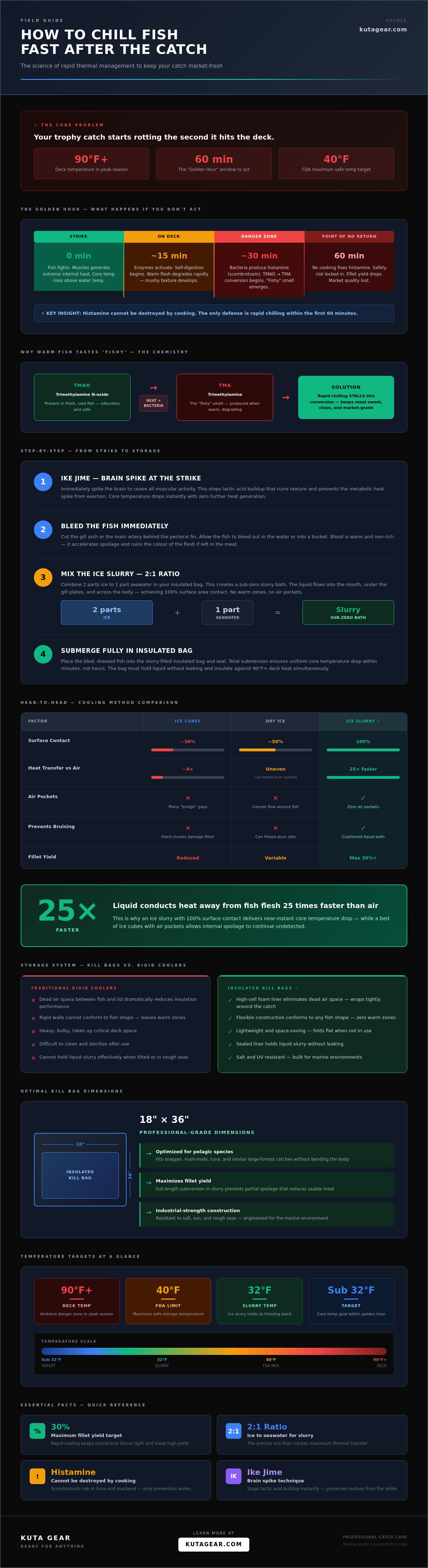
The first 60 minutes on deck determine your final product quality. If your catch sits in the sun, you're inviting disaster. Ambient deck temperatures often exceed 90 degrees Fahrenheit in peak season. This heat penetrates the core rapidly. You have a one-hour window to drop that internal temperature to safe levels. Failure to do so allows bacteria to begin producing histamine, also known as scombrotoxin. This is a major concern for species like mackerel and tuna. It's a safety risk that no amount of cooking can fix. You aren't just preserving taste; you're preserving safety.
Chemical Breakdown: Why Warm Fish Tastes "Fishy"
Fresh fish shouldn't smell like the docks. That "fishy" odor comes from the conversion of Trimethylamine N-oxide (TMAO) into Trimethylamine (TMA). This chemical shift is driven by heat and bacterial growth. Rapid chilling stalls this conversion. It keeps the meat sweet and clean. There is a massive difference between "safe to eat" and "market-grade" freshness. Market-grade fish requires professional thermal management. You need to pull the heat out of the core faster than the enzymes can destroy it. This is why standard plastic coolers often fail. They lack the rapid thermal transfer capacity needed during that critical first hour on the water.
Creating the Ultimate Ice Slurry for Maximum Heat Transfer
Dumping your catch onto a bed of ice cubes is a rookie mistake. It leaves air pockets. Air is an insulator, not a conductor. To lock in quality, you need a liquid heat-sink. An ice slurry is the best way to chill fish quickly after catch because liquid water pulls heat away from the core 25 times faster than air. This is basic thermodynamics applied to the deck. If the meat stays warm, it rots. If it’s submerged in a slurry, the temperature plummet is near-instant.
Professional anglers use a 2:1 ratio. That means two parts ice to one part seawater. This mixture creates a freezing bath that conforms to the shape of the fish. Unlike solid blocks, a slurry ensures 100 percent surface area contact. It flows into the mouth, under the gill plates, and across the belly. There are no warm zones. Every inch of the skin is in direct contact with the cooling medium. This total submersion is the secret to reaching a uniform core temperature in minutes. For those running a serious operation, using an insulated fish bag designed to hold liquid without leaking is mandatory gear.
Why Liquid Outperforms Solid Ice
Standard ice cubes create "bridge" points. The fish rests on a few cold spots while the rest of the body is surrounded by dead air. This leads to uneven cooling and internal spoilage. A slurry eliminates the air pocket problem entirely. It also provides a liquid suspension that prevents bruising. When the boat takes a hard swell, your catch isn't slamming against rigid plastic or hard ice chunks. It’s cradled in a sub-zero bath. This keeps the skin pristine and the meat firm. Citing the FAO on properly chilling fish confirms that this method is the gold standard for maintaining market-grade quality in commercial and sport fishing alike.
The Role of Salt in Sub-Zero Chilling
Pure water freezes at 32°F. That isn't cold enough for rapid thermal transfer in pelagic species. Adding salt triggers freezing point depression. By mixing seawater with your ice, you can push the slurry temperature down to 28°F or lower. This sub-zero environment shocks the bacteria and stalls enzymatic breakdown instantly. If you’re using freshwater ice from a shore-side machine, add a few handfuls of rock salt to the mix. It supercharges the brine. Monitor your slurry throughout the day. If it becomes too watery, drain a portion and replenish the ice. You want a thick, slushy consistency. It should look like a frozen drink, not a cold puddle. Keep the slurry dense, keep the bag sealed, and you’ll bring home fish that looks like it just came out of the water.
Preparation Steps Before the Bag: Bleeding and Dressing
Catching the fish is only half the battle. If you toss a live, stressed fish directly into the bag, you've already lost the quality war. The best way to chill fish quickly after catch starts with neutralizing the animal's internal biology. Use a brain spike, or Ike Jime, to stall the nervous system immediately. This stops the heart from pumping out lactic acid. It prevents the meat from turning sour and soft. It's a professional move that separates market-grade fillets from dockside waste. You want the muscles to relax, not seize up in a final, heat-generating struggle.
Blood carries the majority of a fish's metabolic heat post-fight. If you don't remove it, you're essentially keeping a hot radiator inside the carcass. Cut the gill arches or the tail to allow the blood to drain completely. This process, known as exsanguination, is the fastest way to drop the core temperature before the fish even touches the ice. It clears the vascular system. It ensures the fillets remain white and clean. Professional handling freshwater fish or saltwater species follows this same industrial logic: drain the heat source first.
Gills and guts are bacterial hotspots. They act as internal insulators that trap heat in the thickest part of the fish. Removing them allows the cooling medium to reach the internal cavity directly. Before the fish goes into the bag, give it a thorough clean water rinse. This removes bacteria-laden slime and scales that can contaminate your slurry. You don't want deck filth entering your cooling environment. Keep the workspace clean to keep the meat pristine.
Why Bleeding Accelerates Cooling
The circulatory system is a highway for heat. During a long fight, the fish's blood temperature spikes. By cutting the gills, you use the heart's final beats to pump that thermal energy out of the body. Don't just toss it in a bucket. Use a dedicated bleed barrel or hang it over the side if sharks aren't active. A properly bled fish cools significantly faster than one left whole. This step is a non-negotiable part of the best way to chill fish quickly after catch because it addresses the heat at its source.
Field Dressing: To Gut or Not to Gut?
For large pelagics, evisceration is mandatory. Removing the stomach and intestines eliminates a massive source of internal heat and bacteria. For smaller reef fish, you can often skip the gutting if your slurry is cold enough. If you do gut them, use the "Ice Belly" technique. Stuff the empty cavity with crushed ice or slurry to ensure internal thermal transfer. This cools the thickest part of the meat from the inside out. Always protect the belly cavity from deck filth. Contamination here leads to rapid spoilage even in cold temperatures. Use a sharp knife and make clean cuts to minimize surface area for bacteria to take hold.
Choosing the Right Insulation: Kill Bags vs. Traditional Coolers
Hard-sided coolers are great for beer. They're often useless for professional fish care. On a boat, deck space is a premium resource you can't afford to waste. A massive rotomolded cooler takes up a permanent footprint whether it's full or empty. More importantly, it traps dead air. This air acts as a thermal bridge that melts your ice from the inside out. When you're looking for the best way to chill fish quickly after catch, you need an insulation system that adapts to your haul. Flexible kill bags provide a tighter thermal envelope than any rigid box. They offer industrial-strength performance without the bulk.
Traditional coolers rely on thick plastic walls that are heavy and inefficient when half-empty. Kill bags use advanced high-cell foam liners. These liners provide extreme thermal resistance while remaining lightweight. They don't just sit on the deck; they work with you. A bag can be tucked into a corner or lashed to a rail. It stays out of the way until the strike happens. This versatility is why serious anglers are ditching the plastic boxes for something more functional and durable.
Why "Dead Air" Destroys Ice Retention
Physics doesn't care about your cooler's brand name. If you put a 20-pound snapper in a 100-quart cooler, you're cooling 80 quarts of air along with the fish. Convection currents within that empty space constantly pull heat from the lid and walls. This heat transfers directly to your ice. A high-performance fish bag solves this problem immediately. It’s collapsible. It "shrinks" to fit the catch. By squeezing out the air, you ensure the insulation is in direct contact with the slurry. This is why a 18" x 36" bag is the sweet spot for most coastal species. It maximizes thermal efficiency by eliminating the primary enemy: empty space. You get more cooling power with less ice.
Maximizing Surface Contact in a Flexible Bag
Industrial-grade bags use high-cell foam liners. This material offers superior density compared to cheap plastic shells found in big-box stores. The walls are flexible. They conform to the shape of the fish and the ice slurry. This creates a vacuum-like environment that locks in sub-zero temperatures for hours. You need a watertight vapor barrier to keep that brine from leaking onto your deck. Heat-sealed seams and heavy-duty zippers aren't just for durability. They're critical for temperature locking. They prevent the exchange of warm outside air with your internal cooling medium. Maintaining these bags is simple. A quick rinse with fresh water and soap keeps the industrial-grade materials from holding odors. For a storage solution that actually survives the salt and sun, buy an insulated fish bag that’s built for the rigors of the open sea. It’s easier to clean, easier to store, and keeps your catch market-fresh until you reach the dock.
The Kuta Gear 18" x 36" Insulated Bag: Professional Catch Care
The best way to chill fish quickly after catch requires gear that doesn't quit. You can have the perfect brine slurry and the sharpest gaff, but it's useless if your storage leaks or lets in heat. The Kuta Gear 18" x 36" Insulated Bag is built for this specific purpose. It’s not a luxury item. It’s a tool. We designed it to handle the abuse of a saltwater environment. High-cell foam insulation keeps your catch firm and market-fresh for the entire trip. Even in direct sun. Even on the hottest summer days. This is industrial-strength thermal management for people who take fishing seriously. It provides the rapid heat transfer you need to lock in quality the moment the fish is landed.
The 18" x 36" footprint is intentional. It’s the versatile choice for coastal anglers. It’s large enough for a limit of snapper or a solid cobia. It’s small enough to stay out of the way on a center console. Most rigid coolers are either too big or too small. This bag hits the sweet spot. It maximizes thermal efficiency by wrapping tightly around your catch. It eliminates the dead air that kills your ice. It’s the logical solution for maximizing deck space and meat quality simultaneously. You get professional-grade results without the bulk of a traditional rotomolded box.
Built for Marine Environments
Marine gear takes a beating. Punctures from fins and gaffs ruin cheap bags. We use industrial-strength materials that resist tears and abrasions. The inner liner is smooth and non-porous. It won't retain the "fishy" smell of last week's trip. A quick scrub and it’s ready for the next run. We reinforced the handles with heavy-duty stitching and rugged webbing. You can haul a bag full of ice and fish from the boat to the truck without worrying about a strap snapping. It’s built to work as hard as you do. It stands up to salt, blood, and UV rays without breaking down.
Why Professional Anglers Trust Kuta Gear
We don't believe in corporate markups. You're paying for insulation and durability, not a fancy logo or a massive marketing budget. Our direct-to-consumer model means you get more performance per dollar. We focus on immediate stock availability. When you need gear, it's ready to ship. No waiting on corporate fulfillment timelines or endless backorders. We understand the field because we’re in it. We know that reliability is the only thing that matters when the bite is on. It’s time to upgrade your catch care. Grab a Kuta Gear 18" x 36" bag and stop wasting your catch.
Stop Wasting Your Catch and Start Preserving Quality
Your hard work shouldn't go to waste because of a warm deck and a cheap cooler. Rapid thermal transfer is a race against biology. You've seen why bleeding your catch and using a sub-zero brine slurry are the only ways to win. These methods are the professional standard for a reason. They keep meat firm. They keep it clean. Stop fighting the physics of dead air in oversized plastic boxes. It’s time to use gear that matches your effort on the water.
Finding the best way to chill fish quickly after catch is the difference between a market-grade fillet and a total waste of fuel. You need insulation that actually holds in extreme heat. Our gear is engineered for extreme marine conditions and offered at direct-to-consumer pricing to keep your money in your pocket. Don't settle for soft fillets or "fishy" smells at the dock. You owe it to your catch and your crew to do it right.
Upgrade your catch care with the Kuta Gear 18" x 36" Insulated Bag. This industrial-strength 18" x 36" design is built to survive the rigors of the open sea. Get out there, land the big one, and bring it home in better condition than you found it. You've got the knowledge; now get the gear.
Frequently Asked Questions
How much ice do I really need for a day of fishing?
Plan for a 1:1 ratio of ice weight to expected fish weight. For a standard coastal trip, 20 to 40 pounds of ice is usually sufficient to maintain a cold environment. If ambient deck temperatures exceed 90 degrees Fahrenheit, increase your ice volume by 25 percent. You need enough volume to maintain a thick slurry throughout the entire journey back to the dock.
Can I use freshwater ice for saltwater fish?
Yes, but you must add salt to reach professional cooling temperatures. Freshwater ice alone won't drop below 32 degrees Fahrenheit. Adding sea water or rock salt creates a brine that can reach 28 degrees or lower. This is the best way to chill fish quickly after catch when you're limited to shore-side ice machines. The salt is the catalyst for rapid thermal transfer.
Should I drain the water out of my fish bag as the ice melts?
Don't drain the water until you're ready to add more ice. That cold liquid is your primary cooling medium. It provides total surface area contact that solid cubes can't achieve. Only drain a portion of the liquid if the bag becomes too full to add fresh ice. You want a slushy consistency, not a dry pile of cubes or a lukewarm puddle.
How long can a fish stay in an insulated bag before it needs to be filleted?
Fish can stay in a high-performance insulated bag for up to 48 hours if you maintain a temperature at or below 40 degrees Fahrenheit. FDA standards recommend processing fresh seafood within two days for safety. For market-grade quality, fillet your catch the same day. The bag buys you time, but it doesn't stop the clock on enzymatic breakdown forever.
Is it better to bleed the fish before or after putting it in the slurry?
Bleed the fish immediately before dropping it into the slurry. Use a bleed barrel or hang the fish to drain the blood while the heart is still beating. This removes the primary source of metabolic heat from the carcass. Once the blood is gone, the sub-zero brine can penetrate the core meat faster. It’s a two-step process for maximum firmness.
How do I clean my Kuta Gear bag to prevent smells?
Use a mixture of fresh water, mild dish soap, and a splash of bleach. Scrub the non-porous liner thoroughly with a soft brush, paying close attention to the heat-sealed seams and the zipper track. Rinse it completely with a hose. Always hang the bag upside down with the zipper open to air dry. Never store a damp bag; it’s the fastest way to grow mold.
What is the best way to stack fish in a 18x36 bag?
Layer your catch with ice slurry between every fish. Place the heaviest carcasses at the bottom and smaller fish on top to prevent crushing. Ensure the brine can circulate around every part of the body. Don't overstuff the bag to the point where the zipper won't close. A sealed bag is a cold bag. Proper circulation ensures a uniform core temperature drop for every fish.
Does the color of the fish bag affect ice retention?
White bags offer the best ice retention in direct sunlight by reflecting UV rays. Darker colors like camo or grey will absorb more heat on an open deck. However, the high-cell foam insulation in our bags is dense enough to manage the thermal load regardless of the exterior color. If you're fishing in extreme tropical heat, white is the utilitarian choice for maximum efficiency.

Also in Contact

Portable Fish Storage for Pier Fishing: The Rugged Guide to Catch Preservation

Insulated Fish Kill Bags: The 2026 Buying Guide for Serious Anglers
