

Insulated Fish Kill Bags: The 2026 Buying Guide for Serious Anglers
A heavy, hard-sided cooler is nothing but a liability when deck space is tight and the bite is on. You know the drill. You’re tired of zippers that seize after two trips and insulation that sweats through in hours. Most anglers just accept a bloody mess in their truck bed as part of the price of a good day. It shouldn't be that way. You deserve gear that works as hard as you do and stays in the fight for multiple seasons.
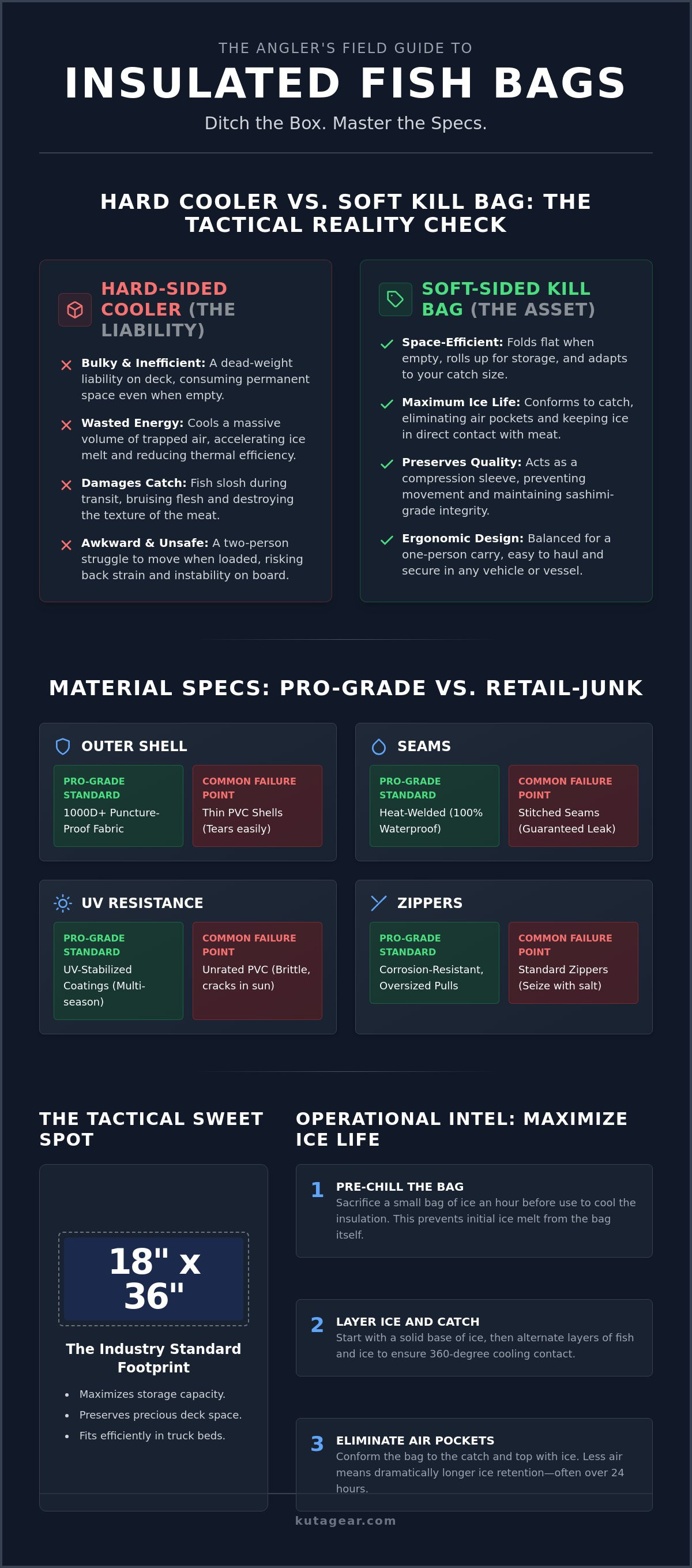
Choosing the right insulated bags/fish kill bags (soft-sided coolers) is about technical manufacturing, not marketing hype. This 2026 guide helps you master the specs and tactical advantages of high-performance gear. You’ll learn how to ensure your catch stays tournament-fresh from deck to dock. We’ll break down the difference between welded and stitched seams, examine the durability of TPU versus PVC, and show you why the 18 x 36 inch footprint is the tactical standard for serious anglers who prioritize meat quality and deck efficiency.
Key Takeaways
- Ditch the dead weight of hard coolers. Soft-sided bags fold flat when empty and conform to your catch to eliminate air pockets that accelerate ice melt.
- Demand professional-grade construction with heat-welded seams and 1000D+ outer shells to ensure your insulated bags/fish kill bags (soft-sided coolers) never leak in your vehicle.
- Standardize your gear with the 18" x 36" footprint. It is the industry sweet spot for maximizing storage capacity without sacrificing precious deck or truck bed space.
- Protect your investment with operational intel. Learn the specific techniques for pre-chilling and loading that extend ice life and preserve sashimi-grade meat quality for over 24 hours.
Hard-Sided Coolers vs. Soft-Sided Kill Bags: The Reality Check
Hard-sided coolers are built for tailgates, not tactical deck management. On a boat, space is your most valuable asset. A massive plastic box is a liability the moment it is empty. It occupies a permanent footprint that forces you to choose between storage and movement. Professional insulated bags/fish kill bags (soft-sided coolers) solve this logistical failure. They fold flat. They tuck away. They stay out of the way until the first fish hits the deck. Stop fighting the box and start managing your deck like a professional.
Thermal efficiency is about more than just foam thickness. A hard cooler has a fixed internal volume. If you only have two fish in a 100-quart box, you are cooling a massive amount of empty space. That trapped air kills your ice retention. Soft bags are different. They conform to the shape of the catch. This physical adaptability reduces air pockets and keeps the ice in direct contact with the meat. It is a fundamental shift in Cooler technology and materials that ensures sashimi-grade quality for your fillets.
Transit is where meat quality is often lost. In a traditional hard cooler, fish slosh around during the run back to the dock. This constant movement bruises the flesh and destroys the texture of the meat. High-quality insulated bags/fish kill bags (soft-sided coolers) provide a snug fit. They act like a compression sleeve for your catch. This prevents movement and maintains the integrity of the fish even in heavy seas.
The Ergonomics of Catch Management
Moving a loaded 150-quart hard cooler is a two-person struggle that usually ends in a back strain. It is inefficient. Professional fish bags are designed for a one-person carry. The handles are positioned for balance. You can haul your limit from the boat to the truck bed without calling for backup. These bags are also easier to secure. You can wedge them into boat corners or strap them down in a truck bed with far more stability than a sliding plastic box. Tapered designs further improve this, offering a lower center of gravity that prevents the bag from tipping when the boat is on the move.
Space Efficiency: From Storage to Deployment
Your garage does not need another oversized plastic monument. Hard coolers are a storage nightmare. A soft-sided kill bag can be rolled up and shoved on a shelf when the season is over. This "roll-up" advantage is critical for minimalist boat setups or kayak anglers with limited tank well space. The bag adapts to the size of your catch. If you have a slow day, the bag stays small. If you are on the meat, it expands to meet the demand. It is a tool that works with you, not a box that gets in your way.
Material Specs: What Separates Professional Gear from Retail Junk
Retail gear fails when the pressure is on. Professional insulated bags/fish kill bags (soft-sided coolers) rely on 1000D+ outer shells. This material is non-negotiable. It stops punctures from dorsal fins and sharp deck hardware. Anything less is just a glorified grocery bag. You need a shell that survives the friction of a truck bed and the grit of a salt-soaked deck. Rugged utility starts with the fabric. If your bag can't handle a thrashing tuna, it doesn't belong on your boat.
Stitched seams are a guaranteed leak. They rely on thousands of tiny holes. Those holes let out cold meltwater and let in heat and bacteria. Heat-welded seams are the industry standard for a reason. They fuse the material into a continuous, waterproof barrier. This construction ensures your truck stays clean and your catch stays cold. If it isn't welded, it isn't a kill bag; it's a mess waiting to happen. You want to spend your time fishing, not scrubbing fish blood out of your upholstery.
UV resistance is the silent gear killer. The sun eats cheap PVC for breakfast. Within a single season, unrated materials become brittle and crack. Professional-grade insulated bags/fish kill bags (soft-sided coolers) use UV-stabilized coatings to handle 12-hour days in direct sunlight. This keeps the bag flexible and the thermal barrier intact. You aren't just buying a bag for today. You're buying gear that ignores the sun and stays in the fight for years. Reliability is built into the chemistry of the material.
The Zipper: The First Point of Failure
Salt air destroys standard hardware. You've seen it happen. A zipper seizes, and the bag becomes a useless sack. You need corrosion-resistant zippers designed for marine environments. Oversized pulls are another tactical necessity. You need to be able to operate the bag with wet, bloody, or gloved hands without fumbling. A heavy-duty zipper flap acts as the final seal. It blocks the heat from creeping in through the teeth and keeps your ice working longer.
Insulation Thickness and Ice Retention
Bulk is not a substitute for quality. Two inches of cheap, airy foam is useless compared to a half-inch of high-density closed-cell foam. Density wins the thermal war every time. It maintains internal temperatures even when the deck is scorching. This is critical for following seafood safety guidelines to keep your catch below 40°F. High-density closed-cell foam insulation is the primary driver of ice retention because it creates a dense thermal vacuum that blocks external heat transfer. If you want a build that actually lasts, the 18" x 36" Insulated Fish Bag provides the exact specs needed for professional results.
Finding the Tactical Sweet Spot: Sizing for Decks and Truck Beds
Bigger isn't always better. It's often just a burden. A massive 90-inch bag might look impressive in a catalog. On the deck, it is a footprint hog. Once it's full of tuna and ice, it is an anchor. You won't move it alone. You'll need a crew or a crane. Tactical sizing is about balance. You need enough volume for the catch but a footprint that respects your deck space. Professional insulated bags/fish kill bags (soft-sided coolers) should enhance your mobility, not restrict it.
The 18" x 36" size has become the industry standard for a reason. It fits. It fits in the tank well of most sit-on-top kayaks. It fits in the corner of a center console. It fits across the back of a truck bed. This size accommodates the majority of game fish you target. Think mahi, blackfin tuna, or heavy snapper. It provides the capacity you need without the dead weight of an oversized plastic box. Utility wins over ego every single time.
Don't ignore the math of a loaded bag. A gallon of water weighs over 8 pounds. Add 40 pounds of ice and 60 pounds of fish. Suddenly, your "portable" solution is pushing 150 pounds. This is the weight trap. If you can't move your insulated bags/fish kill bags (soft-sided coolers) from the deck to the tailgate without help, the gear has failed you. Stick to dimensions that a single angler can manage. Efficiency is the mark of a seasoned expert.
The 18 x 36 Advantage
This footprint is the tactical standard. It is long enough for pelagics but narrow enough to stay out of the way. It fits perfectly into standard boat fish boxes that are often too small for rigid coolers. For the solo angler, this is the maximum manageable size. It allows you to maintain one-person carry capability even when the bag is at capacity. It is the sweet spot between storage volume and physical portability.
Transport Logistics: Boat to Vehicle
The transition from boat to vehicle is where most bags fail. This is the "truck bed swamp" phase. If your bag leaks, your truck smells like a bait shop for a month. You need the heat-welded seams we discussed earlier. They ensure a 100% leak-proof experience. Reinforced handles are also critical. A tear at the handle point during a lift is a disaster. Look for wrap-around webbing that supports the load from the bottom. Your bag shouldn't be a projectile; use the tie-down points to keep it secure during the run home.
Operational Intel: Maximizing Ice Retention & Bag Life
Owning professional gear is only half the battle. You have to know how to run it. Most anglers fail at ice management before they even leave the dock. They throw fresh ice into a warm bag and wonder why it melts by noon. Tactical application ensures your catch stays cold for 48 hours or more. It is about thermal physics, not luck. If you want to maintain sashimi-grade quality, you need to follow a strict cooling protocol. High-performance insulated bags/fish kill bags (soft-sided coolers) are tools. Use them correctly.
The debate over draining meltwater is settled by your immediate goal. For the fastest possible cooling, you want a brine. Adding a scoop of rock salt to your ice and water creates a super-cooled slurry. This slurry surrounds the fish and drops core temperatures in minutes. This is how pros handle high-value targets like tuna. However, if you are transitioning to a truck bed for a long haul, drain the excess liquid. You want to keep the weight manageable and prevent any potential for sloshing. The insulation will maintain the temp once the fish is chilled.
Don't starve the bag of cooling power. Your ice-to-fish ratio is the most important variable in the field. Aim for a 1:1 ratio at a minimum. If you are fishing in 90-degree heat, push that to 2:1. The thermal mass of the ice must be sufficient to absorb the heat of the catch and the external environment. If you fill a bag with fish and only a single bag of ice, the internal temp will spike. Protect your meat quality by over-delivering on ice every single trip.
Professional Ice Management
Crushed ice is for immediate surface contact. Block ice is for longevity. For a full-day offshore trip, use a foundation of block ice and fill the gaps with crushed ice. This combination provides the best of both worlds. Pre-chilling a bag for 30 minutes increases ice life by 20% because it removes the latent heat stored in the high-density foam before the primary ice load is added. This simple step prevents your first two bags of ice from melting just to cool the bag itself.
Cleaning and Maintenance
Fish funk is a choice. It is the result of poor maintenance. After every trip, wash the interior with mild dish soap and warm water. Avoid bleach or harsh industrial chemicals. These can degrade the liner's integrity and eat through the heat-welded seams over time. Drying is the most critical step. Never store a damp bag zipped shut. That creates a breeding ground for mold and permanent odors. Open the bag, hang it upside down, and let it air dry completely. Apply a marine-grade silicone lubricant to the zippers once a month to keep the hardware moving. Master your ice management with the 18" x 36" Insulated Fish Bag, which is built to hold a heavy brine without failing.
The Kuta Gear Standard: Professional Grade Insulated Bags
The Pacific doesn't care about brand names. It cares about durability. Kuta Gear was born from a need for equipment that ignores corporate margins and focuses on performance. We don't build gear for the showroom. We build insulated bags/fish kill bags (soft-sided coolers) for the deck. Our 18" x 36" Insulated Fish Bag is the physical result of that philosophy. It is a tactical tool designed for anglers who prioritize meat quality over social status. You get professional-grade materials without the "luxury" markup that plagues the retail market.
Utility is our only metric. We've stripped away the marketing hyperbole and focused on the technical specs that actually matter in the field. This is gear for the person who is out there every weekend. It is for the angler who needs a bag that can handle the grit, the blood, and the heat of a 12-hour run. Kuta Gear is the choice for those who demand reliability without the unnecessary overhead of big-box retail. We understand the frustration of paying for a logo instead of performance. We've fixed that problem by putting the value back into the construction of the bag itself.
Reliability is built into every seam. When you are miles offshore, you can't afford a gear failure. You need a bag that maintains its integrity under the weight of a full limit. Our focus remains on industrial-strength utility. We use manufacturing processes that ensure our insulated bags/fish kill bags (soft-sided coolers) remain leak-proof and rugged for years. We don't follow trends. We follow the requirements of the environment. If a feature doesn't help you keep fish fresh or save deck space, it doesn't make it onto our bags.
Standout Features of the Kuta Collection
Our bags feature heavy-duty insulation designed for high-heat environments. We don't use cheap fillers. We use high-density foam that blocks heat transfer effectively. The rugged outer skin is built to handle scales, fins, and constant deck friction. It is a puncture-resistant barrier that stays in the fight for multiple seasons. Because we sell direct-to-consumer, you get more bag for less money. We've eliminated the middleman to ensure you have access to professional gear at a fair price. This is industrial strength designed specifically for the serious angler who values their catch.
Ready for Your Next Run
Your season won't wait for a backorder. Competitors often leave you waiting for months while they manage their supply chains. We maintain stock to ensure immediate availability when the bite is on. Our gear is designed by people who actually fish. We understand the logistics of catch management because we live it every day. Don't settle for gear designed in a corporate boardroom by people who have never bled a tuna. Browse the full Kuta Gear Insulated Bag Collection today and equip your vessel with the tactical standard. Your catch is too valuable to trust to anything less than professional equipment. It is time to upgrade your deck efficiency.
Secure Your Catch with Professional Grade Gear
Meat quality is won or lost in the hours after the strike. You've seen how material specs and tactical sizing define a successful run. Stitched seams and cheap foam lead to bloody messes and warm fish. Professional insulated bags/fish kill bags (soft-sided coolers) provide the thermal vacuum needed to stop heat in its tracks. By mastering ice management and choosing gear that respects your deck space, you move from an amateur hobbyist to a serious meat manager. Reliability is the only metric that matters when you're miles from the dock.
The Kuta Gear 18" x 36" flagship design is built specifically for these demanding marine environments. It offers the rugged construction you need without the middleman markup that drives up retail prices. We focus on industrial strength so you can focus on the bite. Stop settling for gear that fails after a single season. It's time to equip your boat with the tactical standard. Shop the Kuta Gear Insulated Fish Bag Collection and experience the difference of direct-to-consumer value. Get back on the water and bring home a catch you can be proud of.
Frequently Asked Questions
How long will ice last in a soft-sided fish kill bag?
Ice retention depends on the insulation quality and your management. Premium insulated bags/fish kill bags (soft-sided coolers) with closed-cell foam can maintain ice for 12 to 24 hours in direct sunlight. If you pre-chill the bag and use a proper 1:1 ice-to-fish ratio, you can push that to 48 hours. Budget bags with open-cell foam usually lose their cooling power in under 8 hours.
Are insulated fish bags actually leak-proof for my car or truck?
Only bags with heat-welded seams are 100% leak-proof. Stitched seams rely on thousands of needle holes that eventually weep fish blood and meltwater into your upholstery. If you plan to transport your catch in a truck bed or SUV, verify the bag uses welded construction. This ensures the liquid stays inside the bag and away from your vehicle's carpet.
What size fish bag do I need for most offshore fishing?
The 18" x 36" size is the tactical standard for most offshore game fish like mahi, tuna, and large snapper. It provides enough volume for a limit while remaining light enough for a one-person carry. Larger bags exist for pelagics like swordfish, but they require a crew to move once loaded. Stick to a size that fits your deck and your physical lifting capacity.
How do I get the fish smell out of my kill bag?
Use mild dish soap and warm water immediately after your trip. Scrub the liner thoroughly and rinse until the water runs clear. The most important step is air drying the bag completely while it is open and upside down. Never zip a damp bag shut. That is how you lock in permanent odors and mold that ruin gear.
Can I use a fish kill bag as a regular cooler for drinks?
You can definitely use insulated bags/fish kill bags (soft-sided coolers) for drinks and food. The high-density insulation is just as effective at keeping ice for beverages as it is for preserving tuna. Just ensure the bag is decontaminated from previous catches to avoid cross-contamination. It is a versatile tool that replaces heavy plastic coolers for beach trips or tailgates.
What is the best way to store a fish bag when not in use?
Store your bag in a cool, dry place away from direct sunlight. High-quality bags can be rolled up or folded flat to save space in your garage or boat locker. Always leave the zipper slightly open to allow for airflow. This prevents the interior liner from sticking together or developing a stale smell during the off-season months.
Do I need to add saltwater to the ice inside my fish bag?
Adding saltwater creates a super-cooled brine that drops fish core temperatures rapidly. This is the best method for maintaining sashimi-grade quality. However, a brine will melt your ice faster than dry ice management. Use the brine method for the first hour of cooling, then drain the excess liquid to maximize ice longevity for the long ride home.
Are Kuta Gear bags puncture-resistant against sharp fins?
Kuta Gear bags are built with heavy-duty 1000D+ outer shells specifically for puncture resistance. This material is designed to handle sharp dorsal fins, scales, and rough deck friction without failing. While no soft material is completely indestructible against a knife, our industrial-strength skin is the professional standard for durability. It stays in the fight for multiple seasons of heavy use.

Also in Contact

Portable Fish Storage for Pier Fishing: The Rugged Guide to Catch Preservation

The Best Way to Chill Fish Quickly After Catch: A Professional Guide
