

Best Insulation Material for Fish Bags: The Science of Catch Preservation
Most fish bags are just glorified grocery totes that fail the second the sun hits the deck. You've seen it happen. You're miles offshore with a trophy catch, but your ice is already a lukewarm slurry of meltwater and blood. Finding the best insulation material for fish bags is the only way to stop the rot. It's a waste of money and a disaster for your meat quality. You need a solution that doesn't involve a bulky hard cooler taking up half your deck space.
You want gear that works as hard as you do. This guide breaks down the science of catch preservation so you can hold ice in extreme heat. We'll prove why high-density closed-cell foam is the only choice for professional-grade bags. This material offers a superior R-value of up to 7.0 per inch. It's proven to keep your catch chilled for up to 96 hours in 70-degree weather. We will compare technical shell materials like PVC and TPU, explain the necessity of welded seams, and show you how to maintain meat quality without the bulk. Get ready to ditch the smell and save your ice.
Key Takeaways
- Stop treating your bag like a cooler and start treating it like a thermal shield. Learn how to minimize heat transfer from scorching boat decks.
- Discover why closed-cell foam is the best insulation material for fish bags. Its independent air cells block moisture and eliminate mold growth.
- Compare the durability of TPU and PVC tarpaulin shells. Get the facts on puncture resistance and environmental longevity in harsh marine conditions.
- Master the math behind R-values and ice retention. Find out which specific materials hold ice for multi-day trips in extreme heat.
- See why industrial construction matters. Professional-grade bags are built to survive the hunt from the deck to the truck bed.
Understanding the Core: Why Fish Bag Insulation Matters
Your fish bag is not a refrigerator. It does not create cold. It is a thermal wall. Its only job is to defend the ice you already bought. When you are miles offshore, the environment is actively trying to steal your cold. The sun beats down. The deck plate sizzles. If your gear cannot stand its ground, your ice turns into a lukewarm slurry in hours. This is why choosing the best insulation material for fish bags is a matter of professional pride, not just a gear preference. It is the difference between firm, sushi-grade fillets and a bag full of mushy, bacteria-ridden waste.
Most retail bags prioritize thickness. They look bulky to trick you into thinking they are effective. Real performance comes from density. A professional-grade bag uses high-density materials that offer a higher resistance to heat flow. This resistance is what keeps the internal temperature stable when the external environment is hostile. If your insulation is thin or low-quality, you aren't just losing ice. You are losing the quality of your catch and the money you spent on the trip.
The Physics of Cold Retention on the Water
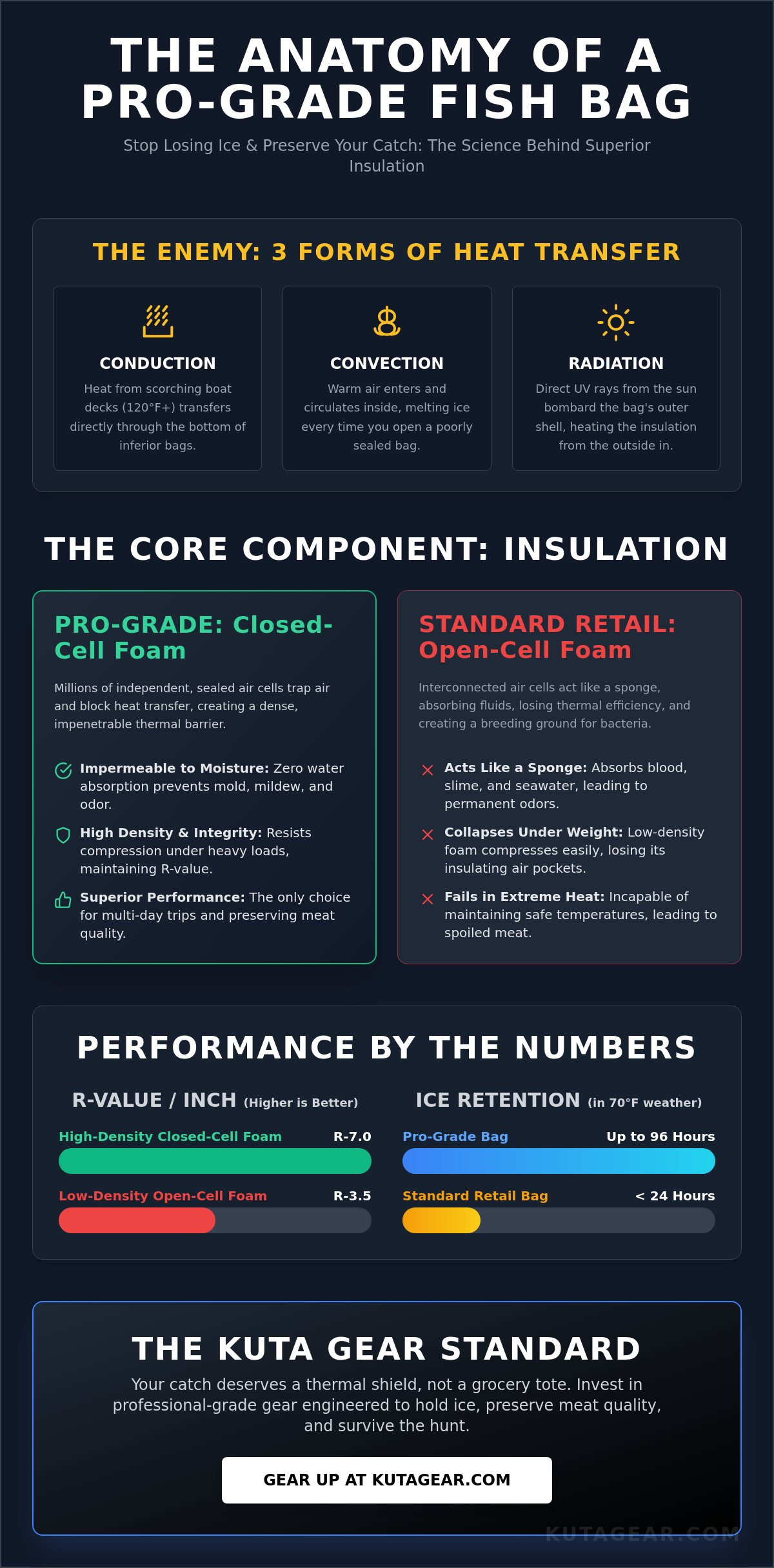
Heat is aggressive. It moves from the hot deck to your catch through conduction. On a summer day, a fiberglass deck can easily exceed 120 degrees. Without a dense thermal barrier, that heat transfers directly through the bottom of the bag. Convection is the next threat. This happens when warm air enters the bag and circulates around your fish. Every time you open a poorly designed zipper, you lose the fight. Finally, radiation from direct UV rays attacks the outer shell. A high-quality bag uses a UV-resistant skin to reflect this energy before it even reaches the insulation. The effectiveness of this defense is measured by its R-value. A higher value means the material is more stubborn against heat transfer. You want a material that refuses to let energy pass.
Meat Quality and Temperature Control
The clock starts the moment the fish hits the deck. To preserve the texture of pelagic species like tuna or mahi, you must drop the internal temperature to between 32 and 40 degrees Fahrenheit immediately. Rapid cooling locks in the flavor. It stops the enzymatic breakdown that leads to "mushy" meat. Cheap, thin-walled bags cannot maintain this window in extreme heat. They sweat. They leak. They fail. When they fail, bacteria begins to grow. You didn't spend hundreds on fuel and bait to bring home spoiled meat. Investing in the best insulation material for fish bags ensures that your hard work translates into high-quality food on the table. Reliability is the only metric that matters when the sun is high and the dock is hours away.
Closed-Cell Foam: The Gold Standard for Marine Insulation
Your bag's shell is the armor. The foam is the engine. If you want the best insulation material for fish bags, you look at the cell structure. Closed-cell foam is the industry standard for a reason. It consists of millions of independent, sealed air cells. These cells aren't connected. They don't share space. Each one is a microscopic bunker that traps air and blocks heat. This creates a thermal barrier that can hold ice for up to 96 hours in 70-degree heat. It is an absolute requirement for any serious offshore trip.
Reliability comes from consistency. Closed-cell foam provides structural integrity that cheap alternatives can't match. It doesn't compress under pressure. It doesn't thin out over years of use. It also provides a layer of impact protection. Your catch stays cushioned during rough transit through heavy chop. It even adds buoyancy. If your bag goes overboard, it stays on the surface. That is the difference between professional gear and a disposable retail toy. You need gear that survives the environment and the workload.
Closed-Cell vs. Open-Cell Foam
Open-cell foam is a liability on a boat. It acts like a sponge. It pulls in blood, seawater, and slime through the seams. Once those fluids are inside the foam, you can't wash them out. This is the primary cause of permanent fish bag odors and mold growth. Closed-cell foam has zero moisture absorption. It stays dry. It stays clean. It stays light. Beyond hygiene, the thermal efficiency is unmatched. Closed-cell foam offers an R-value of 6.0 to 7.0 per inch. Open-cell foam can't compete. It's a weight-saving shortcut that costs you ice and meat quality every single time.
Density and Compression Resistance
Thickness is often a marketing gimmick. Density is a technical fact. Low-density foam feels soft and thick, but it collapses under the weight of a heavy catch. When foam compresses, it loses its air pockets. When it loses air pockets, it loses its ability to stop heat. High-density closed-cell foam maintains its loft. It stands up to the weight of a heavy tuna without flinching. This ensures the 18" x 36" Insulated Fish Bag keeps a consistent thermal barrier from the bottom of the bag to the top. If your bag goes flat under a load, your ice is already melting. Choose a high-density build that maintains its shape and its cold.
Outer Shell Materials: TPU vs. PVC Tarpaulin and Polyester
The shell is your bag's skin. It protects the heart of the system. If the outer layer fails, even the best insulation material for fish bags won't save your catch. You need a shell that survives the deck, the sun, and the fish. It must be impenetrable. It must be easy to scrub. It must be built to last more than one season. Most retail bags use cheap materials that degrade the moment they hit salt air. Professional gear uses advanced polymers designed for the hunt.
TPU (Thermoplastic Polyurethane) is the current gold standard for high-performance gear. It is incredibly puncture-resistant. It handles sharp dorsal fins and rough fiberglass without tearing. PVC tarpaulin is the old-school alternative. It's heavy and waterproof. But PVC has a weakness. It's prone to cracking after repeated UV exposure. Vinyl-coated polyester is another common choice. It’s tough, but it’s often too stiff. It holds onto blood and scales. It makes cleaning a nightmare. You don't want a bag that carries the stench of last month's trip.
UV resistance is a requirement. The sun is a constant threat on the water. It degrades cheap materials. It makes them brittle. A high-quality shell acts as a shield. It prevents UV radiation from reaching the internal foam. This preserves the life of your bag and your insulation. Without a UV-resistant skin, your bag will literally fall apart under the sun.
TPU: The Performance Leader
Professional anglers are switching to TPU shells. The reason is simple. TPU offers a superior weight-to-strength ratio. You get industrial-grade durability without the weight of traditional PVC. Research indicates that 840 Nylon TPU is 30% more abrasion-resistant than standard vinyl-coated polyester. It also performs better in the cold. While PVC becomes stiff and prone to snapping, TPU remains flexible. It won't fail when the temperature drops on a winter morning. It resists salt corrosion and long-term sun damage. It is engineered for the reality of the marine environment.
The Problem with Stitched Seams
Stitched seams are a design flaw. Every stitch is a hole. These holes allow cold air to bleed out. They let warm seawater seep in. This ruins your ice retention. Welded seams are the only professional answer. Radio frequency welding uses energy to fuse the shell materials into a single piece. There are no holes. There are no leaks. It is a permanent, waterproof bond. Seam integrity determines the success of your insulation. If the shell leaks, the foam gets wet. If the foam gets wet, your catch is at risk. Welded construction is the only way to ensure your bag stays leak-proof and effective.
Calculating Performance: R-Value and Ice Retention
Performance isn't a guess; it's a calculation. The best insulation material for fish bags must have a high R-value, which measures a material's resistance to heat flow. High-density closed-cell foam is the professional choice because it offers an R-value of 6.0 to 7.0 per inch of thickness. Generic polyester batting or open-cell foam cannot compete. They have too much air movement. They have no resistance. If your bag doesn't have a rated foam core, it’s just a wet sack.
Geometry plays a major role in how long your ice lasts. The surface area to volume ratio determines how fast heat enters the bag. A long, thin bag has more surface area exposed to the sun than a cube. This is why packing your gear correctly matters. More ice in a concentrated mass survives longer than ice spread thin. If you are using an 18" x 36" Insulated Fish Bag, keep your ice centered around the thickest part of the catch to maximize thermal efficiency.
External factors will kill your ice if you aren't prepared. A dark boat deck or a black truck bed acts as a heat sink. These surfaces can reach 120 degrees Fahrenheit in direct sun. This temperature differential forces heat through your insulation faster. Density is your only defense here. A 1/2-inch layer of high-density closed-cell foam will outperform a full inch of cheap lofted batting every time. Density stops the flow. Thickness without density is just wasted space.
Thermal Conductivity in Marine Gear
Thermal conductivity is the rate at which heat passes through the specific materials making up your fish bag. Foam is a poor conductor; water is a great one. This is why you must drain your bag regularly. Standing melt-water creates a thermal bridge that pulls heat from the shell directly to your catch. Air pockets in the foam act as dead space to stop this transfer. Drain the water to save the ice. When you're hunting for the best insulation material for fish bags, prioritize materials that refuse to absorb that moisture.
The 'Ice Test' Reality
Don't trust every marketing claim you read. Some manufacturers claim 96-hour retention but test their products in a 70-degree lab with zero sun. Perform your own baseline test at home. Fill the bag with a set amount of ice and leave it on your deck for 24 hours. Measure what's left. This is the only real-world metric that matters for your specific environment. It cuts through the hype and shows you exactly what your gear can handle.
You can boost your bag's performance with simple field tactics. Keep it out of direct sunlight whenever possible. Use a reflective cover or a light-colored towel to deflect radiation. If you want a bag built on these thermal principles, order the 18" x 36" Insulated Fish Bag. It is engineered for high-heat environments. It is built for the hunt.
The Kuta Gear Standard: Engineered for the Hunt
Performance isn't found in a marketing brochure. It's found on the deck at 2:00 PM when the sun is relentless. The 18" x 36" Insulated Fish Bag is built for this specific moment. We don't use generic fillers or thin liners. We utilize the best insulation material for fish bags: high-density closed-cell foam. This isn't a leisure product. It is a piece of industrial equipment designed for all-day ice retention in extreme environments. It holds the cold because the science demands it.
Our construction process ignores the shortcuts taken by retail brands. We focus on structural integrity. Boat decks are abrasive. Truck beds are unforgiving. Our bag handles both without compromising the thermal seal. The shell is rugged. The seams are fused. The result is a utilitarian tool that keeps your catch in prime condition from the hook to the table. We skip the fluff. We prioritize the hunt.
Why 18x36 is the Versatile Choice
This dimension is the sweet spot for most anglers. It provides ample capacity without the unnecessary bulk of a massive kill bag. It is the ideal size for a variety of hauls:
- Medium Pelagics: Perfect for Mahi, small Tuna, and Yellowtail.
- Reef Fish: Holds a limit of Snapper or Grouper with ease.
- Shore-Pounding: Light enough to carry to remote spots but tough enough to stay there.
When the work is done, the space-saving design pays off. It rolls up tight. It fits in standard boat lockers or under truck seats. You get professional-grade insulation that doesn't own your entire deck space.
Built to Outlast Corporate Competitors
We see the high-priced alternatives. We know the retail markups. Kuta Gear provides a direct-to-consumer value that puts more money into the materials and less into corporate overhead. You get a thicker thermal barrier and a more durable shell for a fair price. Our bags are built to handle the blood, guts, and salt of a real fishing environment. They are easy to clean and impossible to ignore when your ice is still solid on day three. Stop paying for a logo. Start paying for performance.
Don't settle for a bag that sweats through by noon. Secure your catch with gear that understands the physics of the water. Get the Kuta Gear 18x36 Insulated Fish Bag and stop wasting ice.
Secure Your Catch with Professional Grade Gear
The science is clear. Your catch quality depends entirely on the thermal barrier you put between the fish and the deck. Closed-cell foam stands alone as the best insulation material for fish bags because it refuses to absorb moisture and maintains its R-value under pressure. When you combine that core with a puncture-resistant TPU shell and welded seams, you have a tool that outlasts any corporate retail alternative. You've seen how heat transfer and poor materials lead to spoiled meat. Now you have the technical knowledge to prevent it.
Professional catch care requires gear that is engineered for demanding marine conditions. Our specialized 18" x 36" dimensions provide maximum versatility. It fits everything from reef fish to medium pelagics without wasting deck space. This is industrial-strength insulation designed for the reality of the hunt. Don't let your hard work rot in a cheap bag. Upgrade to the Kuta Gear 18x36 Insulated Fish Bag and take control of your ice retention. Get out there and bring home the quality you deserve.
Frequently Asked Questions
What is the best insulation for a DIY fish bag?
High-density closed-cell foam is the only choice for a DIY project. Avoid bubble wrap or generic liners. They fail under the heat. Use polyethylene or EVA foam sheets. These materials provide the thermal resistance needed for the best insulation material for fish bags. Ensure you seal the edges. If the core gets wet, the insulation value drops to zero. It's a waste of time to use anything less than industrial foam.
How thick should the insulation be in a professional fish kill bag?
Professional bags prioritize density over sheer bulk. Most high-performance gear uses 1/2-inch to 3/4-inch high-density closed-cell foam. This thickness provides an R-value between 6.0 and 7.0 per inch. Thicker bags are often filled with low-density open-cell foam. That material collapses under the weight of a heavy catch. Stick to high-density builds for consistent performance on the water.
Can I use a regular cooler bag for saltwater fish?
Regular cooler bags are a liability in saltwater. They use metal zippers that corrode in weeks. They have stitched seams that act like straws for fish blood and salt. You need gear with non-corrosive zippers and welded seams. Professional fish bags are designed to be hosed out without trapping bacteria in the lining. A grocery store cooler bag won't survive one serious offshore trip.
Does the color of the fish bag affect how long the ice lasts?
Color is a functional choice. Light colors reflect UV radiation and keep the surface temperature lower. A white or light grey bag absorbs less heat from the sun. This reduces the energy load on your insulation. Darker bags look clean longer, but they cook your ice on a hot deck. Choose light colors for maximum ice retention in high-heat environments. It is a simple matter of physics.
Why does my fish bag smell even after I wash it?
Permanent odors come from trapped bacteria. If your bag uses open-cell foam or stitched seams, blood and slime have reached the core. You can't wash that out. This is why professional bags use closed-cell foam and welded construction. To fix a smelly bag, use an enzymatic cleaner specifically designed to break down organic proteins. If the smell persists, your insulation is compromised and holding rot.
Is TPU better than PVC for fish bag construction?
TPU is the clear winner for marine gear. It is 30% more abrasion-resistant than standard vinyl-coated polyester. It stays flexible in freezing temperatures while PVC becomes brittle and cracks. TPU is lighter and more puncture-resistant. It handles the rough environment of a boat deck without flinching. If you want gear that lasts multiple seasons, choose TPU construction. It is built for the long haul.
How do I maximize ice retention in my fish bag on a hot day?
Start with a pre-chill. Put a sacrificial bag of ice in the bag 30 minutes before you load your catch. Keep the bag in the shade whenever possible. Drain the melt-water every few hours to prevent thermal bridging. Use a high ice-to-fish ratio. Every time you open the zipper, you lose cold air. Keep it shut until you have another fish to load. Discipline saves ice.
Can closed-cell foam in fish bags be repaired if punctured?
You repair the shell, not the foam. Closed-cell foam is waterproof by design. A puncture won't cause it to soak up water like a sponge. However, you must seal the outer skin to keep the bag leak-proof. Use a marine-grade TPU or PVC patch kit. Clean the area with alcohol first. Apply the adhesive and patch to restore the waterproof integrity of the bag. It is a quick fix for a tough bag.

Also in Contact

Portable Fish Storage for Pier Fishing: The Rugged Guide to Catch Preservation

The Best Way to Chill Fish Quickly After Catch: A Professional Guide
