

Fish Storage for Boats With No Fish Box: Professional Catch Preservation
A built-in fish box is often the worst place on your boat to store a trophy catch. Most uninsulated hatches turn into ovens by noon. They melt your ice fast and leave your dinner floating in a warm, bloody soup. You're right to be frustrated with the lack of dedicated fish storage for boats with no fish box. Standard hard coolers are just bulky space killers. They trip you up while you're fighting a fish and eat your limited deck space. Those plastic boxes are built for the dock, not for the deck of a working boat.
You can maintain tournament-grade fish quality on any vessel without sacrificing your entire floor plan. We'll show you how to use professional insulated storage solutions to stop slime and blood from ruining your unfinished fiberglass. You'll learn how premium materials keep ice solid for over 12 hours in the summer heat. This guide covers the shift toward high-performance kill bags that offer 50-quart capacity but fold flat when the job is done. Built-in storage is for gear; insulated bags are for meat. It's time to stop settling for bruised, warm meat. Start treating your catch with the respect it deserves.
Key Takeaways
- Rapid cooling stops enzymatic breakdown. Learn why industrial closed-cell foam beats cheap open-cell alternatives every time.
- Stop relying on uninsulated hatches that cook your catch. Professional fish storage for boats with no fish box requires a dedicated thermal barrier to stop ice melt.
- Hard coolers kill deck space. Discover how rugged fish bags provide a better footprint-to-volume ratio while resisting sharp gaffs and fins.
- Secure your storage anywhere using tactical tie-down points. Maintain boat safety and maximize floor space even in heavy seas.
The Problem: Why Factory Boat Storage is Not a Fish Box
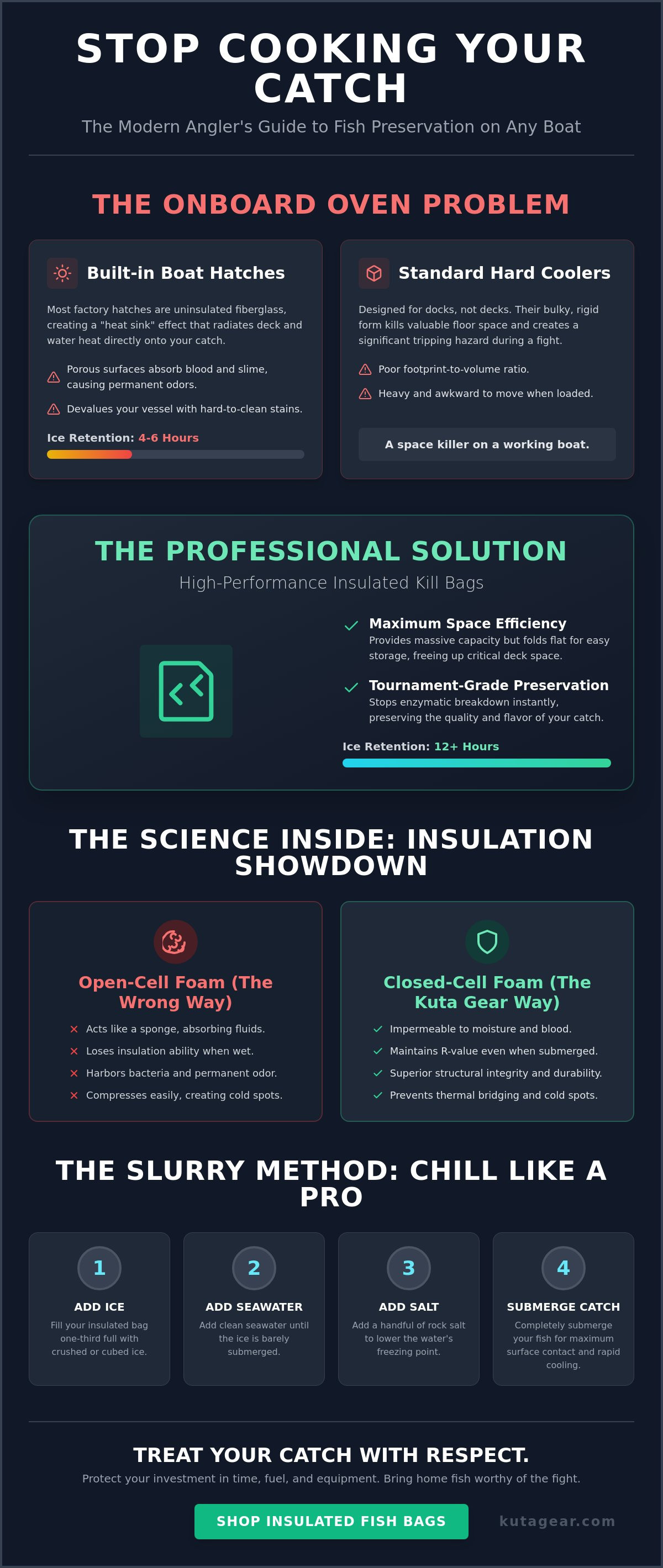
Your boat has hatches. They look like storage. They aren't fish boxes. Most manufacturers cut corners. They give you a dry storage hatch and call it "fishable." It isn't. A true fish box needs thick, closed-cell insulation. Without it, you just have a hole in the floor that leaks cold air and absorbs heat. Finding effective fish storage for boats with no fish box is about understanding how fiberglass works. Uninsulated fiberglass is a thermal conductor. It doesn't stop heat; it invites it in. It acts as a bridge between the blazing sun on your deck and your expensive catch. If your storage compartment isn't built with a thermal barrier, you're just putting your fish in an oven.
The Heat Sink Effect
Ambient deck temperature is your enemy. The sun beats down on the deck. The hull sits in warm water. That heat radiates through the fiberglass walls of your storage hatch. This creates a heat sink effect. In these uninsulated conditions, ice disappears in four to six hours. Once the ice is gone, the science of catch preservation tells us that enzymatic breakdown starts immediately. Your fish core temperature rises. The meat turns mushy. You're left with a wasted catch and a wet hatch. This isn't just an inconvenience. It's a failure of equipment. You spent thousands on the boat and hundreds on the fuel. Don't waste it all because your storage hatch is actually a slow cooker.
Cleanup and Long-Term Boat Value
Raw fiberglass is a nightmare for hygiene. Most storage hatches aren't gel-coated on the inside. They are unfinished. The surface is porous. It's basically a hard sponge. When fish blood and slime hit that surface, they soak into the fibers. You can't scrub it out with a brush. Bacteria grows deep in the pores. The smell becomes permanent. This isn't just about a stinky boat. It's about resale value. A boat that smells like rotting tuna is a liability. Blood stains in the hatches devalue the vessel during a survey. Using proper fish storage for boats with no fish box keeps the mess contained. A self-contained bag protects the vessel's integrity. It keeps the slime off your deck and out of your bilge. It ensures your boat stays clean and your meat stays tournament-grade.
The Science of Catch Preservation and Temperature Control
Catching the fish is the easy part. Keeping it edible is the job. The second a fish hits the deck, a biological timer starts. Enzymatic breakdown begins immediately. This process turns firm fillets into mush and ruins the flavor profile. To stop this, you must drop the core temperature of the fish to near-freezing within minutes. Solving the problem of fish storage for boats with no fish box isn't just about finding a container. It's about thermal management. You need a solution that fights ambient heat and stops the clock on spoilage.
Most cheap bags use open-cell foam. This is a mistake. Open-cell foam acts like a sponge. It absorbs fish blood, water, and bacteria. Once it's saturated, it loses its ability to insulate. Professional-grade gear uses high-density, closed-cell foam. This material is packed with tiny, individual air pockets that don't share walls. It doesn't absorb moisture. It maintains its R-value even when submerged. Proper fish storage for boats with no fish box relies on density, not just bulk. Choosing a heavy-duty 18 x 36 inch bag ensures your insulation remains effective season after season.
Closed-Cell Insulation Advantages
Closed-cell foam is the industry standard for a reason. It provides superior structural integrity and thermal resistance. Because the cells are sealed, the foam doesn't compress easily under the weight of a heavy catch. This prevents "cold spots" where the insulation would otherwise fail. A thermal bridge is the uninsulated gap at the zipper or seam where heat bypasses the foam walls and attacks your ice. To combat this, look for bags with heat-sealed seams and oversized zippers that minimize air exchange. Aim for a 2:1 ice-to-fish ratio to ensure the core temperature stays below 40 degrees Fahrenheit for the duration of your trip.
The Slurry Method
Ice alone is inefficient. Air is an insulator, and air gaps between ice cubes slow down the cooling process. To achieve professional-grade results, use the brine slurry method. This creates maximum surface contact with the fish.
- Step 1: Fill your insulated bag one-third full with crushed or cubed ice.
- Step 2: Add clean seawater until the ice is barely submerged.
- Step 3: Add a handful of rock salt to lower the freezing point of the water.
- Step 4: Submerge your catch completely in the liquid.
Conduction is the king of cooling. This liquid environment pulls heat out of the fish significantly faster than air-gapped ice. It also prevents bruising because the fish floats in the slurry rather than pressing against hard surfaces. Ensure your bag is zipped tight and secured to the deck. A watertight seal is mandatory to prevent the slurry from leaking into your bilge during transport. This method keeps your catch in prime condition from the hook to the frying pan.
Kill Bags vs. Hard Coolers: Which is Best for Small Boats?
Hard-sided coolers are the default for most weekend warriors. They shouldn't be. On a center console under 23 feet, a 65-quart rotomolded cooler is a permanent obstacle. It doesn't move. It doesn't flex. It just sits there, waiting to trip you while you're gaffing a fish. When you're solving the problem of fish storage for boats with no fish box, you need gear that works with your deck, not against it. Hard coolers are built for the dock; insulated kill bags are built for the fight. They offer a superior footprint-to-volume ratio because they don't rely on thick, rigid plastic walls to maintain structure.
Durability is often the main concern for skeptics. They worry about a dorsal fin or a gaff point puncturing the lining. Professional bags use heavy-duty, industrial-strength vinyl. This material is designed to take a beating on a commercial deck. It resists punctures and abrasions better than the brittle plastic found in many budget coolers. Portability is another win for the bag. Carrying a heavy, rigid cooler off a boat is a two-person job that kills your back. A bag has reinforced handles and a flexible shape. You can sling it over your shoulder or carry it solo from the gunwale to the truck without breaking a sweat.
The Space Management Argument
A bag conforms to your boat. If you have an awkward bow space or a narrow walkway next to the console, the bag adapts to that shape. It utilizes the "dead space" that a square cooler can't touch. There is also a "shrinking" benefit that hard coolers can't match. As your ice melts and your slurry is drained, the bag loses volume. You actually gain deck space as the day progresses. A hard cooler takes up the same four square feet whether it's packed with tuna or completely empty. It remains a trip-hazard until you're back at the trailer.
Cleaning and Maintenance Comparison
Scrubbing out a deep, rigid cooler is a chore. You have to climb into it to reach the corners where blood and slime collect. A bag is different. You can unzip it completely, flip it inside out, and hose it down in seconds. High-performance fish storage for boats with no fish box must be easy to maintain, or you'll stop using it. Look for these specific features:
- UV Resistance: Marine-grade vinyl won't crack or yellow after a season in the sun.
- Heat-Sealed Seams: These prevent blood from leaking into the insulation layers.
- Oversized Drain Plugs: Essential for clearing out scales and debris without clogging.
Some anglers try to DIY their way out of this by spraying expanding foam into factory hatches. This is a mess. It's irreversible, and it often traps moisture against your boat's core, leading to rot. Don't ruin your vessel's resale value with "hacks." A professional kill bag is a self-contained, removable solution that keeps your boat clean and your catch fresh. When the trip is over, it folds flat and hangs on a garage wall. Your deck stays clear, and your boat stays worth every penny.
Optimizing Your Deck: How to Use Fish Bags Without Losing Space
The biggest complaint about aftermarket fish storage is that it gets in the way. Anglers on forums often claim that bags are trip hazards. They're wrong. A bag is only in the way if you don't know how to rig your deck. High-performance fish storage for boats with no fish box is about tactical placement. Unlike a rigid cooler that dictates where it sits, a kill bag is flexible. It adapts to the geometry of your vessel. You can tuck it into the bow, lash it to a transom, or secure it along a gunwale. It’s about working with your floor plan, not fighting it.
Tactical placement depends on your boat's layout. On a center console, the bow is often dead space during a fight. Placing your bag forward helps with weight distribution and keeps the cockpit clear for footwork. If you're fishing a smaller skiff, the transom is often the best bet. It puts the bag within reach the moment the fish is gaffed. For those with narrow walkways, vertical storage is an option. If the bag isn't at maximum capacity, you can stand it upright against the console to reclaim precious square footage. This versatility is why professional anglers choose bags over bulky plastic boxes.
Securing the Load
A loose bag is a liability. In heavy seas, a 50-pound bag of ice and fish becomes a sliding projectile. You must secure it. Industrial-grade bags feature reinforced D-rings for this exact reason. Use heavy-duty carabiners to fix the bag to your t-top legs or deck cleats. This prevents the bag from shifting during high-speed runs or sudden maneuvers. A secured bag is safer for the crew and protects the fish from bruising. Proper positioning also prevents hull chafing. Ensure the bag is lashed tight so it doesn't vibrate against the gelcoat while you're on plane. It’s a simple rigging step that separates the pros from the amateurs.
The 18" x 36" Utility Standard
Sizing matters. You don't need a six-foot bag for regional game fish like snapper, mahi, or schoolie tuna. An 18" x 36" bag is the utility standard for a reason. It holds a significant volume of meat while maintaining a manageable footprint. This size fits perfectly in front of most center consoles or tucked neatly against a transom wall. It provides enough length for a 30-pound kingfish but doesn't eat your entire deck. Oversizing your bag leads to faster ice melt because the excess air volume forces the ice to work harder to cool empty space. Stick to the "Goldilocks" size for maximum thermal efficiency. If you're ready to upgrade your setup, get the 18" x 36" insulated fish bag designed for rugged marine use.
Stop settling for a crowded deck. A professional bag is a tool, not an obstacle. It gives you the storage you need without the bulk you hate. When the trip is over, it unclips and disappears. That is the utility of a well-rigged boat. You keep the meat cold and the deck clear. It’s the only logical way to handle fish storage for boats with no fish box.
Kuta Gear 18" x 36" Insulated Bags: Rugged, Reliable, Ready
Stop overpaying for a logo. Most "premium" brands in the marine industry charge you for their massive marketing budgets and retail margins. We don't. Kuta Gear is built for the angler who values performance over prestige. When you need fish storage for boats with no fish box, you need a tool that works as hard as you do. Our 18" x 36" insulated bags provide professional-grade catch preservation without the corporate markup. It’s a straightforward solution for a serious problem. No hype. Just results.
Built for the Rigors of the Sea
The marine environment destroys weak gear. Salt, UV rays, and sharp fins are constant threats. Kuta Gear bags feature an industrial-strength outer shell designed to resist punctures. A thrashing mahi or a sharp snapper fin won't compromise the insulation. We focus on technical construction. The seams are heat-sealed to prevent leaks. The insulation is high-density, closed-cell foam that won't absorb water. This isn't a soft cooler for a picnic. It’s a kill bag for the deck. It is designed to maintain ice for over 12 hours in the summer heat.
Hauling a full limit isn't easy. A bag packed with ice and fish can easily exceed 60 pounds. Cheap handles rip. Ours don't. We use reinforced, wrap-around handles that distribute the weight across the entire structure of the bag. You can carry your catch from the gunwale to the cleaning station with total confidence. We prioritize function because we know how a working boat operates. There is no room for failure when you're miles offshore. This is the professional standard for fish storage for boats with no fish box.
The Kuta Gear Advantage
We believe in direct-to-consumer value. By cutting out the middleman, we provide a heavy-duty 18" x 36" bag that rivals the utility of competitors charging significantly more. Why pay for a brand's skyscraper office when you just need a bag that keeps ice? Our gear is ready for the upcoming season. As of June 2026, our white bags are in stock and ready for immediate deployment. Don't wait until the bite is on to realize your boat lacks proper storage. Be prepared. Be professional.
Your catch represents an investment in time, fuel, and effort. Don't let it spoil in an uninsulated hatch or a bulky, tripping-hazard cooler. Upgrade to a solution that respects the meat and the vessel. Get the Kuta Gear 18" x 36" Insulated Fish Bag here and experience the difference of utilitarian design. It’s rugged. It’s reliable. It’s ready for the deck. Secure your storage today and start bringing home tournament-quality fillets every time you hit the water.
Protect Your Catch and Your Vessel
Don't let a lack of factory equipment dictate the quality of your dinner. You've seen the science. Rapid cooling through brine slurries and high-density thermal barriers is the only way to stop spoilage. Uninsulated hatches are for dry gear; they are not for meat. By choosing a flexible, high-performance solution, you reclaim your deck space and protect your boat's resale value from permanent stains and smells. Professional results come from professional preparation.
Solving the problem of fish storage for boats with no fish box requires gear that is built for the rigors of the sea. It requires closed-cell insulation technology that won't fail when wet. It demands rugged marine-grade vinyl construction that stands up to sharp fins and gaffs. Our design features heavy-duty reinforced handles to ensure you can haul your limit without equipment failure. Stop settling for warm meat and crowded decks. Upgrade your boat with the Kuta Gear 18" x 36" Insulated Fish Bag and take control of your catch preservation. The fish are waiting. Be ready to bring them home in tournament-grade condition.
Frequently Asked Questions
How long will ice last in an insulated fish bag compared to a hard cooler?
Premium bags with closed-cell insulation keep ice solid for over 12 hours in typical summer conditions. Hard-sided rotomolded coolers can hold ice for 24 to 72 hours but take up permanent deck space. A bag is a specialized tool for day trips. It provides the necessary thermal protection for your catch without the bulk of a plastic box. It is about performance and efficiency on the water.
Can I put a fish bag inside my uninsulated boat hatch?
You should place an insulated bag inside an uninsulated hatch to solve the problem of fish storage for boats with no fish box. This setup creates a makeshift fish box with a proper thermal barrier. The bag keeps the ice from melting against the warm hull. It also protects your boat's unfinished fiberglass from permanent blood stains and the smell of rotting fish slime.
Are insulated fish bags puncture-proof against sharp fins?
Heavy-duty bags are puncture-resistant but not entirely puncture-proof. Professional-grade marine vinyl is designed to withstand thrashing fins and sharp gaff points during normal use. It is far more durable than the thin liners found in cheap soft coolers. For the best results, slide large fish into the bag head-first to keep the sharpest dorsal spines away from the zipper and seams.
How do I clean a fish bag to prevent it from smelling?
Clean your bag with fresh water and mild soap immediately after every trip. Unzip it completely and hose out the corners where scales and blood collect. Air drying is the most important step. Never store a bag zipped up while it is still damp. A high-quality non-porous lining won't absorb odors if you keep it clean and dry between uses.
What is the best way to secure a fish bag on a small boat deck?
Use the reinforced D-rings and heavy-duty carabiners to lash the bag to your cleats or t-top legs. A bag full of ice and fish can weigh over 50 pounds and will slide in heavy seas. Anchoring it prevents hull chafing and keeps the deck safe for your crew. Proper rigging ensures the bag stays exactly where you put it, even during high-speed runs.
Will a fish bag leak blood and water onto my boat deck?
High-quality bags with heat-sealed seams and watertight zippers will not leak. This is a critical feature of professional fish storage for boats with no fish box. It keeps the mess contained so your bilge stays clean. Cheap bags with stitched seams often weep liquid through the needle holes. Always check that your zipper is fully seated to maintain a total seal against the deck.
What size fish bag do I need for average offshore fishing?
An 18" x 36" bag is the utility standard for snapper, mahi, and schoolie tuna. This size offers roughly 50 quarts of capacity, which is enough for most regional limits. It fits perfectly along transoms or in front of center consoles without killing your footwork. Avoid oversized bags for average trips. Excess air space inside the bag only leads to faster ice melt and wasted space.
Can I use a fish bag for groceries or drinks when not fishing?
You can use an insulated fish bag as a versatile utility cooler for drinks or groceries. The closed-cell foam keeps supplies cold for hours during sandbar trips or long boat runs. Since the lining is easy to sanitize and food-grade, it is a practical alternative to a hard cooler. It folds flat when you're done, making it much easier to store at home.

Also in Contact

Portable Fish Storage for Pier Fishing: The Rugged Guide to Catch Preservation

The Best Way to Chill Fish Quickly After Catch: A Professional Guide
