

How Long Does Ice Last in an Insulated Fish Bag? The Cold Truth for Anglers
A $200 day on the water is a total waste if your prize catch turns into mushy fertilizer before you hit the ramp. You need to know exactly how long does ice last in an insulated fish bag before you trust it with a limit of snapper or tuna. Most anglers think soft bags are just flimsy backups for heavy plastic boxes. They're wrong. Cheap, thin-walled gear fails the moment the sun hits the deck. Professional-grade equipment stays cold. It is a matter of choosing the right armor and using the right tactics to load it.
You're tired of bulky hard coolers stealing your deck space and tripping your crew. You want the portability of a bag but refuse to compromise on meat quality. We agree that performance matters more than a flashy logo or a high price tag. You can maintain sushi-grade freshness for 24 to 48 hours if you understand the physics of the chill. This guide delivers the cold truth about ice retention. We'll break down the exact ice-to-fish ratios, the importance of high-density insulation, and the tactical packing secrets that keep your ice solid while the competition's catch spoils in the summer heat.
Key Takeaways
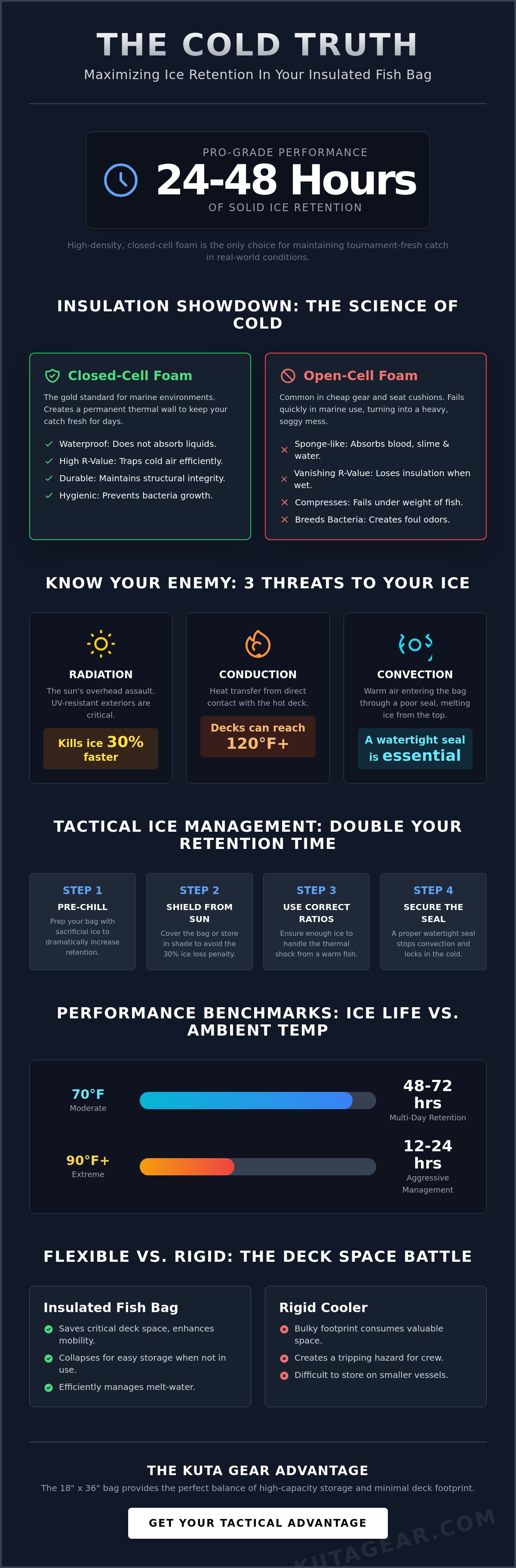
- Professional-grade insulation keeps ice solid for 24 to 48 hours. High-density, closed-cell foam is the only choice for maintaining tournament-fresh catch.
- Discover exactly how long does ice last in an insulated fish bag when fighting the sun. Direct exposure can kill your ice 30% faster without proper tactical shielding.
- Pre-chilling is a non-negotiable step for serious anglers. Prep your bag with a sacrificial ice load to double your retention time before the first fish hits the deck.
- Flexible bags outperform rigid coolers by saving deck space and managing melt-water more efficiently. They expand for the catch and collapse when the job is done.
- Leverage the 18" x 36" footprint for maximum utility. This specific dimension provides the perfect balance of boat space and high-capacity storage for large game fish.
The Science of Cold: How Insulated Fish Bags Hold Ice
An insulated fish bag is a tactical piece of equipment. It is a heavy-duty, flexible thermal barrier. It is designed for high-capacity storage when deck space is at a premium. Understanding The Science of Cold is the difference between a successful trip and a wasted limit. Every angler asks how long does ice last in an insulated fish bag. The answer is found in the material layers. Thick-walled vinyl prevents heat transfer from the deck. UV-resistant exteriors reflect radiant heat on open boats. These are not just features. They are requirements for survival in the salt. A quality bag acts as an armor for your catch. It battles the elements from the moment you leave the dock.
The core of the bag is the insulation. This is where the battle is won or lost. Cheap bags use thin materials that fail under pressure. Professional-grade bags use thick, industrial materials that stand up to the sun. The goal is simple. Keep the heat out. Keep the cold in. This requires a multi-layered approach to thermal defense. It requires materials that don't quit when the temperature climbs. It requires a design that prioritizes function over everything else.
Closed-Cell vs. Open-Cell Foam Insulation
Open-cell foam is for seat cushions. It is not for fish storage. It acts like a sponge. It absorbs blood, slime, and water. Once it gets wet, the R-value vanishes. It becomes a heavy, soggy mess that breeds bacteria. Closed-cell foam is different. It is the gold standard for marine environments. It maintains its structural integrity under the weight of heavy pelagics. It uses the dead air space principle. Millions of microscopic bubbles trap cold air inside. This foam does not absorb liquids. It creates a permanent thermal wall. This wall keeps your catch tournament-fresh for days. It is rugged. It is reliable. It works.
Heat Transfer: Radiation, Conduction, and Your Catch
Heat moves in three ways. You must fight all of them. Conduction is the direct threat from your boat's fiberglass deck. A hot deck can reach 120 degrees in the summer. Thick insulation blocks this energy transfer. It keeps the deck heat from reaching your ice. Radiation is the sun's overhead assault. A premium bag uses a light-reflective outer skin. This skin bounces those rays away before they penetrate the bag. Convection involves air movement. If your bag doesn't have a watertight seal, warm air enters. This melts your ice from the top down. A professional seal stops this exchange. It's about total environmental control. You control the temperature. You control the quality of the meat.
The question of how long does ice last in an insulated fish bag is answered by these physics. When you eliminate heat transfer, you extend ice life. You stop the melt. You preserve the value of your catch. This is the cold truth every serious angler needs to know.
Ice Life Expectations: Hours vs. Days
Time is the enemy on the water. You need a realistic timeline to protect your investment. Standard expectations for premium bags range from 24 to 48 hours in moderate conditions. This is the baseline for professional gear. Cheap, thin-walled alternatives won't even make it to the afternoon bite. Maintaining Ice Life Expectations is about more than just convenience. It is about food safety and meat quality. In 85-degree weather, a high-quality 18" x 36" bag maintains ice for approximately 24 to 28 hours under standard fishing loads. Beyond that window, you are gambling with your catch.
The sun is a predator. Direct sunlight is the fastest way to kill your ice. It can cut your retention time by 30% or more. Radiant heat penetrates the outer skin and forces the insulation to work double shifts. Fish volume also dictates the clock. Dropping a warm 50lb tuna into the bag causes an immediate thermal shock. That mass of warm meat instantly consumes a massive portion of your ice. You are not just cooling the air. You are fighting the internal body temperature of a large pelagic. To stay ahead, you need an 18" x 36" insulated fish bag that is built to take the heat without flinching.
The Temperature Variable Table
Ambient air temperature dictates your tactical approach. Use these benchmarks to plan your trip:
- 70°F Ambient: Expect multi-day retention. You can push 48 to 72 hours with proper packing and minimal openings.
- 90°F+ Ambient: The game changes. Ice management becomes a 12 to 24-hour operation. You must be aggressive with your ratios.
- The Deck Heat Factor: Fiberglass decks act like heaters. Elevate your bag or move it to a shaded area. A bag in the shade lasts significantly longer than one cooking on the open deck.
Thermal Mass and Empty Space
Air is the enemy of cold. A half-empty bag melts ice faster than a full one because the ice has to work to cool the empty space. Every cubic inch of air is a liability. If you don't have enough fish to fill the bag, use filler. Wet towels or frozen water jugs eliminate air pockets and preserve your thermal mass. The relationship between ice weight and fish weight is absolute. Aim for a 2:1 ice-to-fish ratio for long-haul trips. This ensures you have enough cooling power to offset the heat of the catch. Knowing how long does ice last in an insulated fish bag depends entirely on how well you manage this internal environment. Fill the gaps. Kill the air. Keep the cold.
Fish Bag vs. Rigid Cooler: Which Wins for Ice?
Rigid coolers are dead weight. They occupy the same footprint whether they are full of limits or empty air. An insulated fish bag is a tactical alternative. It expands when you are on the meat and collapses when the work is done. It does not force the fish to fit the box. It adapts to the catch. You gain deck space. You gain flexibility. You lose the bulk of a plastic coffin that serves no purpose once the ice starts to melt.
Performance is the primary concern for any serious angler. Critics claim bags cannot compete with rotomolded walls. The data says otherwise. In direct comparison tests, 20lbs of ice in an insulated fish bag survived 28 hours in 92°F heat. A rigid box lasted 38 hours. For any standard 24-hour trip, the bag provides the same sushi-grade protection without the logistical headache. You have to ask yourself if ten extra hours of ice is worth losing half your deck space to a permanent plastic obstacle.
Managing the melt is simpler in a flexible system. You do not have to crack the lid and lose your cold air to drain a bag. Use the integrated plug. Keep the seal tight. Portability is the final win. Lugging a 100lb rotomolded box off the boat is a two-man job. A bag with reinforced handles is a one-man operation. It is about efficiency. It is about getting your catch to the table without breaking your back or your budget.
Deck Footprint and Storage
Rigid coolers are deck-space killers on small boats. They are permanent trip hazards. The 18" x 36" footprint is the sweet spot for most center consoles. It fits standard deck configurations along the gunwale or tucked in the bow. When the trip is over and the fish are at the processor, the bag disappears into a storage locker. A cooler stays a box for the entire drive home. It demands space you don't have.
The Sealing Mechanism
Lids leak. Zippers seal. Zippers create a superior thermal barrier compared to loose-fitting cooler lids. Heavy-duty, oversized zippers are mandatory for salt environments. They don't just close; they lock in the cold. This prevents the chimney effect where cold air escapes and warm air rushes in to fill the void. A tight seal is essential to answering how long does ice last in an insulated fish bag. If you can't seal it, you can't save it. The zipper is your frontline defense against the heat.
Tactical Ice Management: How to Double Your Retention
Ice retention is not a passive event. It is a tactical operation. The bag provides the armor, but your packing technique provides the ammunition. If you want to know how long does ice last in an insulated fish bag, look at your preparation. Every zip is a thermal leak. Every minute of exposure kills your ice. Master the management, and you double your time on the water. It is the difference between a prime fillet and a wasted trip.
Discipline is the final factor. Stop peaking. Every time you open the bag to check your catch, you invite a thermal disaster. Trust your setup. Keep the zipper closed until the next fish is boat-side. This discipline is what determines how long does ice last in an insulated fish bag when the bite is on and the sun is high. You are either protecting the cold or letting it escape. There is no middle ground.
The Pre-Chill Protocol
Never put ice into a hot bag. If your gear has been sitting in a 100-degree garage, the foam is a heat sink. It will melt your first bag of ice in minutes. Use a sacrificial bag of ice two hours before you leave. This brings the internal foam temperature down to 32°F. When you load your fresh ice for the trip, it won't waste energy cooling the bag itself. You want the insulation working for you, not against you. Pre-chilling is the most ignored step in ice management, and it is the most critical for long-haul success.
Creating the Perfect Slurry
A dry bag is a slow cooler. Air is an insulator, and it works against you here. The secret to sushi-grade core temperatures is the saltwater slurry. Use a ratio of two parts ice to one part seawater. Salt lowers the freezing point of water. This creates a sub-zero bath that surrounds the fish entirely. Total immersion is superior to resting fish on top of ice. It pulls heat from the core of the fish instantly. This is how professionals handle high-value pelagics to ensure the meat stays firm and clear.
Ice Ratios for Success
Follow the 2:1 rule. Use two pounds of ice for every pound of fish you expect to catch. Layer your defense. Put ice on the bottom. Place the fish in the middle. Pack ice on the top. This creates a cold-trap that heat cannot penetrate. Use block ice for longevity. Use crushed ice for surface contact. This combination provides the best of both worlds. For a bag that handles these heavy loads without failing, get the 18" x 36" insulated fish bag from Kuta Gear. It is built for the weight. It is built for the cold.
The Kuta Gear 18" x 36" Advantage
Most brands sell you a lifestyle. We sell you a tool. The 18" x 36" Insulated Fish Bag is built for the salt. It is designed for the heat. We don't use thin-walled liners or cheap zippers. We use industrial-grade materials that stand up to the midday sun. When you ask how long does ice last in an insulated fish bag, the answer is only as good as the construction. Our bag provides a professional-grade thermal barrier that challenges high-priced corporate brands without the retail markup. It is direct-to-consumer value. It is performance without the prestige tax.
We know the field. We understand the frustration of gear that fails when the bite is on. High-density, closed-cell insulation is not a luxury. It is a requirement. Our construction ensures that your ice stays solid and your catch stays tournament-fresh. We prioritize function over aesthetics every time. This is gear for the hardworking angler who demands reliability and preparedness. It's about constant readiness. It's about having the right armor for the hunt. It works. You win.
Built for the Hunt
- Reinforced Handles: These won't rip. We built them to handle max capacity. You can carry a full load of pelagics with total confidence.
- Puncture-Resistant Lining: Fins and gills are sharp. Our inner lining is designed to take the abuse. It is rugged. It is durable. It doesn't quit.
- Easy-Clean Surfaces: Fish funk is a choice. Our materials don't hold odors. A quick spray-down after the trip keeps your gear ready for the next run.
Why the 18" x 36" Size is the Sweet Spot
Size matters on a boat. You need versatility. The 18" x 36" footprint is the ideal balance. It is large enough for everything from bottom fish to medium pelagics. It fits perfectly in truck beds. It tucks away on small boat decks. It doesn't steal your space; it optimizes it. This is the tactical choice for the resourceful angler who values efficiency. You don't need a massive plastic box when you have a bag this capable. It is the ultimate storage solution for the modern hunt.
Stop overpaying for corporate logos. Get the gear that works as hard as you do. You can Get the Kuta Gear 18" x 36" Insulated Fish Bag here and see the difference for yourself. Don't let your catch spoil because of inferior equipment. Trust the cold truth of Kuta Gear. Our bag answers the question of how long does ice last in an insulated fish bag with a resounding 24 to 48 hours of sushi-grade protection. It's time to upgrade your ice retention game.
Secure Your Catch with Tactical Cooling
You have the tactics. You have the ratios. Now you need the armor. Don't let a long run back to the ramp ruin your investment. Successful anglers know that ice retention is a tactical operation. It requires industrial-strength tools and a disciplined approach. Understanding how long does ice last in an insulated fish bag gives you the confidence to stay on the bite until the job is done. Your catch stays tournament-fresh. Your deck stays clear. Your reputation stays intact.
We build gear for the hunt. Our industrial-strength 18" x 36" design is the standard for serious anglers. We utilize closed-cell foam technology that blocks the heat and locks in the cold. Professional anglers nationwide trust this setup because it works. It doesn't quit when the temperature climbs. It doesn't fail when the bag is at max capacity. You deserve a partner that works as hard as you do. Stop gambling with your limits and start protecting your meat with gear that's built for the salt.
Upgrade your catch care with the Kuta Gear 18" x 36" Insulated Fish Bag
Get out there and fill the bag. The cold truth is on your side.
Frequently Asked Questions
How much ice do I need for a 36-inch fish bag?
You need a 2:1 ice-to-fish ratio for maximum efficiency. For an 18" x 36" bag, starting with 40 to 60 pounds of ice is standard for a full day. This volume ensures you have enough thermal mass to offset the heat of the catch. If you're targeting large pelagics, err on the side of more ice. Empty space is the enemy of cold. Fill the bag to the limit to ensure the insulation works for you.
Should I drain the water out of my fish bag as the ice melts?
Keep the water inside to create a cooling slurry. Cold water provides better surface contact than air or ice cubes alone. It pulls heat from the fish core faster than dry ice. Only drain the bag if you are adding a fresh load of ice and need the physical space. Otherwise, that melt-water is a sub-zero bath that maintains sushi-grade freshness throughout the trip. It is a tactical advantage.
What is the best type of ice for long-term retention?
Use a combination of block ice and crushed ice. Block ice has less surface area and melts much slower. It acts as the anchor for your thermal defense. Crushed ice fills the gaps and provides immediate contact with the fish. This tactical pairing is how you extend how long does ice last in an insulated fish bag during multi-day trips. It provides both longevity and immediate cooling power.
How do I clean an insulated fish bag to prevent odors?
Use mild dish soap and a soft brush immediately after the trip. Scrub the inner lining to remove blood and slime. Rinse thoroughly with fresh water. The most critical step is air drying. Hang the bag upside down with the zipper open. This prevents fish funk from trapping in the seams. Avoid harsh chemicals that can degrade the puncture-resistant liner. A clean bag is always ready for the next hunt.
Can I use dry ice in an insulated fish bag?
Do not use dry ice. It is too cold for the vinyl and foam materials. The extreme temperature can cause the inner lining to become brittle and crack. Dry ice also sublimates into gas. In a sealed bag, this creates pressure that can damage the heavy-duty zippers or seams. Stick to standard ice or a saltwater slurry for safe, effective cooling. Protect your gear and your catch by using the right cooling medium.
How long will a tuna stay fresh in a Kuta Gear bag?
A tuna stays sushi-grade for 24 to 48 hours with proper management. You must use the pre-chill protocol and a 2:1 ice ratio. The high-density insulation in our 18" x 36" bag is built for this exact scenario. Keep the bag in the shade and keep the zipper closed. Your catch quality depends on your discipline as much as the gear. When you follow the rules, the gear delivers the results.
Does the color of the fish bag affect ice retention?
Color matters in the midday sun. Light-colored exteriors reflect radiant heat away from the bag. Darker colors absorb the sun's rays and transfer that heat to the insulation. This forces the bag to work harder. We use light-reflective materials to ensure the foam maintains its R-value. This detail determines how long does ice last in an insulated fish bag when the deck temperature climbs. It is a simple matter of physics.
Are insulated fish bags completely leak-proof?
Professional-grade bags with welded seams and heavy-duty zippers are designed to be water-resistant. They won't leak under normal conditions on the deck. However, they are not submersible pressure vessels. If you flip the bag upside down, moisture may eventually find a path through the zipper teeth. Keep the bag upright and use the integrated drain plug for controlled water management. This keeps your deck dry and your slurry contained.

Also in Contact

Portable Fish Storage for Pier Fishing: The Rugged Guide to Catch Preservation

The Best Way to Chill Fish Quickly After Catch: A Professional Guide
