

How Proper Chilling on the Boat Prevents Freezer Burn: The Angler’s Guide
Freezer burn is not a freezer problem. It is a deck problem. You spend hundreds on fuel and hours on the water, only to pull a gray, leathery fillet out of the deep freeze three months later. It is a total waste of a hard-earned catch. Most anglers believe the damage happens in the kitchen. The truth is that understanding how proper chilling on the boat prevents freezer burn is the only way to stop the chemical breakdown that starts the moment the fish hits the deck. If you do not drop the core temperature immediately, the texture is already compromised.
We agree that nothing is worse than wasting a significant portion of your seafood to poor handling. This guide promises to show you how immediate on-deck temperature control stops the processes that cause cellular damage long before your catch hits the house. We will preview the science of the 1:1 ice ratio, the benefits of slurry ice technology, and why professional-grade insulated gear is a requirement for serious anglers. It is time to stop guessing and start preserving your catch with industrial-strength efficiency.
Key Takeaways
- Stop the damage before it starts. High core temperatures on the boat deck trigger the cellular breakdown that leads to dry, leathery fillets.
- Discover how proper chilling on the boat prevents freezer burn by halting sublimation, the process where moisture turns into gas long before you reach the dock.
- Master the slurry strategy. Learn why a water and ice mixture conducts cold faster than air, instantly locking in the texture and flavor of your catch.
- Eliminate dead air space. Understand why collapsible insulated fish bags outperform rigid coolers by keeping thermal mass concentrated directly against the meat.
- Protect your investment. Professional-grade temperature control on the water is the only way to ensure restaurant-quality results months after the trip.
The Hidden Link: Why Freezer Burn Starts on the Boat Deck
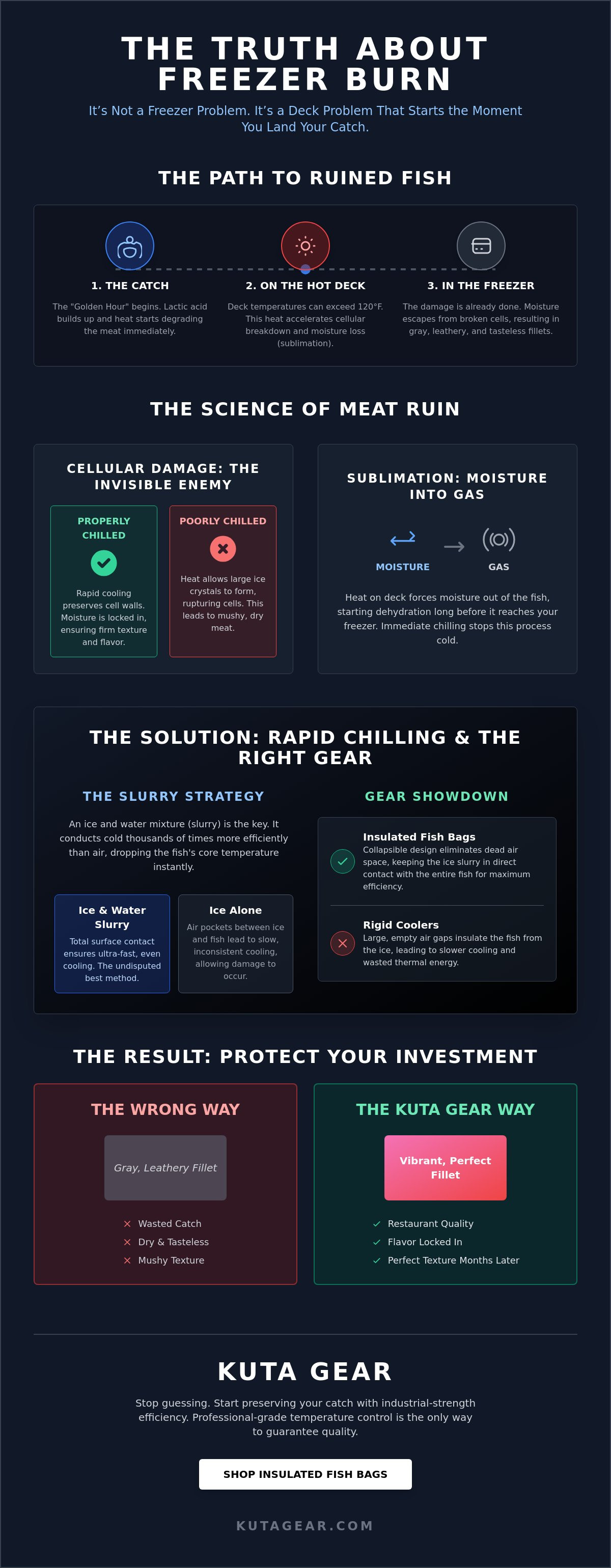
Most anglers blame their freezer when a fillet comes out gray and leathery. They're wrong. Freezer burn is not a storage failure; it's a deck failure. It's the result of The Science of Sublimation, where moisture turns into gas. This process doesn't wait for your kitchen. It starts the moment your catch hits a hot deck. High core temperatures at the time of catch accelerate cellular breakdown. This breakdown destroys the meat's internal structure. It creates a path for moisture to escape later. Proper on-deck chilling preserves the moisture barrier of the meat. It locks the water inside the cells. Learning how proper chilling on the boat prevents freezer burn is a requirement for anyone who values their catch. If you don't control the temperature on the boat, you're prepping the fish to fail in the freezer.
The "Golden Hour" of Fish Preservation
You have sixty minutes. The first hour after the catch determines everything. A struggling fish builds up massive amounts of lactic acid. This acid drops the pH level of the meat. It makes the flesh soft. If the fish sits in the sun, that heat cooks the meat from the inside out. This is not a guess; it's a chemical reality. By the time you reach the dock, the cellular damage is done. You need to kill the heat before it kills the quality. It's about preparedness and immediate action.
Cellular Integrity vs. Sublimation
Rapid chilling prevents large ice crystals from expanding and rupturing cell walls within the fish meat. When these walls break, the meat becomes mushy. Mushy meat cannot hold onto its natural fluids. Once you put that fish in the freezer, the moisture leaks out of the broken cells. It then turns to gas. This is why fresh fish often tastes like cardboard after a few months. A cold surface is a lie. You must drop the core temperature. Deep, immediate cooling preserves the moisture barrier. It keeps the water where it belongs, inside the cells. This is how proper chilling on the boat prevents freezer burn before the fish ever touches a vacuum sealer. If you wait until you get home, you've already lost the fight. Proper gear makes the difference between a ruined catch and a restaurant-quality meal.
The Science of Sublimation: How Boat Heat Accelerates Meat Ruin
The sun is a butcher. On a clear day, an exposed boat deck can hit 120°F or higher. That's a heat lamp for your catch. This thermal load increases the vapor pressure inside the fish meat. It forces water toward the surface. Once it hits the surface, it evaporates. This is pre-freeze dehydration. You lose weight. You lose quality. Understanding how proper chilling on the boat prevents freezer burn starts with realizing that moisture loss begins hours before the fish hits your home freezer. If the meat is already dry when it goes into the bag, it has no chance in the deep freeze.
Vapor Pressure and Moisture Migration
Think of moisture like a pressurized gas. Heat provides the energy. The temperature gradient between the warm fish and the dry air creates a vacuum effect. It pulls moisture out of the muscle fibers. If the skin is damaged, the process is even faster. A fish that arrives at the dock dry is already compromised. It has no internal moisture left to survive long-term storage. You need a barrier against the sun. Using a heavy-duty fish bag creates a controlled environment that stops this moisture loss immediately after the catch.
Enzymatic Breakdown and Texture
Heat does more than steal water. It triggers enzymes. When the core temperature stays above 50°F, these enzymes begin to dismantle protein structures. The meat loses its snap. It becomes soft. This isn't just about texture; it's about chemistry. Soft meat has larger gaps between fibers. These gaps allow for massive ice crystal formation during freezing. These crystals puncture cell walls. When you thaw the fish, it leaks. That's a direct result of failing to cool the fish on the water.
Surface bacteria also love the heat. Warm fish equals fast-growing colonies. These bacteria produce the fishy odors people associate with old seafood. Freshness is a measurement of temperature. If it isn't cold, it isn't fresh. It doesn't matter if it was swimming ten minutes ago. If the core is warm, the meat is degrading. Rapid core-chilling stops the clock. It protects the protein integrity. This is how proper chilling on the boat prevents freezer burn and ensures your fillets don't turn into mush in the bag. You're not just cooling the fish; you're stopping a chemical chain reaction.
The Slurry Strategy: Rapid Core-Chilling for Long-Term Preservation
Air is the enemy. Water is the tool. If you put your catch on a bed of cubed ice, you're failing. Cubed ice leaves air pockets. These pockets act as thermal insulators. They slow down the cooling process and allow the core temperature to remain dangerously high. A brine or ice slurry provides 100% surface contact. It surrounds the fish with a high-density thermal medium. This method allows core temperatures to drop three times faster than plain ice. Speed is the only thing that matters. The goal is reaching 33°F as fast as physically possible. This rapid heat transfer is how proper chilling on the boat prevents freezer burn. You're locking the moisture in before it has a chance to migrate toward the surface.
How to Build the Perfect On-Board Slurry
Professional results require a specific process. Don't eyeball the ratios. You need an industrial-strength cooling medium to protect your investment. Follow these steps to ensure a total thermal lockdown:
- Step 1: Fill your insulated bag with 2/3 ice. Crushed or flake ice is better than large cubes. It has more surface area for faster heat absorption.
- Step 2: Add clean seawater until a thick slush forms. It should have the consistency of a heavy milkshake.
- Step 3: Submerge the catch completely. Ensure no air pockets remain. The fish must be fully encased in the slush to ensure uniform cooling.
- Step 4: Monitor the slushiness. As the fish transfers its internal heat to the slurry, the ice will melt. Add more ice to maintain the thermal mass.
Remember the 1:1 ratio. You need at least one pound of ice for every pound of fish. In tropical heat, a 3:1 ratio is safer. Don't be cheap with the ice. Cheapness leads to waste.
Saltwater vs. Freshwater Ice
Freshwater ice melts at 32°F. Saltwater slurries go lower. They can reach temperatures below the freezing point of freshwater without turning the meat into a solid brick. This is the super-chill effect. It puts the catch into a state of suspended animation. It extends shelf life and improves the final frozen texture. Using seawater also prevents freshwater bloat. Fish meat absorbs freshwater through osmosis. This swells the cells. Swollen cells are fragile. They rupture more easily during the final deep freeze. Ruptured cells leak moisture. This is how proper chilling on the boat prevents freezer burn; it maintains the osmotic balance of the muscle fibers. Stick to seawater. It's colder. It's more effective. It's the only way to handle a high-value catch properly.
Why Insulated Fish Bags Outperform Rigid Coolers in Meat Protection
Rigid coolers are built for drinks. They are not built for high-stakes meat preservation. The fatal flaw of any rigid box is dead air. Unless that cooler is packed to the lid, it contains a pocket of warm air that circulates every time the boat moves. This air acts as a heat sink. It eats your ice. It raises the core temperature of your catch. An insulated bag is superior because it is flexible. It collapses. You can purge the air out as you zip it closed. This creates a tight thermal envelope. This is how proper chilling on the boat prevents freezer burn; you eliminate the air that drives moisture out of the meat.
Eliminating the "Air Gap"
Air pockets in a half-full cooler are the primary cause of rapid ice melt. In a rigid environment, the ice shifts. Hot spots form where the fish touches the plastic instead of the ice slurry. A high-quality bag produces a vacuum effect. It wraps the insulation directly around the thermal mass of the fish and ice. For most coastal anglers, an 18" x 36" footprint is the perfect size. It handles everything from slot reds to large snapper without the bulk of a 100-quart box. You get better cooling with less ice. You get a better product at the end of the day.
Thermal Efficiency and Insulation Thickness
Most rigid coolers use hollow-wall construction or low-density foam. They are designed for a price point, not for professional performance. Professional fish bags utilize thick, closed-cell insulation. This material does not lose its R-value when wet. It maintains a consistent internal environment even during high-speed runs through salt spray and wind. The bag stays cold because it doesn't have the massive surface area of a box catching the sun. It is utilitarian. It is effective. It is built to survive the UV rays and the salt. It is prepared for the work.
Hygiene is the final factor in long-term storage. Rigid coolers have seams, drains, and porous surfaces that harbor bacteria. These bacteria create the odors that ruin a freezer's reputation. A professional bag uses a non-porous, heavy-duty liner. It is easy to scrub. It doesn't hold the smell of the last trip. If you want restaurant-quality fillets, you need a clean environment. Invest in a professional 18" x 36" Insulated Fish Bag to ensure your catch stays as clean as it is cold. This is the difference between a wasted trip and a stocked freezer. You owe it to the resource to protect the meat properly.
Hardcore Protection: The Kuta Gear 18x36 Insulated Fish Bag
The Kuta Gear 18x36 Insulated Fish Bag is the final line of defense for your catch. We engineered this bag for the professional angler who demands zero waste. It's not a luxury item. It's a piece of industrial equipment. High-heat environments destroy fish. Our heavy-duty insulation stops that destruction. The 18" x 36" dimensions are optimized for deck space. You get maximum capacity without sacrificing your walking room. This bag is built to survive gaffs, sharp scales, and constant salt exposure. It doesn't quit. It's a tool designed for the specific purpose of meat preservation in the harshest conditions.
Built for the Hunt
A leak-proof design is a requirement, not an option. You need to transport your catch in a truck without ruining the upholstery. Our liners are heat-sealed to keep the brine inside the bag. We reinforced the handles for a reason. Hauling a heavy, chilled load of meat and ice is a physical challenge. These handles won't tear under pressure. The liners are also non-porous. They don't hold onto that "fishy" smell after a long day in the sun. You scrub it out; it's ready for the next trip. This durability mirrors the work you do on the water. It's about being prepared for the weight of a successful day.
Investment in Quality
A professional bag pays for itself. Every time you throw away a freezer-burned fillet, you're throwing away money. If you save even a small percentage of your annual catch from the trash, the bag is paid for in a single season. We focus on direct-to-consumer value. You get more insulation and less marketing fluff. We don't care about social status. We care about performance and reliability. Understanding how proper chilling on the boat prevents freezer burn is the theory. Owning the right gear is the application. It is a logical conclusion for anyone serious about their harvest.
Don't let your hard work rot on the deck or dry out in the freezer. You've seen the science of sublimation. You know the risks of air gaps and heat. Now, get the tool that solves the problem. This is how proper chilling on the boat prevents freezer burn at a professional level. It's time to stop gambling with your catch. Protect your catch with the Kuta Gear 18x36 Insulated Fish Bag. Be the angler who brings home restaurant-quality meat every single time. The gear is ready. Are you?
Lock in Your Catch Quality
You've done the hard work. You've spent the fuel and the time. Don't let a hot boat deck steal your reward. We've shown you that freezer burn isn't just a kitchen storage issue. It starts on the water. By mastering the saltwater slurry and eliminating dead air, you protect the cellular integrity of your fish. This is how proper chilling on the boat prevents freezer burn long before the vacuum sealer comes out. You need gear that works as hard as you do. Our rugged 18" x 36" design provides high-density insulation for extreme heat. It's equipment built by anglers, for anglers. Stop settling for leathery fillets and gray meat. It's time to treat your harvest with the respect it deserves. Upgrade your gear with the Kuta Gear 18x36 Insulated Fish Bag today. Get back on the water with confidence. Your next meal depends on it.
Frequently Asked Questions
Is freezer-burned fish safe to eat?
Yes, freezer-burned fish is safe to eat, but you won't enjoy it. The dry, leathery patches are the result of moisture loss, not spoilage. While it doesn't harbor bacteria, the texture and flavor are compromised beyond repair. You're eating cardboard at that point. Most people end up tossing it, which is a waste of a good trip. Proper handling on the boat ensures you never have to make that choice.
How long can fish stay in an insulated bag before the quality drops?
Your catch can stay in a high-quality insulated bag for 24 to 48 hours without losing quality, provided you maintain a proper ice slurry. The goal is a constant 32°F to 33°F environment. If the ice melts and the water warms up, the clock starts ticking fast. Check your slush levels every few hours. This sustained cold is exactly how proper chilling on the boat prevents freezer burn by keeping cellular moisture locked in place.
Can I use dry ice in a Kuta Gear fish bag?
No, do not use dry ice in your fish bag. Dry ice is -109.3°F and will flash-freeze the meat, which can actually cause cellular damage if not controlled. It can also make the heavy-duty liners brittle and prone to cracking. Stick to a saltwater ice slurry. It provides the most efficient heat transfer for immediate core-chilling without the risks associated with carbon dioxide gas or extreme sub-zero temperatures.
What is the best way to wrap fish for the freezer after chilling?
Vacuum sealing is the gold standard for long-term storage. If you don't have a sealer, use heavy-duty freezer bags and submerge them in water to force out every pocket of air before zipping. Air is the enemy of frozen meat. By removing the air, you prevent the sublimation process. Combine this with the fact that you already dropped the core temp on the boat for the best results.
How much ice do I really need for a day of fishing?
You need a 1:1 ratio of ice to fish as a baseline. If you expect to catch 50 pounds of fish, bring 50 pounds of ice. In tropical climates or mid-summer heat, move to a 3:1 ratio to compensate for rapid melting. Being cheap with ice is the fastest way to ruin a catch. Fill your 18" x 36" bag with enough ice to create a deep, submerged slurry for every fish.
Does bleeding the fish help prevent freezer burn?
Bleeding the fish improves overall meat quality, which indirectly helps with storage. Removing the blood reduces the rate of enzymatic breakdown and prevents off-flavors from developing. Clean, white fillets have a more stable cellular structure. When you combine bleeding with rapid cooling, you create a superior product. This total process is how proper chilling on the boat prevents freezer burn by ensuring the meat is in peak condition before it ever hits the ice.
Can I use a fish bag for grocery transport or other cold storage?
Yes, the 18" x 36" Insulated Fish Bag is a versatile tool for any cold storage need. It works for transporting frozen groceries, keeping drinks cold at a campsite, or hauling meat from a hunting trip. The closed-cell insulation doesn't care what's inside. It just maintains the temperature. Its collapsible design makes it easier to pack in a truck than a bulky, rigid cooler, regardless of what you're hauling.
How do I clean my Kuta Gear bag to prevent bacteria buildup?
Clean your bag with mild dish soap and warm water after every use. Use a soft brush to scrub the liner, paying attention to the corners. Avoid harsh chemicals or bleach that can degrade the materials. Rinse it thoroughly and hang it upside down to air dry completely before zipping it shut for storage. A clean bag prevents the bacteria that cause odors and ruin the taste of your next catch.

Also in Contact

Portable Fish Storage for Pier Fishing: The Rugged Guide to Catch Preservation

The Best Way to Chill Fish Quickly After Catch: A Professional Guide
