

How to Fold and Store a Large Fish Bag to Maximize Longevity
Your garage shouldn't smell like a rotting pier. Most anglers treat their gear like an afterthought once the boat is trailered. That is a mistake. Storage is actually the most dangerous time for your equipment. Improper handling kills insulation faster than a jagged gaff. If you want your 18" x 36" Insulated Fish Bag to last a decade instead of a season, you need a system. Learning how to fold and store a large fish bag is the difference between a reliable piece of kit and a bulky, moldy mess that ends up in the trash.
We agree that gear should work as hard as you do. You didn't invest in professional-grade cooling just to watch the internal foam crack under pressure. You don't want to fight mold every spring. This guide shows you the technical process of sanitizing and stowing your bag to protect its thermal integrity. We will break down the exact cleaning solutions that kill odors, the folding techniques that prevent insulation failure, and the storage habits that keep your gear ready for the next sunrise.
Key Takeaways
- Sanitization is non-negotiable. Bacteria destroys PVC liners and creates permanent odors if organic residue remains in the bag.
- Master the "Roll Method" to protect closed-cell foam. Learning how to fold and store a large fish bag correctly prevents insulation cracks and thermal leaks.
- Control your storage environment. Temperature stability prevents delamination, while low humidity stops mold and mildew from colonizing your gear.
- Avoid crease fatigue and zipper seizure. Tight folds lead to structural failure. Use a loose roll and keep hardware lubricated to ensure the bag is ready for the next trip.
Sanitization First: The No-Stink Storage Protocol
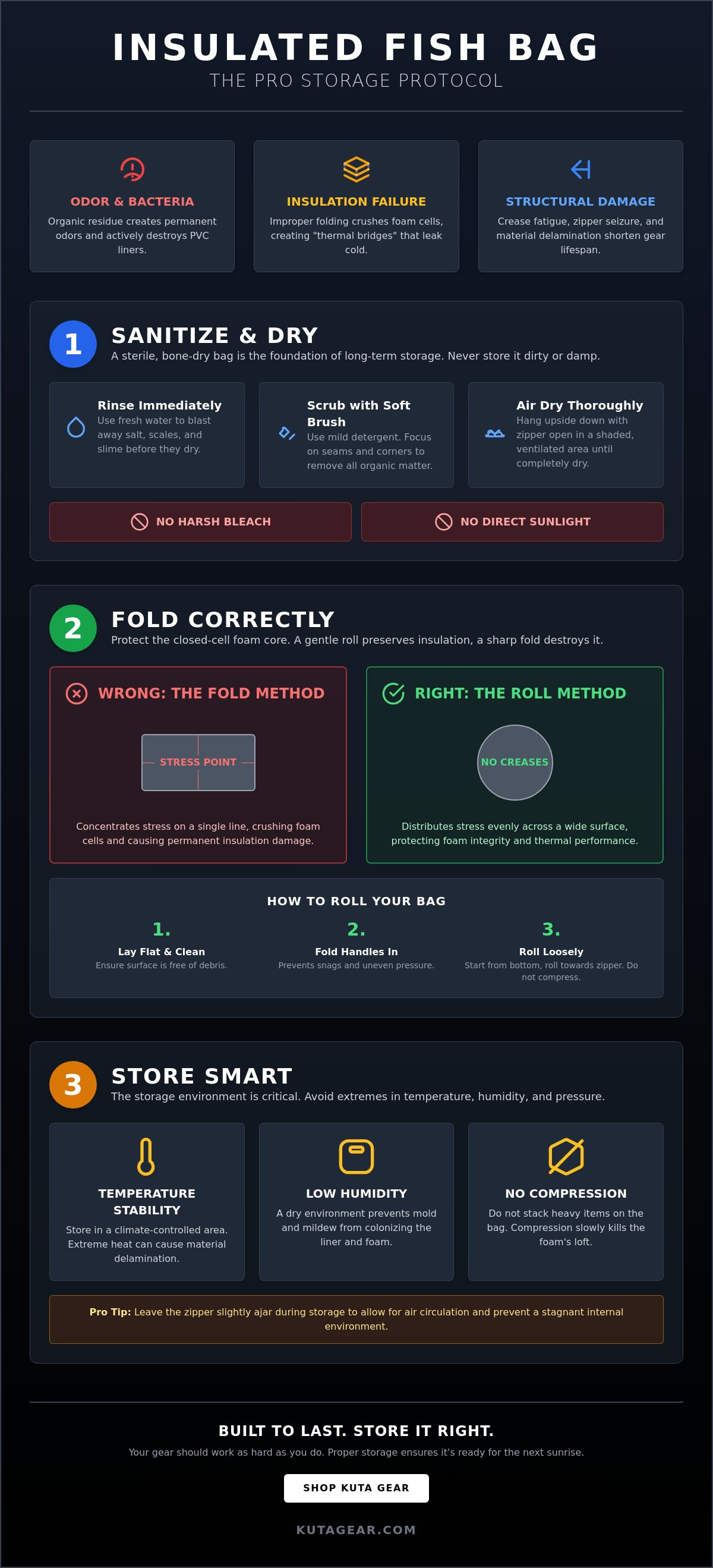
Never store a bag with organic residue. It's a rookie mistake that ends in a biohazard. Bacteria doesn't just smell; it actively destroys PVC liners. When fish blood and slime sit in a sealed environment, they break down the chemical bonds of the waterproof coating. If you want to know how to fold and store a large fish bag, you must start with a sterile surface. Clean gear lasts. Dirty gear rots.
Maintenance begins with these non-negotiable steps:
- Rinse immediately: Use fresh water to blast away salt and scales. Salt is an abrasive that grinds down seams and hardware. Do this before the slime dries.
- Break down oils: Apply a mild, non-abrasive detergent. Fish oils are persistent. They require a surfactant to lift them from the PVC surface without stripping the material.
- Scrub the seams: Biological matter accumulates in the stitching. Use a soft brush to ensure these areas are clear. If you miss a spot, you're incubating mold.
The integrity of your gear depends on the liner. Understanding how insulated containers work highlights the importance of this barrier. The liner protects the internal foam from moisture. The foam protects the catch from heat. If the liner is compromised by bacteria or harsh chemicals, the insulation will eventually fail. You're left with a heavy, waterlogged bag that cannot hold ice. It becomes dead weight on your boat.
Deep Cleaning the Inner Liner
Turn the bag inside out. Our industrial-strength liner is built for rugged use, but it requires a thorough scrub. Use a soft-bristled brush to reach into the deep corners where the bottom meets the sidewalls. Avoid harsh bleach. It's a corrosive agent that degrades the waterproof coating and weakens the stitching over time. Stick to soap and water. It's safer for the materials and just as effective for hygiene. This hygiene routine is the mandatory first step in learning how to fold and store a large fish bag for maximum longevity.
The Critical Drying Phase
Moisture is the silent killer of marine gear. Never rush this. Hang the bag upside down with the zipper fully open. Gravity pulls water out of the drainage ports and away from the internal folds. Ensure no moisture remains in the corners or around the heavy-duty handles. A damp bag stored in a hot garage is a recipe for a mildew colony. Keep the bag out of the direct midday sun. High UV exposure makes the outer PVC tarpaulin brittle. This leads to cracking during the folding process. Choose a shaded, well-ventilated area. Let the air do the work. Only when the bag is bone-dry is it ready for compact storage.
Folding for Longevity: Protecting the Insulated Core
Closed-cell foam is the backbone of your bag's performance. It consists of a dense network of trapped gas bubbles. These bubbles block heat transfer. When you force a sharp, permanent bend into this material, you crush those cells. This creates a "thermal bridge." Heat leaks in. Cold leaks out. Mastering how to fold and store a large fish bag prevents this structural failure. You want to avoid "memory" in the foam. Once a crease becomes permanent, the insulation at that point is effectively dead.
The "Roll Method" is superior to the "Fold Method" for thick, professional-grade bags. A roll distributes the stress across a wide surface area. A fold concentrates all the stress on a single line. This is why many budget bags fail after one season. They develop cracks along the fold lines. Just like you maintain and store your fishing equipment to prevent rust and corrosion, you must protect your bag's core from mechanical damage. Don't treat it like a tarp. Treat it like a precision tool.
Avoid stacking heavy objects on top of your stored gear. Compression is the enemy. If you throw a 20-pound anchor or a heavy tackle box on a folded bag, you are slowly killing the foam's loft. Keep the zipper slightly ajar. This allows for air circulation. It prevents the internal environment from becoming stagnant. If floor space allows, the best option is always to store the bag in a flat, uncompressed position. If you need a bag that can handle the rigors of the deck and the shelf, our 18" x 36" Insulated Fish Bag is built with high-density, flexible foam that resists permanent creasing.
The Step-by-Step Roll Technique
Lay the bag flat on a clean, dry surface. Ensure there are no pebbles or debris underneath that could puncture the PVC. Fold the carry handles inward toward the center. This prevents them from snagging or creating uneven pressure points during the roll. Start from the bottom of the bag and roll loosely toward the zipper. Do not pull it tight. The goal is a cylinder, not a compressed tube. This technique preserves the foam's integrity for the long haul.
Managing the 18" x 36" Footprint
If your garage shelf is too narrow for a roll, a lengthwise fold is the secondary option. Fold the bag once along its longest axis. Ensure the fold is loose and rounded. Never press it flat or sit on it to save space. Use a loose bungee cord or a Velcro strap to secure the bag. It should be just tight enough to hold the shape. If the cord is digging into the material, it is too tight. Proper storage ensures your gear stays ready for the next sunrise.
Selecting the Ideal Storage Environment
Where you park your gear is as critical as how you clean it. You have already mastered the roll technique. You have scrubbed the liners. Don't throw that effort away by tossing your gear into a hostile environment. A shed that hits 120 degrees in July is a graveyard for professional-grade equipment. Understanding how to fold and store a large fish bag requires a basic grasp of environmental science. Your goal is stability. Fluctuations in temperature and moisture are the primary catalysts for material failure.
Temperature stability is the first priority. Extreme heat is a silent killer for PVC tarpaulin. When the ambient temperature spikes, the adhesives used in the construction can soften. This leads to delamination, where the outer protective layer begins to peel away from the internal reinforcement. Once this starts, the bag loses its structural integrity and waterproof capabilities. Cold isn't much better. In freezing conditions, the material becomes brittle. If you try to unroll a frozen bag, the outer shell can crack like an egg. Aim for a consistent, moderate climate.
Humidity control is your next battle. Damp basements or humid garages are breeding grounds for mildew. Even if you dried the bag perfectly, ambient moisture can settle into the webbing of the handles or the zipper teeth. This leads to rot. Pests are the final threat. Rodents find the dense, insulated foam of a fish bag highly attractive for nesting. They will chew through industrial-strength PVC to get to it. If you store your bag in an area with known pest activity, you are providing them with a luxury apartment. Keep it sealed or keep it elevated.
Indoor vs. Outdoor Storage
Climate-controlled environments are the gold standard for high-end gear. A spare closet or a dry mudroom is ideal. If you must use a garage, never place the bag directly on a concrete floor. Concrete wicks moisture and can transfer cold or heat directly into the foam. Use a heavy-duty plastic bin to provide a secondary barrier against dust and pests. This extra layer of protection ensures your gear stays in "ready-to-fish" condition during the off-season.
Hanging Storage Pros and Cons
Hanging your bag can save valuable floor space, but it carries risks. Storing the bag by its handles for months can stretch the heavy-duty webbing. This creates weak points that may fail when the bag is fully loaded with ice and catch. If vertical storage is your only option, use a wide, padded hanger. This distributes the weight across a larger surface area. Ensure the weight is balanced. An uneven hang puts unnecessary stress on the seams and can warp the internal foam over time.
Avoiding Critical Storage Failures
Storage is where most gear goes to die. It isn't the rough seas or the heavy fish that kill a bag. It is the six months it spends neglected in a corner. If you don't know how to fold and store a large fish bag correctly, you are essentially setting a timer on its lifespan. Crease fatigue is the first major threat. When you force a tight fold, you create a permanent hinge in the insulation. This hinge becomes a thermal bridge where heat penetrates the core. Your ice melts faster. Your catch spoils sooner. Keep your folds loose or stick to the roll method to maintain the bag's structural integrity.
The second threat is zipper seizure. This is the silent killer of marine-grade storage. Salt air is corrosive. Even if the bag looks clean, microscopic salt crystals remain in the zipper teeth. Over time, these crystals bond with the metal or plastic, locking the slider in place. Forcing a seized zipper almost always leads to a blown-out track. Once the zipper fails, the bag is useless. It can no longer hold a seal. It can no longer hold temperature.
Chemical contamination is another overlooked failure point. Boat garages and sheds are often filled with gasoline, oil, and harsh solvents. These chemicals are volatile. Their vapors can delaminate the outer PVC layer or soften the adhesives used in the seams. Never store your bag near fuel tanks or cleaning supplies. Finally, beware of the "damp trap." Storing a bag that is 95% dry is the same as storing it soaking wet. That remaining 5% of moisture will migrate to the corners and start a mildew colony within 48 hours. If you want gear that survives these common failures, get a bag designed for the grind. Shop our 18" x 36" Insulated Fish Bag here.
Zipper Maintenance Protocol
Clean the zipper teeth with a stiff toothbrush to remove stubborn salt crystals. This is a mandatory step before long-term storage. Once clean, apply a light coat of food-grade silicone lubricant or specialized zipper wax. Do not use petroleum-based greases. They attract dirt and can degrade the surrounding fabric. Cycle the zipper several times to distribute the lubricant evenly. This ensures the slider moves freely when you pull the bag out for the next season.
Identifying and Fixing Mildew
If you find small mold spots, act immediately. Spot-treat the area with a simple vinegar and water solution. Vinegar kills the spores without damaging the PVC liner. Never use a pressure washer on your bag. The high-pressure stream can force water past the seams and into the insulation. This creates a permanent moisture pocket that is impossible to dry. If the bag smells funky, it is not dry enough. Open it up, put a fan on it, and wait. Patience is the only cure for a damp bag.
The Kuta Gear Advantage: Built to be Stored
Storage isn't an afterthought. It's an engineering challenge. Most manufacturers build bags to survive a retail shelf. We build them to survive the off-season grind. Our 18" x 36" Insulated Fish Bag uses high-density, flexible foam that remembers its shape. While cheap competitors use low-grade insulation that collapses under pressure, our foam maintains its loft. This flexibility is critical when you are learning how to fold and store a large fish bag. You need materials that bend without breaking. You need gear that resists the permanent "hinge" effect that kills thermal performance.
The rugged PVC tarpaulin exterior is a deliberate choice. It resists permanent creasing far better than standard nylon. Nylon is prone to fraying and holding moisture. Our industrial PVC is non-porous and resilient. We've reinforced the heavy-duty webbing handles to handle the specific stresses of transport and long-term hanging. These aren't just straps; they are integrated structural components. The Kuta Gear build quality stands as the industry benchmark for ice retention and thermal endurance.
We don't settle for "good enough." We design for the professional angler who demands reliability every time the boat leaves the dock. If your bag fails in the garage, it fails on the water. We've eliminated the weak points that lead to mid-season disasters. By focusing on material density and seam strength, we ensure your investment stays ready for the next sunrise. This is utilitarian design at its peak.
Material Specs for Longevity
- Heat-welded seams: Unlike stitched seams, our heat-welded bonds won't pull apart or leak during tight storage. They create a unified structure that handles the tension of the roll method.
- UV-resistant coatings: We treat the exterior to prevent the PVC from becoming brittle. This stops the surface from cracking when you unroll the bag after months of storage.
- Industrial zippers: Our zippers are built to withstand salt residue and periods of inactivity. They are oversized to prevent the "teeth jump" common in lighter gear.
Why the 18" x 36" Size is the Sweet Spot
Size matters for logistics. The 18" x 36" footprint provides the perfect dimensions for rolling into a compact, manageable cylinder. It isn't a struggle to handle. It fits into standard storage bins and garage shelving units without being forced. You don't have to sacrifice half your workspace to store it. This manageable size, combined with our superior foam, makes the process of how to fold and store a large fish bag efficient and effective. Order your Kuta Gear bag now for professional-grade catch care.
Ready Your Gear for the Next Run
Discipline in the off-season defines your success on the water. A bag that smells like last year or leaks heat because of a crushed core is a liability you can't afford. You now have the technical blueprint for how to fold and store a large fish bag to ensure it performs when the bite is on. Prioritize deep sanitization to protect the industrial PVC liner. Use the roll method to maintain the structural integrity of your high-density foam. Keep your gear in a stable, dry environment to prevent delamination and pest damage.
If your current equipment isn't surviving the storage grind, it's time for a professional-grade replacement. Our rugged 18" x 36" design is built for extreme marine conditions and features high-performance insulation for maximum ice retention. It's gear trusted by professional anglers nationwide who demand reliability every time they leave the dock. Upgrade to a Kuta Gear 18" x 36" Insulated Fish Bag today. Keep your catch fresh and your gear ready for the next sunrise.
Frequently Asked Questions
Can I machine wash my insulated fish bag?
No, never put your insulated fish bag in a washing machine. Mechanical agitators and high heat destroy the industrial PVC coating and crush the internal foam cells. Hand washing is the only way to preserve the bag's integrity. Use a garden hose, a soft-bristled brush, and a mild detergent to get the job done without compromising the heat-welded seams.
How do I get the fish smell out of the bag before storage?
Use a solution of white vinegar and fresh water to neutralize persistent odors. Scrub the seams and corners where blood and slime accumulate. A mild, non-abrasive detergent helps break down stubborn fish oils that a simple rinse won't touch. Rinse the bag thoroughly and ensure it is bone-dry before you begin the process of how to fold and store a large fish bag.
Is it better to store the bag open or closed?
Store the bag with the zipper slightly ajar to allow for constant air circulation. A completely sealed bag traps residual moisture and creates a breeding ground for mildew colonies. Keeping the zipper open ensures the internal environment stays fresh and dry. This prevents the "funky" smell that often greets anglers who seal their gear for the winter.
What is the best lubricant for the fish bag zipper?
Use a food-grade silicone lubricant or specialized zipper wax to maintain the slider. Avoid petroleum-based products like WD-40. They attract grit and can degrade the surrounding marine-grade PVC material. Apply the lubricant to clean teeth and cycle the zipper several times. This prevents salt-air seizure and ensures the bag is ready for immediate use on your next trip.
Will folding the bag ruin its ability to keep ice cold?
Tight, sharp folds will damage the insulation, but a loose roll preserves its performance. Closed-cell foam hates permanent creases because they create thermal bridges where heat penetrates the bag. When you master how to fold and store a large fish bag using the roll method, you protect the foam's loft. This keeps your ice solid and your catch cold for the long haul.
Can I store my fish bag in a hot garage during the summer?
No, avoid storing your bag in high-heat environments like a summer garage or shed. Extreme heat causes the outer PVC layer to delaminate from the internal reinforcement. It also makes the industrial materials brittle over time. Find a climate-controlled area or a cool, shaded corner in your mudroom. Stability is the key to preventing material failure during the off-season.
How often should I clean the bag if I use it every weekend?
Clean the bag after every single use without exception. Salt and organic residue start corroding seams and liners the moment they touch the surface. Letting slime sit for even a few days makes it much harder to remove and invites bacterial growth. A quick rinse and scrub every Sunday ensures your gear stays in professional-grade condition and remains odor-free.
What should I do if my fish bag develops a small leak?
Patch a small leak immediately using a marine-grade PVC repair kit. Clean the area around the puncture with alcohol before applying the patch to ensure a permanent bond. If water gets into the internal foam, the bag will become heavy and lose its cooling efficiency. A quick fix prevents a total gear failure and keeps your insulation dry and functional.

Also in Contact

Portable Fish Storage for Pier Fishing: The Rugged Guide to Catch Preservation

The Best Way to Chill Fish Quickly After Catch: A Professional Guide
