

How to Keep Tuna Fresh After Catching: The Pro’s Guide to Meat Quality
A tuna is a high-speed engine. It keeps running long after it hits the deck. If you don't kill the internal heat immediately, you're just hauling home expensive fertilizer. Most anglers think a bag of ice is enough. It isn't. You've seen the results. Grey meat. Mushy texture. That metallic, fishy taste that ruins a prime cut. It's a waste of time and fuel when your catch spoils before you hit the dock. Learning how to keep tuna fresh after catching requires more than a cooler. It requires immediate biological intervention to stop the "cooking" process from the inside out.
You want sushi-grade fillets at the cleaning table. We understand the frustration of watching a trophy fish lose its value in the sun. This guide will show you how to stop spoilage with professional bleeding, spiking, and cooling techniques. We'll preview the exact steps to maximize shelf life and explain why technical insulation is your best defense against the heat. With 2026 NOAA retention limits allowing for multiple bluefin per trip, you need a system that works. Don't settle for mediocre meat. Follow this pro's guide to keep your catch perfect.
Key Takeaways
- Stop the internal "burn" immediately. Spike the brain and bleed the fish to dump metabolic heat before it destroys the meat quality.
- Master how to keep tuna fresh after catching by using a saltwater ice slurry. Liquid cooling is 25 times more efficient than air-filled ice chests.
- Ditch the bulky coolers. Specialized insulated fish bags wrap around your catch to eliminate dead air space and maximize ice retention on a crowded deck.
- Protect the cold chain during processing. Keep core temperatures low by filleting in small batches and returning meat to the ice immediately.
- Invest in industrial-strength gear like the 18" x 36" Insulated Fish Bag. It's engineered for maximum durability and thermal resistance in extreme heat.
Immediate Post-Catch Intervention: The 'Kill Floor' Protocol
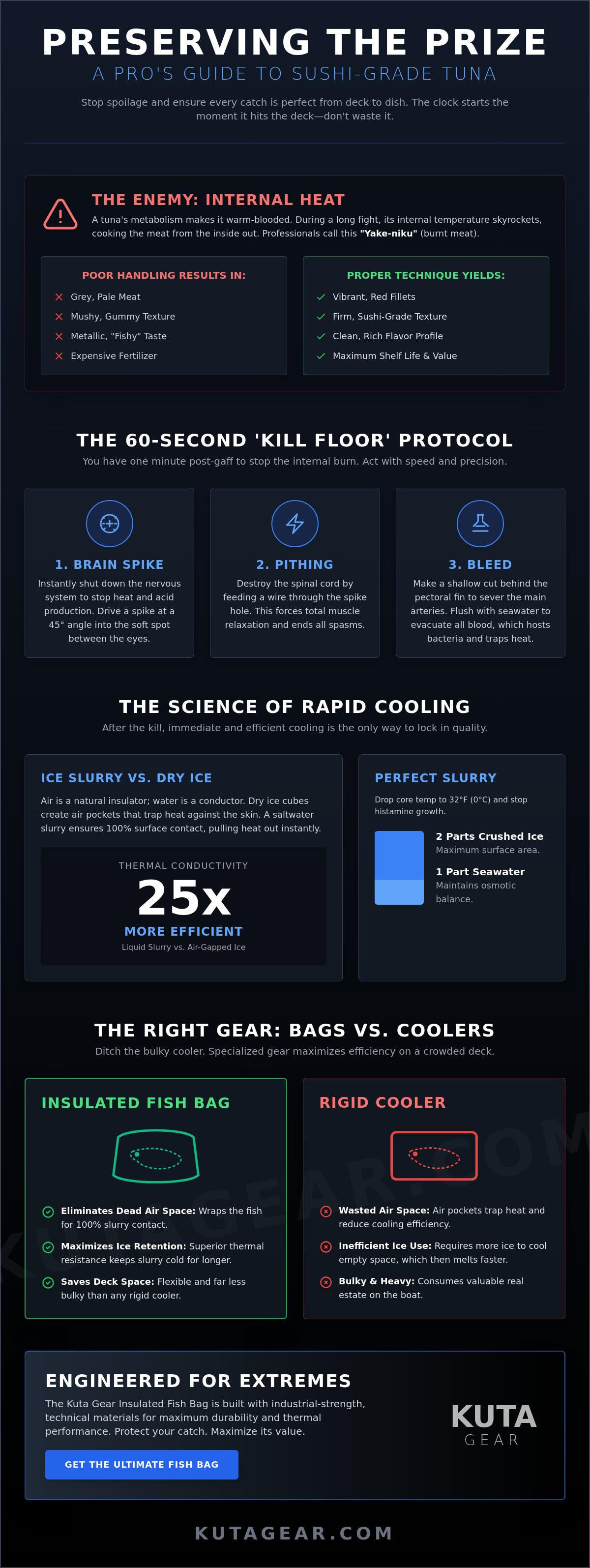
Tuna are biological engines. Unlike most species, they are warm-blooded. During a long fight, their internal temperature skyrockets. If you don't act within the first 60 seconds of the gaff, that metabolic heat stays trapped. It cooks the meat from the inside out. Professionals call this Yake-niku, or burnt meat. It turns a prize catch into pale, sour, and mushy fillets. The clock starts the moment the fish touches the deck. You need a "Kill Floor" protocol that is fast, violent, and precise. There is no room for hesitation.
High temperatures also trigger a massive release of lactic acid. This acid destroys the protein structure and ruins the texture. It's the primary reason why many anglers fail at understanding how to keep tuna fresh after catching. You aren't just storing a fish; you're managing a chemical reaction. Your toolkit must include a dedicated brain spike and a razor-sharp deck knife. Don't use a dull blade. Ragged cuts increase the surface area for bacteria and ruin the presentation of sushi-grade loins. With the 2026 NOAA Atlantic bluefin retention limits allowing up to three fish for charter boats, your deck can get crowded fast. Efficiency is your only defense against spoilage.
Brain Spiking (Ike Jime) and Pithing
The goal is total neurological shutdown. Locate the pineal window, the soft spot just above and between the eyes. Drive the spike in at a 45-degree angle. The fish will shudder once and then go limp. This stops the brain from sending signals to the muscles. No signals means no muscle spasms. No spasms means no heat production or acid release. Follow up with pithing. Feed a stainless steel wire down the neural canal through the spike hole. This destroys the spinal cord and forces the muscles to relax completely. This is a foundational step in professional methods of preserving fish to ensure the highest meat quality.
Professional Bleeding Techniques
Blood is a heat conductor and a source of bacteria. You need it out of the carcass immediately. Locate the pectoral fin. Make a shallow, two-inch incision about two fingers behind the fin base. You'll hit the main lateral arteries. Do not cut too deep. You don't want to puncture the heart or the gut cavity. The heart needs to keep beating for a few minutes to pump the blood out naturally. Bleed the fish in a dedicated bucket or hang it over the side. Use a saltwater washdown hose to flush the cuts. Cold seawater helps constrict the vessels and pushes remaining blood out of the capillaries. This prevents "blood spotting" and reduces the risk of histamine buildup, which can lead to scombroid poisoning if the fish isn't chilled immediately.
The Science of Rapid Cooling: Why an Ice Slurry is Non-Negotiable
Dry ice is for campers. If you want sushi-grade meat, you need a slurry. Air is a natural insulator. Water is a conductor. The thermal conductivity of water is approximately 25 times higher than air. When you toss a tuna onto a bed of cubes, you create air pockets. Those pockets trap heat against the skin. A saltwater ice slurry ensures 100% surface contact. It sucks the heat out of the carcass instantly. This is the only way to achieve a total thermal lockdown. Your goal is to drop the core temperature to 32°F as fast as the laws of physics allow.
Speed is about more than just texture. It's about safety. Tuna are high in histidine. When the meat stays warm, specific bacteria convert that histidine into histamine. This leads to scombroid poisoning. You can't cook histamine out, and you can't smell it. Rapid cooling is the only defense. By crashing the temperature immediately after the "Kill Floor" protocol, you stop the bacterial growth that ruins a catch. Professional-grade cooling requires a high-performance vessel. Using a heavy-duty fish bag allows you to maintain this slurry consistency without the bulk of a rigid plastic cooler.
Crafting the Perfect Tuna Slurry
Don't guess the mixture. Use a 2:1 ratio. That means two parts crushed ice to one part clean seawater. Crushed or flake ice is superior to blocks because it provides more surface area for the brine. Never use fresh water for the initial chill. Fresh water has a lower salinity than the fish's cells. Through osmosis, the tuna will absorb the fresh water. This bloats the meat and destroys the delicate flavor profile. Seawater keeps the osmotic pressure balanced. Monitor the "soup" throughout the day. It should be thick enough to submerge the fish but liquid enough to flow into every cavity.
Core Temperature Management
Patience is a requirement. A 50lb tuna has significant thermal mass. Even in a perfect slurry, it can take four to six hours to reach 32°F at the bone. Do not gut the fish before this initial chill. Opening the body cavity exposes the internal meat to bacteria before the temperature is stabilized. Keep the fish whole. Position the tuna belly-down or on its side, fully submerged in the brine. This ensures the thickest part of the loin is in direct contact with the coldest medium. This is how to keep tuna fresh after catching when you're miles from the dock and the sun is beating down on the deck.
Maximizing Cold Retention: Insulated Bags vs. Rigid Coolers
Rigid coolers are space-wasters. They are fixed boxes of air. When you're out on the water, air is the enemy of ice. A standard rotomolded cooler has hard walls that don't move. If your catch doesn't fill the entire volume, you're left with massive air pockets. These pockets act like a heat sink. They melt your ice and raise the internal temperature of your slurry. This is a critical failure point when learning how to keep tuna fresh after catching. You need a container that adapts to the fish, not the other way around. Every cubic inch of empty space is a liability.
Insulated fish bags solve the surface area problem. They wrap the catch. By cinching the bag, you eliminate dead air space. This keeps the ice in direct contact with the tuna skin. It's a more efficient use of thermal mass. On a hot deck, space is at a premium. A rigid cooler takes up the same amount of room whether it's empty or full. An insulated bag stays out of the way until you need it. Once the fish is in, it fits into corners and under gunwales where a plastic box won't go. This is about practical utility in a rugged environment. You want gear that works with your boat, not against it.
Thermal Efficiency and Insulation Thickness
Not all insulation is equal. Hollow plastic walls in cheap coolers rely on trapped air. High-performance insulated bags use thick, closed-cell foam. This material is dense. It doesn't absorb water and provides superior thermal resistance. In a 100-degree cockpit, the sun is your primary adversary. A UV-resistant outer shell reflects radiant heat away from the core. While a rigid cooler's lid can warp or leak over time, a heavy-duty bag maintains a tight seal. This ensures your ice lasts through the long run back to the dock. It's the difference between sushi and scrap meat. You need gear that stands up to the salt and the heat.
- Closed-cell foam: Provides consistent thermal barriers without the bulk or weight of hard plastic.
- UV-Resistant Shell: Prevents the sun from penetrating the insulation layer and melting your slurry.
- Airstop Design: Eliminates the circulation of warm air around the carcass to maintain a steady 32°F.
Storage Logistics on Small Boats
Small boats demand smart gear. An 18" x 36" footprint is the sweet spot for many recreational anglers. It fits into tight deck configurations where a 150-quart cooler would block the walk-around. When the trip is over, the bag folds flat. You can store it in a locker or the bed of your truck without losing half your cargo space. Drainage is also handled better. Built-in valves allow you to purge excess water without tilting a 200-pound box. This keeps the mess contained and your deck clear for the next hookup. It's about being prepared for the catch without sacrificing the limited space you have on the water.
Processing Your Catch: Maintaining the Cold Chain
The slurry did its job. Your tuna is at a stable 32°F. Now, don't blow it at the cleaning table. Most anglers fail at this final stage. They pull the fish out of the bag and let it sit in the sun while they hunt for a knife. Every minute on a warm cutting board is a step toward spoilage. This is the "Clean and Cold" rule. If the meat warms up now, you've wasted your fuel and your effort. Understanding how to keep tuna fresh after catching means protecting that core temperature until the moment the meat hits the vacuum sealer.
Work in small batches. Never pull more than one fish out of the ice at a time. High-carbon steel knives are a requirement here. They hold a razor edge through the thick skin and dense bone of a 50lb tuna. Clean cuts minimize surface area exposure. Ragged, hacked meat creates pockets where bacteria thrive. Maximize your prep time by using an insulated fish bag to keep the rest of your catch at 32°F while you work on the first loin. Speed and temperature control are your only priorities.
Filleting for Longevity
Quarter the fish. This minimizes the amount of meat exposed to the air. Locate the dark red muscle along the spine. This is the bloodline. Remove it immediately. It is high in fat and iron, which means it oxidizes faster than the rest of the loin. If you leave it, that "fishy" taste will migrate into the prime meat. Ignore the advice to rinse fillets with a garden hose. Fresh water is a contaminant. It causes the cells to swell and burst through osmosis, turning the texture mushy. If you need to clean the meat, use a cloth dampened with cold seawater or simply wipe it with a dry paper towel.
Long-Term Preservation Methods
Air is the enemy of frozen fish. Vacuum sealing is the only professional way to prevent freezer burn and dehydration. For short-term fridge storage, use the "paper towel trick." Wrap the loins tightly in high-quality paper towels and place them in a sealed bag. The towels wick away any remaining moisture that would otherwise breed bacteria. Change the towels every 24 hours. You can tell if your tuna has been temperature-abused by looking for "gaping." If the muscle fibers are separating or the meat looks opaque rather than translucent, the cold chain was broken. Stay disciplined. Professional-grade meat requires a professional-grade process.
The Kuta Gear 18" x 36" Insulated Fish Bag: Built for Performance
Success on the water ends at the plate. You've mastered the spike. You've bled the fish. You've built the perfect 2:1 seawater slurry. Now you need gear that holds that line. A standard plastic box is a liability in a hot cockpit. It's bulky. It's inefficient. The Kuta Gear 18" x 36" Insulated Fish Bag is engineered for the specific rigors of the marine environment. It's the final link in the chain of how to keep tuna fresh after catching. This isn't a luxury item. It's a utilitarian tool for anglers who value meat quality over brand prestige. Better insulation. Tougher construction. Lower cost. That's the Kuta Gear mission.
The 18" x 36" footprint is a deliberate design choice. It's the ideal dimension for mid-sized Ahi, Mahi, and Ono. It fits where rigid coolers fail. You can tuck it under a leaning post or along a gunwale. The high-performance insulation is designed for maximum ice retention. It stops the clock on spoilage when the sun is at its peak. This bag doesn't just hold fish. It maintains a professional-grade thermal environment. It's built to withstand punctures from fins and leaks from heavy brine. Built for the spray of the open Atlantic and the heat of the Gulf, it's rugged. It's reliable. It's ready.
Rugged Construction for Marine Environments
Saltwater destroys weak gear. We use industrial-strength zippers that won't corrode or seize. The handles are reinforced to manage heavy loads of ice and tuna without failing. This is equipment built for the deck, not the closet. The exterior is UV-resistant. It reflects the heat that melts your slurry. Inside, the lining is an easy-clean material. It won't hold onto fish odors or bacteria. A quick spray down at the dock and it's ready for the next trip. This is about preparedness. You need gear that stays in the fight as long as you do.
Professional Value Proposition
Corporate competitors charge for the logo. We charge for the performance. Kuta Gear offers more insulation and better durability for less money than the high-priced market alternatives. We've stripped away the marketing hyperbole to focus on what matters: ice retention and physical strength. This bag is the authoritative choice for serious anglers. It's about how to keep tuna fresh after catching without paying a retail premium. We prioritize immediate availability. You shouldn't have to wait weeks for gear when the bite is on. Get the gear that works as hard as your boat does.
Get the 18" x 36" Kuta Gear Insulated Fish Bag here
Secure Your Catch Quality
Don't let your hard work go to waste on the ride home. Meat quality starts within 60 seconds of the gaff. You've learned the protocol. Spike the brain. Bleed the arteries. Submerge the fish in a 2:1 saltwater slurry. These steps are non-negotiable. Mastering how to keep tuna fresh after catching is the difference between a wasted trip and a freezer full of sushi-grade loins. Every minute you spend in the sun without proper cooling is a minute you're losing value.
You need gear that can handle the environment. Rigid coolers create dead air and melt ice. Our heavy-duty 18" x 36" design wraps the catch to lock in the cold. It's built for the Pacific by Hawaii-based experts who understand what real heat looks like. This is professional-grade insulation for serious anglers. Stop settling for mushy fillets and metallic tastes. Upgrade your catch care with the Kuta Gear 18" x 36" Insulated Fish Bag. Get back out there and fish with confidence knowing your meat is protected.
Frequently Asked Questions
How long can tuna stay in an insulated bag before spoiling?
Tuna can stay fresh for 48 to 72 hours in a high-performance insulated bag provided you maintain a consistent 32°F ice slurry. You must monitor the ice levels and drain excess water to keep the thermal mass stable. If the ice melts and the water warms, the clock starts ticking on spoilage immediately. Constant vigilance is the price of high-quality meat at the dock.
Do I really need to spike the brain of a tuna?
Spiking the brain is mandatory for sushi-grade quality. It instantly stops the nervous system from sending signals to the muscles. This prevents the muscle spasms and heat production that lead to lactic acid buildup. Without this step, the fish cooks itself from the inside even while sitting on ice. It is the only way to ensure the meat stays relaxed and tender.
What is the best type of ice for a fish kill bag?
Crushed or flake ice is the superior choice for a fish kill bag. It provides significantly more surface area than blocks or large cubes. This allows it to melt just enough to create a dense, freezing slurry that wraps around the carcass. This is a primary factor in how to keep tuna fresh after catching. Blocks take too long to transfer cold to the skin.
Can I use a fish bag for things other than fish?
You can use an insulated fish bag for any cargo that requires thermal protection. It works for transporting cold drinks, groceries, or even wild game from the field. The heavy-duty construction handles weight and sharp edges that would puncture a standard soft-sided cooler. It is a utilitarian tool for more than just the deck. It's about having a reliable, durable vessel for any outdoor task.
How do I get the fish smell out of my Kuta Gear bag?
Use a solution of mild dish soap and a small amount of bleach to scrub the interior lining. Rinse it thoroughly with fresh water and hang the bag upside down with the zipper open to air dry completely. The non-porous lining is designed to resist odors, but proper ventilation after cleaning is the only way to ensure it stays fresh. Don't store it while it's damp.
Is it better to gut the tuna before putting it in the slurry?
Keep the fish whole for the initial cooling phase. Opening the body cavity before the core temperature has dropped to 32°F exposes the internal meat to bacteria and warm air. Chill the tuna whole in your slurry for at least four hours before you begin processing. This is a critical step in how to keep tuna fresh after catching. It protects the loins from contamination.
How much ice do I need for a 50lb tuna?
You need at least 50 to 75 pounds of ice for a 50lb tuna. The goal is a 1:1 or 1.5:1 ratio of ice to fish weight. You must have enough ice to create a deep slurry that fully submerges the carcass. If you skimp on ice, the tuna's internal heat will win the battle and melt your cooling medium before the core is chilled. Preparedness is the only way to win.
What happens if I don't bleed my tuna immediately?
Failing to bleed the fish leads to blood spotting and a strong metallic taste in the meat. Blood is a heat conductor and a breeding ground for bacteria. If it stays in the vessels, it facilitates the buildup of histamines and lactic acid. This ruins the color and texture of the loins, turning them grey and sour. You lose the value of the catch immediately.

Also in Contact

Portable Fish Storage for Pier Fishing: The Rugged Guide to Catch Preservation

The Best Way to Chill Fish Quickly After Catch: A Professional Guide
