

How to Prevent Fish Spoilage on Long Trips: The Angler’s Tactical Guide
Toxic levels of histamine can form in as little as six hours if you don't drop the core temperature of your catch immediately. It's a tactical race against enzymatic activity. Most anglers lose that race because they rely on outdated gear and lazy cooling habits. If you've ever tossed a trophy catch because of "fishy" odors or mushy meat, you know the frustration of wasted effort. Learning how to prevent fish spoilage on long trips isn't just about food safety. It's about respecting the harvest and ensuring your fillets stay pristine from the offshore canyon to the kitchen table.
You need a system that works as hard as you do. You're about to master the industrial-strength techniques and gear required to keep your catch kitchen-grade for days, not hours. We're moving past bulky hard coolers that eat up your deck space and ice that melts before the sun hits its peak. This guide covers the specific thermal shock protocols and gear configurations required for 48-hour ice retention. You'll learn how to maximize your truck or boat space while maintaining the strict cooling standards necessary to stop spoilage in its tracks.
Key Takeaways
- Stop enzymatic rot before it starts by employing the Pro-Angler Protocol of bleeding and brain spiking immediately after the catch.
- Achieve rapid thermal shock using a 2:1 ice-to-fish ratio and saltwater slurries to drop core temperatures to 33°F within minutes.
- Master how to prevent fish spoilage on long trips by maintaining a strict cold chain that inhibits bacterial growth for over 48 hours.
- Maximize deck space and cooling efficiency by utilizing insulated fish bags that offer superior surface area contact compared to rigid hard coolers.
- Ensure multi-day ice retention on extended hauls by investing in industrial-strength gear like a high-density 18" x 36" Insulated Fish Bag.
The Spoilage Clock: Understanding Why Fish Rot
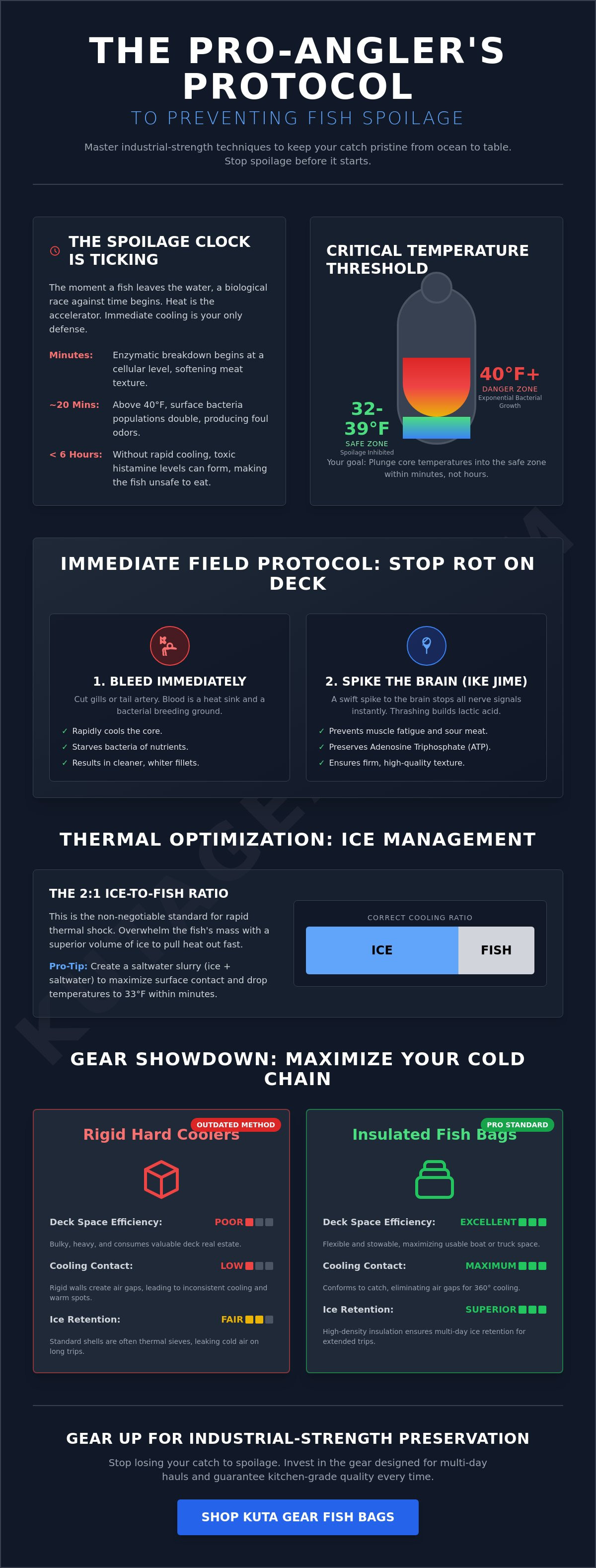
The moment you pull a fish over the gunwale, its biology turns against you. Death triggers an immediate chemical chain reaction. Muscle tissue begins to fail. Understanding the science of decay is the first step in learning how to prevent fish spoilage on long trips. It isn't just about dumping a bag of ice in a bin. It's about managing a biological countdown that accelerates with every degree of ambient heat. You are in a race against microscopic forces that want to turn your prize into trash.
Enzymatic vs. Bacterial Spoilage
Enzymes are the internal demolition crew. They exist to digest food while the fish is alive. Once the heart stops, they start digesting the muscle tissue instead. This internal breakdown softens the meat and ruins the texture. Bacteria provide the second front of the attack. They live on the skin and in the gut. As they consume proteins, they produce trimethylamine (TMA). This is the compound responsible for that foul, ammonia-like smell. Spoilage is a chemical race against time where the finish line is a wasted harvest. Various methods of preserving fish exist to slow this process, but temperature control remains the most critical variable for the recreational angler. Enzymes don't sleep. Bacteria don't negotiate.
The Critical 40-Degree Threshold
Temperature is your only real lever. The safe zone for fresh catch sits between 32°F and 39°F. Once the internal temperature crosses 40°F, bacterial growth turns exponential. It doesn't just double; it explodes. On long trips, the sun is a constant threat. Ambient heat penetrates standard plastic cooler shells with ease. This creates dangerous micro-climates. The fish at the bottom might stay cold, but the ones on top simmer in 50-degree air gaps. If you want to know how to prevent fish spoilage on long trips, you must eliminate these thermal gaps. Plastic shells are often thermal sieves. You need a seal that holds.
Time multiplies your failure points. A four-hour run back to the dock is manageable. A 48-hour expedition is a different beast. Every hour your catch sits at deck temperature equals one full day of lost shelf life. Oxidation of fats begins immediately. Heat accelerates this process, turning healthy oils into rancid, bitter compounds. If you don't drop the core temperature to near-freezing within the first hour, you've already lost the battle. Consider these hard facts:
- Enzymatic breakdown starts at the cellular level within minutes of death.
- Surface bacteria multiply every 20 minutes once you cross the 40-degree mark.
- Fat oxidation turns pristine fillets into bitter, low-quality meat that smells before it hits the pan.
Immediate Field Prep: The Pro-Angler Protocol
Mastering how to prevent fish spoilage on long trips begins the second the fish hits the deck. You cannot wait for the boat to stop. You cannot wait for the ice to settle. Professional results require immediate intervention. If you want fillets that look and taste like they came from a high-end sushi bar, you must kill the fish twice: first its life, then its chemistry. Most recreational anglers fail here. They toss a thrashing fish into a dry bin and wonder why the meat turns grey. Don't be that guy.
The Science of Bleeding
Blood is your enemy. It is a massive heat sink that holds core temperature high for hours. It is also the primary medium where bacteria thrive. For pelagic species like tuna or mackerel, the dark meat is heavily vascularized. If you don't bleed them, that blood remains in the tissue. This accelerates the spoilage clock. Cut the gills or the tail. Let the heart pump the carcass clean while the fish is still in the water or a dedicated bleed bucket. This step is non-negotiable for anyone serious about meat quality. It keeps your storage area cleaner and your fillets whiter.
Ike Jime: The Gold Standard
Spiking the brain, or Ike Jime, is the professional standard. When a fish thrashes on deck, it burns through its Adenosine Triphosphate (ATP). This process creates lactic acid. Lactic acid leads to mushy, sour fillets. By spiking the brain immediately, you stop the nervous system. The muscles stay relaxed. The ATP is preserved. You get firm, high-quality meat every time. A simple sharpened spike is all you need for this professional-grade prep. It is the fastest way to stop the clock.
For trips exceeding 12 hours, you must remove the bacteria factories. This means the guts and the gills. These areas are loaded with the enzymes and microbes that drive decay. Once you've removed them, rinse the cavity with clean saltwater. Never use fresh water at this stage. Fresh water causes osmotic tissue damage. It makes the meat swell and soften. Stick to the environment the fish came from. Following a strict pro-angler protocol for icing fish keeps the harvest stable for the long haul. Tossing a spiked, bled fish into a high-performance insulated fish bag is the final step in the field prep cycle. It ensures the work you did on deck isn't wasted by poor storage. This is how you protect your investment in time and fuel.
Thermal Optimization: Ice Management for Long Hauls
Ice is your primary logistics tool. If you skimp on quantity, you've already failed. The industry standard is a 2:1 ratio. That's two pounds of ice for every one pound of catch. Most weekend warriors do the opposite. They bring a 20-pound bag for a 50-pound tuna. This is a recipe for disaster. On extended expeditions, your ice is your life support system. Learning how to prevent fish spoilage on long trips requires viewing ice as a finite fuel source. You must manage its burn rate with precision.
The Saltwater Slurry Method
Air is a poor conductor. Ice cubes alone leave warm pockets that harbor bacteria. To drop core temperatures instantly, use a saltwater slurry. Mix crushed ice with clean seawater and a handful of rock salt. This creates a sub-freezing liquid bath. Liquid contact cools tissue 20 times faster than air or static ice cubes. It surrounds the fish completely. There are no air gaps. No hot spots. Once the core temperature hits 33°F, you can drain the excess liquid. Transition to a dry ice bed to maintain that temperature without water-logging the meat.
Ice Types: Cubes vs. Blocks vs. Dry Ice
Surface area determines cooling speed. Blocks offer longevity. Cubes offer contact. For a 3-day return trip, use a hybrid approach. Line the bottom of your storage with blocks for sustained thermal mass. Fill the gaps with crushed ice for immediate thermal shock. Thermal mass is the total cooling energy required to counteract ambient heat penetration for the duration of your haul. Avoid dry ice for fresh fillets. It causes localized freezer burn and carbon dioxide buildup. This can alter the pH of the meat and ruin the flavor profile you worked so hard to protect.
Pre-chilling is non-negotiable. Don't throw fresh catch into a hot container. Load your ice at least one hour before the first fish hits the deck. This cools the insulation and the inner liner. It prevents the initial ice melt shock when the storage unit starts working. Manage your drainage carefully. Sitting in stagnant meltwater is a primary cause of bacterial bloom and tissue softening. Keep the drain plug cracked or purge the water every four hours. High-performance gear like an 18" x 36" Insulated Fish Bag makes this management simple. It keeps the cold in and the rot out. This is how to prevent fish spoilage on long trips without babysitting a leaking plastic box all day.
Rigid Coolers vs. Insulated Fish Bags
Most anglers default to rotomolded coolers because they're familiar. They're heavy. They're bulky. They're often the wrong tool for the job. When you're figuring out how to prevent fish spoilage on long trips, the geometry of your storage matters as much as the ice. A rigid box is a fixed volume. A fish bag is dynamic. It adapts to the catch. If you want to keep your fillets pristine for 48 hours or more, you have to look at the physics of heat transfer. You need gear that works with your catch, not against it.
The Air Gap Problem
Air is the enemy of ice. Rigid coolers are rarely packed to the brim. This leaves massive air pockets. These pockets circulate warm air every time the lid opens. They accelerate ice melt significantly. In a high-quality fish bag, you squeeze the air out before sealing the zipper. The insulation wraps directly around the catch. This creates a "locking" effect. It does more than just save ice. It stops the fish from sliding during transport. In a rigid cooler, every wave or turn in the truck bed slams your catch against hard plastic. This causes internal bruising and tissue damage. Bruised meat spoils faster. The high-density foam used in professional bags often provides a better R-value than the hollow plastic shells of mass-market coolers. You get industrial-strength thermal protection without the dead weight.
Logistics for Long Trips
Space is always at a premium on a long-range haul. A 150qt cooler is a permanent fixture. It takes up the same deck or truck bed space whether it's full of trophy tuna or completely empty. An insulated bag is different. It folds flat when the mission is over. It stores in a locker or behind a seat. These bags are built from industrial PVC. This material won't crack in freezing temperatures or shatter upon impact like brittle plastic. It's designed for the salt and the sun. Cleaning is a five-minute hose-down. There are no deep corners or molded hinges to harbor bacteria. For those hauling catch in a truck bed, Kuta Gear’s 18" x 36" bag is the tactical choice. It fits into narrow spaces where traditional coolers fail. It provides the durability of a hard shell with the efficiency of a flexible liner. If you are serious about how to prevent fish spoilage on long trips, you need gear that maximizes ice retention while minimizing footprint. Stop fighting with bulky boxes. Upgrade to an industrial-grade 18" x 36" Insulated Fish Bag today and see the difference in your fillets.
Kuta Gear: Industrial Strength Preservation
Professional results require professional equipment. You've done the hard work on the deck. You've bled the catch. You've pre-chilled the space. Now you need a container that won't quit. This is how to prevent fish spoilage on long trips when the stakes are high and the sun is relentless. Kuta Gear is built for this specific environment. It's not a lifestyle accessory. It's a tactical necessity for the long-range angler. Our design philosophy is simple. We prioritize function over aesthetics. Most brands spend their budget on influencers and prestige marketing. We spend ours on material density and seam strength. Our high-density insulation is designed for multi-day ice retention in high-heat conditions. It doesn't just hold ice; it maintains a sub-40°F environment when others fail.
Built for Performance, Not Prestige
We don't do marketing fluff. We don't care about social status. We care about the R-value of our foam. Our gear uses industrial-grade materials that mock standard retail coolers. The heavy-duty zippers are built to handle grit and salt. The outer shell is engineered to resist intense UV exposure without cracking. This is reliability that outlasts corporate competitors. We focus on the working environment of the seasoned expert. We cut the retail margins to provide a price advantage that makes sense. It's a tool for the job. No more, no less. It's about readiness and authenticity. If the gear can't handle a three-day haul in a salt-soaked truck bed, it doesn't belong in our catalog.
The 18" x 36" Advantage
Dimensions matter in a tight cockpit. The 18" x 36" footprint is the sweet spot for the modern angler. It fits perfectly against the bulkhead of most boat decks. It slides into truck beds without blocking your other equipment. This bag is versatile enough for heavy bottom fish or mid-sized pelagics. You get maximum thermal efficiency in a compact form factor. It is the ultimate solution for how to prevent fish spoilage on long trips. You get the space efficiency of a bag with the insulation of a vault. Stop paying for a corporate logo. Start paying for industrial-strength performance. Our leak-proof construction ensures your vehicle stays clean while your catch stays cold.
Secure Your Harvest for the Long Haul
The mission is clear. You've got the tactics to win the race against the spoilage clock. Immediate bleeding and brain spiking stop the biological breakdown. Saltwater slurries and strict 2:1 ice management provide the thermal shock required for multi-day success. Mastering how to prevent fish spoilage on long trips isn't about luck. It's about professional-grade discipline and using gear that doesn't quit when the heat rises. Don't waste fuel and time only to bring home a box of mush.
Respect the resource. Protect your investment. Upgrade your catch care with the Kuta Gear 18" x 36" Insulated Fish Bag. Our rugged 18" x 36" design features industrial-grade insulation built by anglers for anglers. It's engineered to hold the cold and resist the salt. It's the only way to ensure your fillets hit the table in pristine condition. Get back to the dock with confidence. Your next trophy deserves it.
Frequently Asked Questions
How long can fish stay fresh in an insulated bag?
Fish stay kitchen-grade for 48 to 72 hours in a high-density insulated bag. This assumes you follow the 2:1 ice ratio and maintain a closed thermal seal. Proper field prep like bleeding and spiking is mandatory for these extended timelines. Without immediate cooling, you'll lose the harvest in under 12 hours regardless of the bag quality.
Should I gut my fish before putting them in the bag?
Gut and gill your catch for any trip exceeding 12 hours. The stomach and gills are bacteria factories that drive decay from the inside out. Removing these organs immediately stops the internal clock. If you are only running a few hours back to the dock, whole-icing is acceptable, but long-range hauls require a clean cavity.
Is it better to use block ice or crushed ice for long trips?
A hybrid of block and crushed ice is the tactical choice for multi-day hauls. Use blocks at the base for thermal longevity and sustained cooling mass. Layer crushed ice over the fish to ensure 100% surface contact and rapid heat transfer. This combination is a core part of how to prevent fish spoilage on long trips when ambient temperatures are high.
How do I stop my fish bag from smelling after a long trip?
Stop odors by cleaning the bag immediately after the catch is removed. Use a solution of mild dish soap and a small amount of bleach or specialized enzyme cleaner. Scrub the corners and the zipper track where slime accumulates. Air dry the bag completely while it's inside out to prevent mold growth during storage.
Can I use dry ice in an insulated fish bag?
Avoid dry ice in flexible fish bags. It creates localized freezer burn on the fillets and can make the PVC liner brittle over time. Carbon dioxide gas buildup can also stress the seams and zippers. Stick to saltwater slurries and traditional ice for the best meat quality and gear longevity.
How much ice do I need for a 48-hour trip?
Stick to the 2:1 ratio of ice to fish for a 48-hour return. If you expect a 50-pound haul, you need 100 pounds of ice. This ensures enough thermal mass survives the initial cooling phase and the ambient heat of a long truck ride. Knowing how to prevent fish spoilage on long trips means never underestimating your ice requirements.
Do insulated fish bags leak in the back of a truck?
Industrial-grade bags feature heat-sealed seams and heavy-duty zippers to prevent leakage. Cheaper retail versions often seep at the corners or through the zipper teeth. Ensure the bag is upright and the zipper is fully engaged. A quality 18" x 36" Insulated Fish Bag keeps the meltwater inside the bag and off your truck bed.
What is the best way to clean a heavy-duty fish bag?
Hose the bag down with fresh water to remove salt and scales. Use a soft brush with a non-abrasive cleaner to scrub the interior liner. Pay attention to the zipper gussets. Hang the bag upside down with the zipper open to ensure every drop of moisture evaporates before you fold it for storage.

Also in Contact

Portable Fish Storage for Pier Fishing: The Rugged Guide to Catch Preservation

The Best Way to Chill Fish Quickly After Catch: A Professional Guide
