

How to Transport Fish on a Plane: The Ultimate Angler’s Guide to Air Travel
Checking a massive plastic cooler is a rookie mistake. It costs more in baggage fees than the catch is worth. Most anglers think they need a heavy, hard-sided box to get their limits home. They're wrong. You need thermal density without the dead weight. Knowing how to transport fish on a plane is about outsmarting the airlines and the TSA. It isn't about luck.
We know the anxiety. You spent thousands on a charter. Now you're worried about fillets spoiling during a long layover. You're worried about leaks. It's frustrating to see American Airlines charging $50 for a first bag while United hits you with $45. This guide changes that. You'll master the latest TSA regulations for ice. You'll learn professional packing techniques to keep your catch frozen until you hit your front door. We're breaking down the FAA's 5.5-pound dry ice limit, airline-specific fees, and why soft-sided insulation beats plastic every time.
Key Takeaways
- Understand the TSA "frozen solid" mandate for gel packs to ensure your cooling agents clear security without delay.
- Master how to transport fish on a plane by building a high-density thermal block that locks in cold for long-haul travel.
- Trade heavy hard coolers for specialized insulated bags to maximize your weight limit and avoid surging airline baggage fees.
- Implement professional vacuum sealing and field dressing techniques to prevent leaks and preserve meat quality in the cargo hold.
TSA and Airline Regulations for Flying with Fish
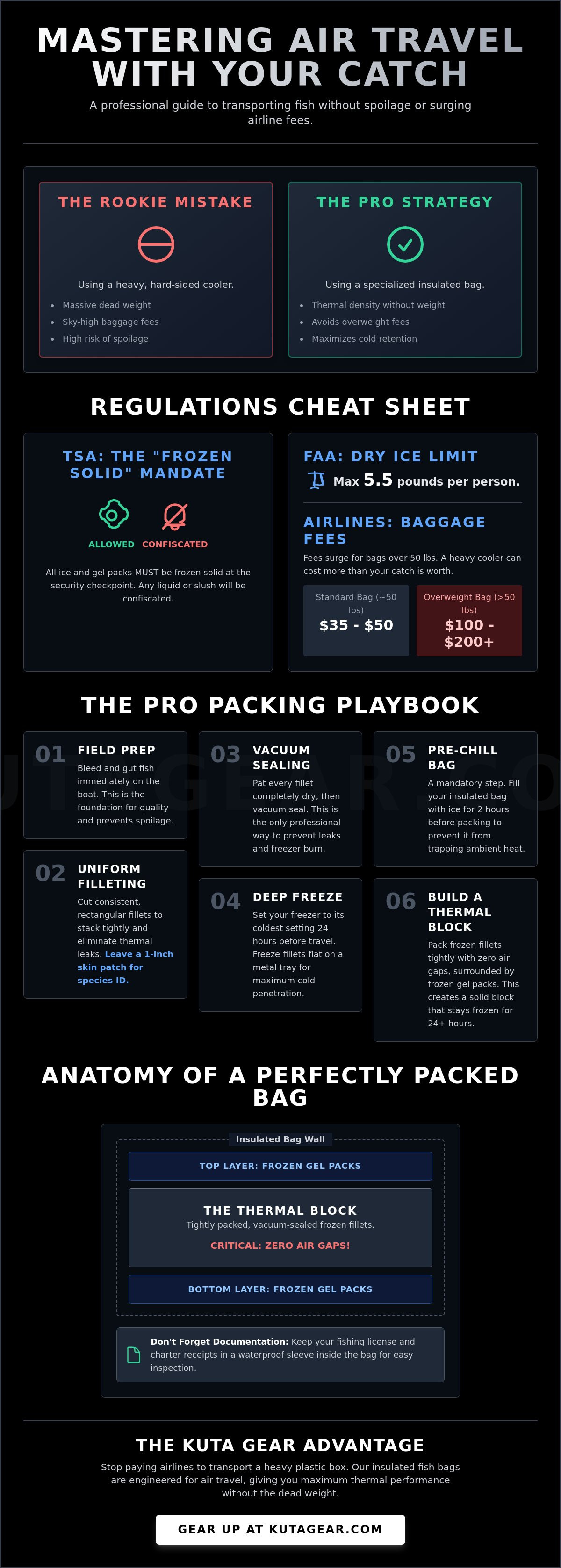
TSA doesn't care about your trophy catch. They care about security. Fresh and frozen fish are permitted in both carry-on and checked bags. The fish itself is rarely the issue. The cooling agent is the primary fail-point. TSA enforces a strict "frozen solid" rule for all ice and gel packs at the security checkpoint. If there is a single drop of liquid or a hint of slush at the bottom of your container, the officer will confiscate the cooling source. Your fish will rot before you reach the gate. This is a logistical failure that can be avoided with proper preparation.
Mastering how to transport fish on a plane means knowing the financial stakes. Airlines classify fish as "perishable baggage." This is a critical distinction. It means the carrier is not liable for spoilage, even if the flight is delayed for hours on the tarmac. You own the risk. You also own the weight. As of early 2026, Delta and United have increased checked bag fees. A standard bag now costs between $35 and $45. If your cooler exceeds the 50-pound limit, you could face overweight fees that surpass the retail value of the fillets. Efficiency isn't just about cold; it's about the bottom line.
International travel adds a layer of agricultural red tape. Domestic flights within the US are straightforward, but crossing borders requires a formal declaration. Customs agents look for invasive species and illegal harvests. When transporting fish by air, you must ensure your haul is compliant with both the point of origin and the destination. Failure to declare can result in heavy fines and the immediate destruction of your catch.
Carry-On vs. Checked Baggage Rules
Checked baggage is the professional choice for serious anglers. It allows for a larger thermal block that maintains sub-zero temperatures for 24 hours or more. Carry-on is an option for a small bag of fillets, but it's risky. If your package starts to sweat or leak, the cabin crew can remove it due to "odor leakage" complaints. One loose seal can ruin a flight for everyone in your row. Always use vacuum-sealed bags. Never rely on a standard zip-top bag for air travel.
Wildlife Identification Requirements
Game wardens and federal agents require proof of what's in your bag. Most jurisdictions mandate that a patch of skin remains on the fillet for species identification. This prevents the illegal transport of protected species. Keep your fishing license and any charter receipts in a waterproof sleeve inside your bag. It proves a legal harvest. Documentation is just as important as insulation when you're moving meat across state lines.
Preparing and Packaging Your Catch for Long-Haul Travel
Quality meat starts with a clean kill. If you don't bleed and gut your fish immediately, you're already losing the battle against spoilage. Blood trapped in the veins ruins the flavor and accelerates bacterial growth. Once the fish is on the deck, bleed it, gut it, and get it on ice. This is the foundation of how to transport fish on a plane. You can't fix poor field dressing with a high-end cooler later. Do the work early to ensure your fillets remain in pristine condition.
Vacuum sealing is the only professional way to package fish for air travel. It eliminates air pockets that cause freezer burn and lead to rapid temperature spikes. When you're prepping your bags, remember that wildlife officers often require a patch of skin on the fillet for species identification. Leave a one-inch square of skin on each piece to avoid legal headaches during an inspection. Before you seal the bags, consult the latest TSA regulations for flying with fish to ensure your packaging meets current security standards. Moisture is the enemy of a good seal. Pat every fillet completely dry with paper towels before placing it in the bag.
Temperature management is a game of physics. You want your fish to act as its own cooling source. This requires a deep freeze strategy that starts long before you leave for the airport. Pre-chilling your insulated fish bag is a mandatory step. If you put frozen meat into a warm bag, the insulation will actually trap the heat inside, causing the outer layers of your fish to thaw. Place your bag in a walk-in freezer or fill it with ice for two hours before packing your catch.
Professional Filleting for Air Travel
Uniformity is key to thermal mass. Cut your fillets into consistent, rectangular sizes. This allows you to stack them tightly with zero air gaps. Air gaps are thermal leaks. Label every bag with the species name, date of catch, and approximate weight. Use a permanent marker that won't smear when wet. Organized packing makes the TSA inspection process faster and keeps your thermal block intact longer.
The Deep Freeze Strategy
Your home freezer isn't cold enough for a quick turn. Lower the setting to its absolute coldest point 24 hours before travel. Stack your vacuum-sealed fillets flat on a metal tray to maximize surface area contact. You need the core temperature of the fish to be solid. Avoid "flash freezing" at the last minute. If the center of the fillet is soft, it will bleed heat into the rest of the bag during your flight. Aim for a 24-hour deep soak in sub-zero temperatures.
Choosing the Right Gear: Insulated Bags vs. Hard Coolers
Rigid coolers are for the boat deck. They don't belong in a cargo hold. They are heavy, loud, and inefficient for long-haul logistics. Every pound of plastic is a pound of meat you leave at the dock. Mastering how to transport fish on a plane requires a shift in gear. You need industrial-strength insulation without the dead weight of a roto-molded shell. A plastic box is a liability. A specialized bag is a tool designed for a specific job. When you're figuring out how to transport fish on a plane, the ratio of gear weight to meat weight is the only metric that matters. You want to pay the airline to move your catch, not a 20-pound plastic box.
Soft-sided fish bags are the professional solution. They offer a superior insulation-to-weight ratio. They are versatile and unapologetically direct in their purpose. You can fold them into your suitcase on the way to your destination and fill them for the flight home. Whether you are dealing with frozen fillets or checking TSA rules for transporting live fish, your gear must be utilitarian. It must be built with heavy-duty PVC and puncture-resistant liners. This isn't luxury gear. It's survival gear for your catch. It’s about constant readiness.
Why Weight Matters for Airline Fees
Most domestic carriers set the checked bag limit at 50 pounds. A heavy plastic cooler eats up nearly half of that allowance before you add a single fillet. If you hit 51 pounds, you'll face heavy surcharges. As of early 2026, baggage fees have increased across the board:
- Delta Air Lines: $35 for the first bag and $45 for the second.
- United Airlines: $45 for the first bag and $55 for the second.
- American Airlines: $50 for the first bag ($45 if paid online) and $60 for the second.
Those fees are for standard weight. Overweight surcharges can reach $200. It's a retail margin killer. Minimize your gear weight to maximize your meat weight. Use a bag that weighs less than five pounds. It's the only way to get your full limit home without paying a ransom at the ticket counter. It's about preparedness. It's about economic efficiency. Don't give your hard-earned money to the airlines.
Thermal Retention and Leak Prevention
Cold retention is about thermal density. Rigid coolers have fixed walls that trap dead air. Air is a heat conductor. Soft bags collapse around the catch. They eliminate air pockets that cause rapid thawing. High-quality bags use thick, closed-cell foam to trap sub-zero air for 24 hours or more. Look for heat-sealed seams and industrial-strength zippers. A "suitcase disaster" occurs when a cheap bag leaks fish slime into the cargo hold. Don't be that guy. Use puncture-resistant materials that withstand the rough handling of airport baggage systems. A bag that survives the cargo hold is a bag that saves your harvest. Reliability and authenticity beat aesthetics every time. Every sentence is a fact. Every layer of foam is a barrier against failure.
How to Pack Your Fish Bag for Maximum Cold Retention
Packing is a tactical operation. If you throw fillets loosely into a bag, you're inviting failure. Cold retention relies on thermal density. You need to create a single, frozen mass that resists external heat. Start by lining the bottom of your bag with a layer of frozen gel packs. These must be 100% solid to clear security. Place your heaviest, most solid fillets on top of this base. This is the core of how to transport fish on a plane. It turns your catch into its own heat sink. One solid block stays frozen longer than twenty individual pieces.
Protection is multi-layered. Even the best gear can face extreme pressure in a cargo hold. Place your entire insulated bag inside a secondary heavy-duty plastic liner. This is your insurance policy against a suitcase disaster. If a vacuum seal fails, the liner catches the brine. Reinforce the zipper with heavy-duty tape before checking it at the counter. Airlines are aggressive with baggage. Preparedness means assuming the worst handling and packing accordingly. For the most reliable results, use a professional 18" x 36" insulated fish bag designed for these specific stresses.
Managing Dry Ice and Gel Packs
Dry ice is the gold standard for flights exceeding six hours. The FAA limits every passenger to 5.5 pounds (2.5 kg) of dry ice. You must declare it at the check-in counter. The package must be labeled "Dry Ice" or "Carbon Dioxide, Solid." Carbon dioxide gas expands. If you airtight seal a bag with dry ice, it will rupture. This applies to your secondary liners too. Ensure the gas can escape safely while the cold stays trapped. Knowing how to transport fish on a plane with dry ice requires strict adherence to these safety protocols. For shorter domestic runs, frozen gel packs are easier. They don't require declarations and clear TSA without the venting headache.
Eliminating Air Pockets
Dead air is a heat conductor. It's the enemy of your frozen catch. If your bag isn't full, fill the empty space with crumpled newspaper or bubble wrap. This prevents air from circulating and thawing your fillets. Tightly roll the bag to compress the contents and force out as much air as possible. Check the seal twice. A loose zipper is a thermal leak. Your goal is zero movement and zero air. This is how you ensure your meat stays in pristine condition from the tarmac to the kitchen table.
The Kuta Gear Advantage for National Air Travel
The 18" x 36" insulated fish bag is built for logistics. It isn't just a container. It's a specialized tool for national air travel. Most airlines enforce a 62-linear-inch limit for standard checked baggage. Our bag hits that sweet spot. It maximizes internal volume while respecting airline dimensions. You don't need a bulky plastic box that triggers oversize fees. You need gear that fits the system. This bag survives the pressure of a pressurized cargo hold and the rough hands of baggage handlers. It keeps your catch frozen for up to 48 hours. That is enough time for a cross-country flight and a delayed connection. It is built for the reality of modern travel.
Industrial-strength handles are mandatory. Airport terminals are long. You need a grip that won't fail when the bag is loaded to the 50-pound airline limit. This gear is about constant readiness. It’s about getting your harvest home in pristine condition. Knowing how to transport fish on a plane is half the battle. Having the right equipment is the other half. We prioritize performance over aesthetics. We avoid marketing hyperbole. We deliver a product that works as hard as you do.
Engineered for Extreme Conditions
Punctures are the primary cause of bag failure. Fish fins and broken bones are sharp. Our bag uses heavy-duty, puncture-resistant materials to prevent leaks in the cargo hold. The interior is industrial-grade and easy to clean. It doesn't hold onto "fishy" smells after the trip. We offer professional-grade performance at a disruptive price point. We don't believe in the high retail margins of corporate competitors. We believe in reliability and value. Every seam is a barrier against failure.
From Boat to Plane: A Seamless Transition
Efficiency is the mark of a seasoned expert. Use the same bag on the boat as you do for the flight home. It saves space in your vehicle. It folds flat in your luggage when empty. There is no need for multiple coolers or wasted storage. This is how to transport fish on a plane without the clutter. It's a streamlined process for the serious angler who values preparedness. Get your 18" x 36" insulated fish bag for your next trip. Stop overpaying for inferior, bulky gear that costs you more at the ticket counter.
Secure Your Catch for the Long Haul
Your trip doesn't end at the dock. It ends when the first fillet hits the pan at home. Success depends on preparation and the right gear. You've mastered the TSA "frozen solid" rule. You know how to build a thermal block by packing fillets tight and eliminating air pockets. These aren't suggestions. They are the protocols for any professional angler who values their harvest. Stop letting airlines take your money through overweight fees for bulky plastic coolers. Use gear that is built for the mission.
Mastering how to transport fish on a plane is about outsmarting the logistics of modern travel. It's about readiness. You need gear that withstands the pressure of a cargo hold and the weight of a full limit. Our rugged 18" x 36" design is insider-approved for professional transport. It provides industrial-strength durability without the dead weight. Don't leave your catch to chance. Shop the 18" x 36" Insulated Fish Bag at Kuta Gear and ensure your hard work pays off. Get your limits home in pristine condition. Your next adventure is waiting. Be ready for it.
Frequently Asked Questions
Can I use real ice to transport fish on a plane?
Real ice is permitted only if it is frozen solid when you reach the security checkpoint. TSA officers will inspect your cooler. If there is any liquid or slush at the bottom, the ice will be confiscated. This is a common point of failure for many anglers. Using gel packs is a more reliable strategy because they maintain their solid state longer than loose ice. Preparedness is the difference between a successful trip and a ruined harvest.
How much dry ice am I allowed to take on a flight?
FAA regulations limit every passenger to 5.5 pounds of dry ice in either checked or carry-on baggage. You must declare the dry ice at the check-in counter. The container must be vented to allow carbon dioxide gas to escape safely. Proper labeling with the words "Dry Ice" or "Carbon Dioxide, Solid" is mandatory. This is a critical safety step for anyone learning how to transport fish on a plane over long distances.
Does TSA require fish to be in a transparent bag?
TSA does not require your fish to be in a transparent bag, but they must be able to inspect the contents. Vacuum sealing is the industry standard for a reason. It provides a clear view of the fillets while preventing leaks. If a TSA officer cannot verify the item, they may open your packaging. Using clear vacuum bags ensures a faster screening process and keeps your thermal block intact. Reliability starts with professional packaging.
Will my fish stay frozen for a 10-hour flight?
Your fish will stay frozen for 10 hours if you build a high-density thermal block. This requires deep freezing the fillets for at least 24 hours before your flight. You must eliminate all air pockets inside your insulated bag. When you pack frozen meat tightly, it acts as its own cooling source. A high-quality insulated bag can maintain sub-zero temperatures for up to 48 hours. It is about physics and proper insulation.
What happens if my fish bag leaks in the cargo hold?
A leaking bag can result in your catch being removed from the aircraft. Airlines have the authority to refuse any baggage that threatens to damage the plane or other luggage. You may also face expensive cleaning fees from the carrier. This is why secondary heavy-duty liners are essential. Don't trust a single seal. Use a bag with heat-sealed seams and reinforce your packaging to prevent a suitcase disaster. Authenticity means acknowledging the risks and preparing for them.
Do I need to declare my fish at the airport?
You do not need to declare fish for domestic flights within the United States. However, you must declare dry ice at the ticket counter. International travel is different. You must declare all seafood to customs agents at your destination. Failure to do so can result in heavy fines or the seizure of your catch. Always carry your fishing license and charter receipts. Documentation is just as important as your gear when crossing borders.
Can I take a fish bag as a carry-on item?
Yes, you can use a fish bag as a carry-on as long as it fits within the airline's size dimensions. You must still follow all how to transport fish on a plane protocols regarding cooling agents. Any gel packs or ice must be 100% frozen solid at the checkpoint. Carry-on is a viable option for small quantities of high-value fillets. It keeps the catch under your direct control throughout the journey. It is a practical choice for short-haul flights.
How do I prevent my fish from smelling during the flight?
Vacuum sealing is the only way to completely eliminate odors. Standard zip-top bags will fail and allow smells to escape. Once the fillets are vacuum-sealed, place them inside an insulated bag with a heavy-duty zipper. Odor complaints from cabin crew or other passengers can lead to your bag being removed. Use industrial-strength materials to trap smells and liquids. A clean, odorless bag is the mark of a seasoned expert who understands the field.

Also in Contact

Portable Fish Storage for Pier Fishing: The Rugged Guide to Catch Preservation

The Best Way to Chill Fish Quickly After Catch: A Professional Guide
