

Insulated Fish Bag Guide: Maximizing Catch Freshness and Ice Retention
Your $600 plastic cooler is a space-hogging relic that's failing your catch. It's time to stop paying for a logo and start paying for industrial performance. A high-quality insulated fish bag provides commercial-grade ice retention without the heavy brand-name markup. With the private recreational red snapper season opening on May 22, 2026, in federal waters, you can't afford to let a two-fish limit spoil in a pool of lukewarm meltwater.
You've likely dealt with the bloody mess of a leaking cooler or gear that gives up after one season. It's frustrating to work for a 12.5 inch black sea bass only to have the meat lose its quality before you even hit the dock. We agree that your gear should be as tough as your day on the water. This guide will teach you how to select a bag built for when the ocean is your office. You'll learn the secrets to maintaining sushi-grade freshness and maximizing ice life through rugged engineering. We'll show you exactly what to look for in a bag that delivers more storage for less money.
Key Takeaways
- Learn why rapid cooling is the only way to prevent histamine buildup and keep your catch sushi-grade.
- Discover why industrial 1/2-inch closed-cell foam and TPU liners are the gold standard for a professional insulated fish bag.
- See how switching from a rigid cooler to a soft-sided bag saves deck space and improves your weight-to-volume ratio.
- Master the "Slurry Method" and pre-chilling techniques to stretch your ice retention to 48 hours or more.
- Understand how to get commercial-grade gear that lasts multiple seasons without paying for a corporate logo.
Why Every Serious Angler Needs an Insulated Fish Bag
A standard plastic cooler is for weekend picnics and lukewarm drinks. It isn't built for a 40-pound tuna or a limit of snapper. Serious anglers use a dedicated insulated fish bag. These "kill bags" are designed for one purpose: preserving the quality of your harvest from the moment it leaves the water. They offer commercial-grade protection for recreational hauls, ensuring your hard work doesn't go to waste in a pool of warm slime.
Space is a premium on any deck. Rigid coolers are bulky, heavy, and impossible to store when empty. An insulated bag solves this. It stays out of the way until the first fish hits the deck. When the day is done, it folds flat for easy storage. This "fold-away" advantage is essential for small boats and crowded decks where every inch of floor space matters. You get more storage capacity without sacrificing the ability to move around your vessel.
The Science of Catch Freshness
The clock starts the second a fish is landed. The first 30 minutes are the most critical for meat quality. Rapid cooling is the only way to prevent histamine buildup and bacterial spoilage. A kill bag is a specialized marine-grade insulated vessel designed for anaerobic catch storage. By using high-density thermal insulation principles, these bags drop core temperatures faster than a standard box. This rapid chill locks in flavor and texture.
Protection goes beyond temperature. Hard plastic coolers cause "bruising" as fish slide around during transit. This damages delicate fillets and ruins the texture of the meat. The soft-sided construction of a professional bag cushions the catch. It keeps the skin intact and the meat firm. You get sushi-grade results every time you fire up the grill. It's the difference between a professional harvest and a wasted trip.
Versatility Beyond the Boat
The utility doesn't stop at the dock. These bags are built for the truck bed. Their leak-proof liners mean no bloody mess on your upholstery or tailgate during the drive home. It's gear that works as hard as you do, whether you're at the marina or the trailhead.
- Grocery runs: Keep frozen items solid during long summer hauls from the warehouse club.
- Campouts: Industrial ice retention for multi-day trips where a traditional cooler is too heavy.
- Ready for anything: A rugged, multi-use tool that outlasts cheap alternatives.
Kuta Gear builds for the outdoorsman who values function over flash. We provide more bag for less money. It's about being prepared for the catch of a lifetime without the unnecessary markup. This is industrial strength for the everyman who knows that the ocean is the office.
The Anatomy of a Professional Kill Bag: Insulation and Seals
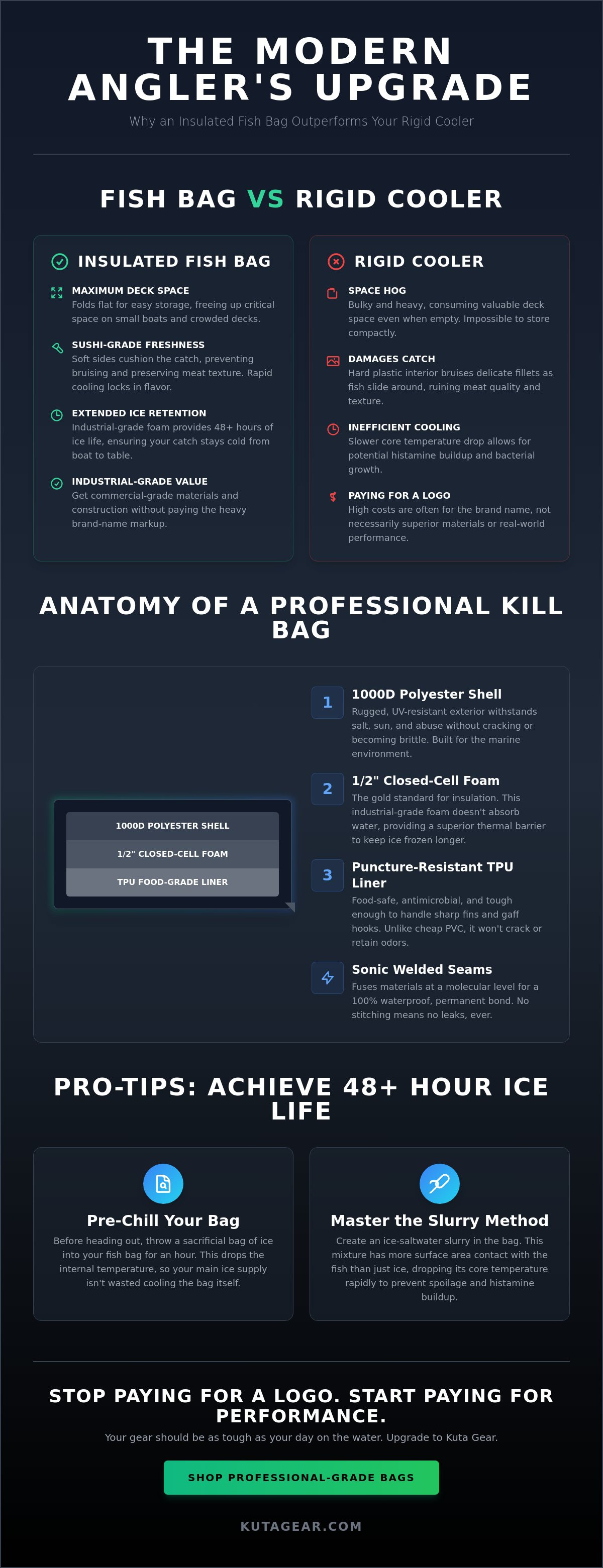
Performance isn't magic. It's industrial engineering. A high-quality insulated fish bag relies on specific material standards to keep ice frozen for 24 hours or more. The industry standard for serious retention is 1/2-inch closed-cell foam. Unlike the open-cell sponges found in cheap lunch boxes, closed-cell foam doesn't absorb water. It stays light. It stays cold. It provides the thermal barrier needed to stop heat transfer in its tracks even when the deck temperature hits triple digits.
Inside the bag, the material choice determines if your gear lasts one season or ten. Most "budget" bags use PVC liners. These are prone to cracking under UV exposure and hold onto fish smells forever. Professional bags utilize TPU. It's puncture-resistant, food-safe, and stays flexible in freezing temperatures. It handles sharp fins, spines, and gaff hooks without tearing. This is the difference between a one-and-done purchase and a piece of gear that stays in your rotation for years.
Why Sonic Welded Seams Matter
Stitched seams are points of failure. Every needle hole is a potential leak. Sonic welding uses high-frequency acoustic vibrations to fuse materials together at the molecular level. This creates a permanent, heat-sealed bond that is 100% waterproof. It keeps the cold in and the bloody mess out of your truck bed. This is gear built where the ocean is the office. It's designed to withstand salt, sun, and blood without flinching. If you're tired of gear that fails when the bite gets hot, check out the professional-grade bags designed for real-world performance.
Material Durability: TPU and 1000D Polyester
The exterior needs to be just as tough as the interior. 1000D polyester provides the rugged shell required for heavy-duty marine use. It's UV resistant to prevent the material from becoming brittle and cracking after a summer in the sun. The interior TPU surfaces are antimicrobial and easy to clean. A quick spray with a hose and a wipe down is all it takes to prep for the next run.
Don't overlook the hardware. Heavy-duty hauls require oversized, corrosion-resistant zippers and reinforced webbing. If you're carrying a 100lb+ haul, you need handles that won't rip out under pressure. Every weld and every strap must be industrial grade. More bag. Less money. That's the only way to stay ready for anything the ocean throws at you.
Insulated Fish Bags vs. Rigid Coolers: Making the Switch
Stop hauling dead weight. A 100-quart rotomolded cooler can weigh nearly 40 pounds before you even add a single bag of ice. That's 40 pounds of fuel-burning plastic taking up space on your deck. An insulated fish bag weighs a fraction of that while providing more internal volume for your catch. It allows you to carry more ice and more fish without overloading your transom or killing your fuel economy. It's a matter of weight-to-volume ROI.
Rigid boxes are fixed. If you don't catch a limit, you're still hauling the same bulky footprint. Bags are different. They adapt to your haul. Flat-bottom designs are superior to gusseted models because they stand upright and drain completely. Blood, slime, and scales don't get trapped in deep, hidden folds. Cleaning is a five-minute job with a hose and a quick wipe. When the day is done, the bag folds flat. It stays out of the way in your garage or dock box until the next run.
Deck Space Optimization
Small boats struggle with "cooler creep." A massive plastic box blocks the path to the bow and creates a constant trip hazard on a wet deck. The 18x36 bag is the "Goldilocks" size for most recreational anglers. It's large enough for a limit of snapper but small enough to tuck into a bow hatch or slide under a leaning post. This flexibility is a safety feature. It keeps your workspace clear and your eyes on the rod tip. You can even mold the bag to fit into tight corners or irregular spaces where a rigid box would never go.
Ice Retention Reality Check
Don't fall for the marketing trap that says you need a $500 plastic box for a day trip. For 24-hour runs, a professional insulated fish bag matches premium rotomolded performance. The secret is the elimination of "dead air." In a half-empty rigid cooler, large air pockets circulate and melt your ice from the inside out. You can compress a soft bag to remove that air. This simple physics trick maximizes every pound of cubes you buy.
- Better compression: Remove warm air to keep ice solid longer.
- Industrial insulation: 1/2-inch closed-cell foam prevents heat soak from hot decks.
- Cost efficiency: Get more storage quarts per dollar spent compared to premium hard coolers.
It's about choosing gear that works as hard as you do. You want industrial storage that performs in the field and disappears when the office is closed. More bag. Less money. It's the only logical choice for the modern outdoorsman.
Maximizing Ice Retention and Catch Care
Don't waste ice on a warm bag. If you start your trip by throwing fresh cubes into a hot insulated fish bag, you're fighting a losing battle. The insulation will absorb the cold from the ice just to reach equilibrium. It's a rookie mistake that kills your retention time. Pre-chill the bag. Toss a sacrificial 10-pound bag of ice into the hold the night before your run. This brings the internal temperature down and primes the 1/2-inch closed-cell foam. When you load your actual supply at 4:00 AM, the ice stays solid for 48 hours instead of melting by noon.
Bleeding your catch is the next step in professional meat preservation. Do it on the deck using a bucket or a dedicated bleed barrel. Don't let the fish pump blood directly into your ice. This keeps the interior TPU liner clean and prevents the fillets from absorbing off-flavors. Once the fish is bled, use proper layering. Heat rises. Place your catch on the bottom of the bag and cover it with a thick layer of ice. It's a simple law of physics that keeps the core temperature at the lowest possible point.
The Perfect Slurry
For tuna and other pelagics, cubes alone won't get the job done. You need a brine. Mix two parts ice with one part clean salt water to create a thick slush. Salt water lowers the freezing point of ice, creating a deeper chill. This liquid ice surrounds the fish completely, eliminating the air gaps that occur with standard cubes. A proper slurry pulls heat from the core of a large fish 50% faster than dry ice alone. This rapid drop in temperature stops cellular breakdown and locks in that sushi-grade texture you're after. It's the difference between a trophy haul and a bag of cat food.
Maintenance and Longevity
Industrial gear lasts if you don't treat it like a toy. Your post-trip ritual is what determines if your bag lasts two seasons or ten. Scrub the interior with mild soap and fresh water after every run. Avoid bleach; it's too aggressive for the TPU surfaces and can degrade the sonic welds over time. Open the bag and air-dry it until it's bone dry to prevent mold and lingering odors.
Hardware needs attention too. Salt is the enemy of every zipper. Apply a silicone-based lubricant to the oversized zippers every 30 days to prevent corrosion and sticking. When you store the bag, lay it flat. Don't fold it into a tight ball or place heavy weights on top of it. Creasing the bag can crush the internal foam and create thermal leaks that ruin ice retention. Ready to see the difference for yourself? Get the 18x36 insulated fish bag that's built for the long haul. More bag. Less money. No excuses.
Kuta Gear 18" x 36": Professional Performance Without the Markup
You're tired of paying for a billionaire's marketing budget. We get it. Kuta Gear was built by an outdoorsman who saw the inflated price tags on plastic boxes and decided to do better. Our philosophy is simple: More bag. Less money. While the top five industry players collectively hold a 35% market share as of 2025, we focus on the serious angler who values industrial engineering over brand prestige. We don't do lifestyle accessories. We build tools for the harvest.
The 36-inch insulated fish bag is the backbone of our lineup. At a verified price of $175.00 as of May 2026, it offers commercial-grade performance that rivals bags costing twice as much. While our larger 5-foot and 6-foot models are currently sold out due to high demand, the 18x36 remains in stock and ready for your next swell. It's the most practical investment you can make for your boat this season. Built by an outdoorsman. For every outdoorsman.
Why 18" x 36" is the Universal Standard
This is the "Goldilocks" size for the North American market, which accounts for 64.5% of global cooler bag sales. It's the perfect dimensions for Mahi, Salmon, and Snapper. It handles the 15-fish daily limit for black sea bass in Delaware or a haul of red snapper from the Texas federal waters opening on May 22, 2026. It's large enough to be useful but small enough for a single person to carry when fully loaded. You can View the 18x36 Insulated Fish Bag to see the exact dimensions for your deck layout.
The Kuta Gear Advantage
We cut out the middleman. By selling direct to you, we eliminate the retail markups that drive up competitor prices. Our gear is built where the ocean is the office. We use the same 1/2-inch closed-cell foam and sonic-welded TPU liners discussed earlier to ensure your catch stays fresh for 24 to 48 hours. This isn't a guess. It's a standard we live by. We don't have time for marketing fluff. We have time for results.
Don't settle for gear that cracks after one summer. Choose the rugged reliability of a bag built for every outdoorsman. Our inventory is live and shipping now. Get your Kuta Gear bag today and keep your catch fresh. Your hard-earned harvest deserves nothing less than professional-grade protection. More bag. Less money. In stock now.
Secure Your Catch for the Long Haul
You've seen the science behind the salt-water slurry and the engineering of the sonic weld. A professional insulated fish bag isn't just another accessory; it's a critical tool for every serious angler. It's the difference between sushi-grade fillets and a wasted day on the water. You need gear that handles the 1000D polyester reality of the ocean. Stitched seams fail. Plastic boxes hog your deck space. Industrial 1/2-inch closed-cell insulation is the only way to guarantee 24-hour ice retention when the bite gets hot.
Stop paying for corporate logos and start paying for industrial performance. We build where the ocean is the office because we know what happens to cheap gear in the salt. You get sonic welded seams for 100% waterproof integrity and a bag that stands up to gaff hooks and sharp fins without leaking into your truck. It's time to upgrade your storage. Upgrade your gear with the Kuta Gear 18" x 36" Insulated Fish Bag, More bag, less money.
Be prepared for the next swell. Your harvest is too valuable to leave to chance. Load the ice, bleed the catch, and trust your gear to do the rest. See you out there.
Frequently Asked Questions
How long will ice last in an insulated fish bag?
Ice lasts 24 to 48 hours in a professional insulated fish bag if you pre-chill it. The 1/2-inch closed-cell foam acts as a thermal barrier that doesn't absorb moisture. Keeping the bag out of direct sunlight and using the slurry method will push retention toward the 48-hour mark even in 90-degree heat. It's about managing the thermal mass correctly from the start of your trip.
Are fish kill bags truly leak-proof for use in a truck?
Sonic welded seams make a bag 100% leak-proof. Unlike stitched seams that have thousands of needle holes, welded seams are fused at the molecular level to create a single waterproof bond. This ensures blood and slime stay inside the bag and off your truck's carpet during the drive home. It's industrial-grade protection for your vehicle's interior.
What is the best way to clean a bloody fish bag?
Use mild dish soap and a garden hose. Spray the interior TPU liner immediately after unloading your catch to prevent blood from drying. Avoid bleach or harsh solvents that can degrade the heat seals over time. Hang the bag open or lay it flat in the shade to dry completely before storage. This prevents mold and keeps the gear ready for the next swell.
Can I use a fish bag for things other than fishing?
These bags are industrial-strength coolers for any scenario. They're perfect for warehouse club grocery runs or weekend camping trips where deck space is tight. The 18x36 footprint fits easily in most trunks and keeps frozen goods solid for hours. It's more bag for less money, whether you're at the marina or the campsite.
How do I prevent my fish bag from smelling?
Odor prevention starts with a non-porous TPU liner and ends with total drying. Bacteria thrives in moisture and blood trapped in hidden folds. Because our liners are antimicrobial and sonic welded, there are no stitched pockets for slime to hide. Always scrub the corners and store the bag bone-dry to keep it smelling fresh for years.
What size fish bag do I need for tuna vs. snapper?
An 18x36 bag is the universal choice for snapper, salmon, and schoolie tuna. It handles a full 15-fish limit of 12.5-inch black sea bass or 16-inch red snapper with ease. If you're targeting 100-pound bluefin or large pelagics, you'll need to step up to a 5-foot or 6-foot kill bag to keep the fish whole and chilled.
Are soft-sided fish bags puncture-resistant?
High-quality bags use 1000D polyester shells to resist punctures from fins, spines, and gaffs. It's industrial-grade gear designed for the "ocean is the office" lifestyle. While no soft material is totally bulletproof, this construction is significantly tougher than the thin vinyl found in department store coolers. It's built to survive multiple seasons of commercial-level use.
Why is a TPU liner better than PVC?
TPU is superior because it's food-safe and remains flexible in freezing temperatures. PVC is a cheaper alternative that becomes brittle, cracks under UV exposure, and leaches chemicals into your catch. TPU is antimicrobial and puncture-resistant, lasting up to 300% longer in harsh marine environments. It's the only choice for an outdoorsman who values durability over a cheap price tag.

Also in Contact

Portable Fish Storage for Pier Fishing: The Rugged Guide to Catch Preservation

The Best Way to Chill Fish Quickly After Catch: A Professional Guide
