

Insulated Fish Bag vs. Hard Cooler: The Ultimate Catch Care Showdown
Your hard cooler is a coffin for your deck space. It's a massive plastic box that eats up square footage long before you've even landed a keeper. Most anglers haul the same heavy gear because they think durability requires bulk. In reality, the choice between an insulated fish bag vs hard cooler is about efficiency and meat quality. You need to stop fighting your equipment and start protecting your investment.
We agree that a crowded deck is a dangerous deck. You're tired of dodging rotomolded corners and lifting dead weight when the bite is on. You want ice that survives the 90-degree sun and a storage solution that doesn't require a crane to move. This guide promises to reveal which storage solution maximizes your boat floor space while keeping your catch in sashimi-grade condition. We'll look at ice retention, puncture resistance against sharp fins, and the logistics of cleaning a 50-pound mahi. It's time to find out which gear actually belongs on your boat.
A heavy cooler is a permanent tax on your boat's performance. It occupies the same massive footprint whether it is full of trophy fish or completely empty. When comparing an insulated fish bag vs hard cooler, the winner is decided by deck efficiency and the final quality of your fillets. We agree that wasted space is a liability when the bite is on. This summary promises to show you how to maintain sashimi-grade meat without sacrificing floor space. You'll see why industrial-strength bags are replacing bulky plastic boxes on serious offshore rigs.
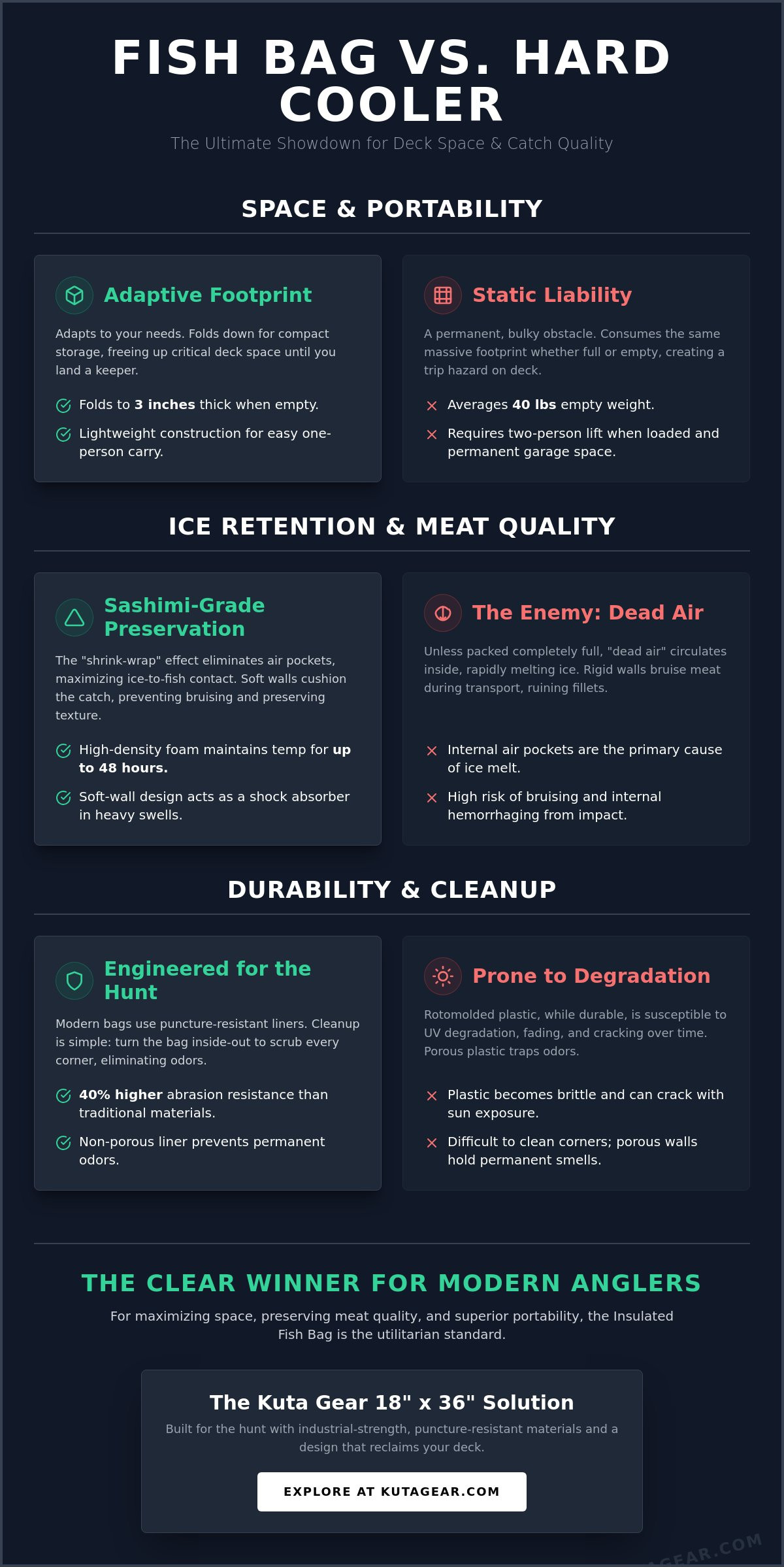
Fish bags offer a "shrink-wrap" effect that hard coolers cannot match. By collapsing around the catch, you eliminate air pockets that melt ice and ruin meat. These bags utilize high-density foam to maintain internal temperatures for up to 48 hours in direct sun. While rotomolded coolers are durable, they're prone to UV degradation and cracking. Modern 18" x 36" Insulated Fish Bags feature puncture-resistant liners with 40% higher abrasion resistance than traditional materials. Cleanup is direct; you turn the bag inside out to scrub every corner, preventing the permanent odors found in porous plastic walls. This is the utilitarian standard for the hunt.
Space Management and Portability: The Footprint Problem
A hard cooler is a static liability. It claims the same square footage on your deck whether it's full of ice or bone dry. On a fishing boat, every inch of floor space is a premium. When you analyze a traditional insulated box versus a pliable bag, the math favors the bag every time. A hard cooler is a permanent obstacle. You trip over it during a fight. You lose casting room. An insulated fish bag vs hard cooler comparison reveals a simple truth: bags adapt while coolers obstruct.
Weight-to-volume ratios matter for fuel and fatigue. A high-capacity rotomolded cooler can weigh 40 pounds before you add a single bag of ice. That's dead weight. It requires a two-person lift once it's loaded with a limit of fish. A professional-grade fish bag provides more storage capacity per pound of gear. It uses lightweight, high-density foam instead of thick plastic shells.
- Hard Coolers: Rigid 40lb empty weight; requires permanent floor space.
- Fish Bags: Lightweight; folds to 3 inches thick when empty.
The "Small Boat" Reality
Deck space is a safety requirement on skiffs and small center consoles. A rigid box in the cockpit is a trip hazard waiting to happen. Bags are flexible. They contour to the bow or fit inside a deck locker. If you're running a flats boat, you don't have room for a plastic chest. Use the bag as your primary storage or as overflow for a heavy haul. It adapts to the boat, not the other way around. You can even secure it to T-top supports to keep the floor completely clear for the footwork of a big catch.
Transport and Storage Logistics
The insulated fish bag vs hard cooler debate is settled when you have to clean the boat alone. Hauling a loaded 100-quart cooler up a ramp is a chore. A fish bag has reinforced handles designed for a balanced, one-person carry. It slides into a truck bed alongside your other gear. It doesn't demand the center spot. Off-season storage is the final win. A massive plastic box occupies a permanent corner of your garage. It collects dust and takes up space you could use for more tackle. A 36-inch bag hangs on a wall hook or sits on a shelf. It stays ready without being an eyesore.
Ice Retention and Meat Quality Preservation
Don't let the bulky walls of a hard cooler fool you. Thick plastic doesn't always equal cold fish. In the insulated fish bag vs hard cooler debate, the real enemy is air. A hard cooler is a rigid box. Unless you fill it to the brim with ice, it's full of "dead air." This air circulates and melts your ice from the inside out. A fish bag is different. It collapses around your catch. This "shrink-wrap" effect eliminates air pockets. You keep the cold exactly where it belongs: on the meat.
- Eliminates thermal-draining air pockets.
- Maximizes ice-to-fish contact.
- Reduces internal convection.
The Science of Thermal Transfer
Industrial-grade fish bags use high-density, closed-cell foam. This material is a thermal barrier that resists heat transfer better than the hollow or air-injected walls of many rigid containers. Professional-grade bags are compact, portable, and surprisingly versatile, allowing you to maximize thermal efficiency. Under 2024 Global Insulated Packaging Standards, professional bags must keep contents below 4°C for at least 24 hours in 32°C heat. While a rotomolded cooler relies on mass, a bag relies on contact. By conforming to the shape of a tuna or mahi, the bag reduces the surface area exposed to ambient temperatures. You maintain a consistent internal environment. You prevent "hot spots" that occur when a fish rests against a warm plastic wall.
Preserving Sashimi-Grade Quality
Meat quality starts the moment the fish hits the deck. Hard coolers have rigid, unforgiving walls. In a heavy swell, your catch bounces against plastic. This causes bruising and internal hemorrhaging. It ruins the texture of the meat. An insulated fish bag offers a soft-wall advantage. The foam acts as a shock absorber. It protects the delicate flesh of high-value species. If you're serious about your harvest, consider the 18" x 36" Insulated Fish Bag for its ability to maintain temperature and texture during the long run back to the dock. Heavy-duty zippers and heat-welded seams seal out the external heat. They lock in the cold.
Proper catch care requires a brine slurry. You need a mix of ice and salt water to drop the core temperature of the fish fast. Hard coolers often leak from the drain plug or lid seal during transport. Bags are built to contain the liquid. The smooth PVC liners are non-porous. They won't absorb blood or bacteria. You keep the fish submerged in a freezing slurry. This rapid cooling stops the degradation process immediately. It's the difference between fishy-tasting fillets and restaurant-quality sashimi.
Durability and the Rigors of Marine Environments
A tool is only as good as its weakest point. Many anglers dismiss bags because they've seen cheap consumer versions rip under pressure. That's a mistake. When you compare an insulated fish bag vs hard cooler for long-term survival, you have to look at material science. A hard cooler is made of polyethylene. It's tough until it isn't. One heavy drop on a cold morning can crack a lid or snap a rigid hinge. A professional-grade bag absorbs impact. It doesn't shatter. It flexes.
Puncture resistance is the baseline for catch care. You're dealing with dorsal spines, sharp gill plates, and gaff hooks. A thin liner is a failure point. Industrial-strength materials are required to resist tearing. While rotomolded plastic is thick, it's also porous over time. It scratches. Those scratches hold bacteria and weaken the structure. A high-denier PVC bag stays smooth and impenetrable. It handles the abuse of a thrashing tuna without losing its integrity. Reliability is the only metric that matters when you're miles from the dock.
Material Matters: PVC vs. Polyethylene
Denier count tells the story of durability. 1000-denier PVC is the marine standard for a reason. It's thick. It's heavy. It's built for the deck. Most hard coolers rely on the thickness of the plastic shell for strength, but plastic becomes brittle in the salt and sun. Heat-sealed seams are another critical factor. Unlike stitched seams that leak and pull apart, heat-welded construction fuses the material into a single, waterproof unit. This prevents blood from seeping into the insulation. It stops the rot before it starts. The handles are often the first thing to go on a heavy cooler. We reinforce our handles to manage the full weight of a loaded 18" x 36" Insulated Fish Bag without failing. You can trust the carry.
Weathering the Salt and Sun
The ocean is a corrosive environment. Salt spray eats metal. Sun destroys polymers. Hard coolers often have stainless steel or plastic latches that seize or snap after a season of exposure. We use corrosion-proof marine zippers. They don't rust. They don't stick. UV resistance is equally vital. Cheap plastics fade and chalk, losing their structural strength. Industrial PVC is formulated to withstand constant UV exposure without cracking. Antimicrobial coatings are integrated into the liner to prevent the permanent fishy smell that haunts old plastic coolers. Kuta Gear builds for the most demanding Pacific conditions. We understand that gear failure isn't an option during the hunt. This is gear designed to outlast the boat.
Cleanup and Long-Term Maintenance
Cleaning your gear shouldn't be a second day of work. After a successful haul, your deck is covered in blood, slime, and scales. This is where the insulated fish bag vs hard cooler debate gets messy. A hard cooler is a rigid obstacle with corners, hinges, and recessed drain plugs. These areas catch every scale and bit of organic matter. They're breeding grounds for bacteria. If you don't scrub every millimeter of that porous plastic, the smell stays forever. It's a permanent reminder of last week's catch that you can't wash away.
A professional fish bag offers the "turn-inside-out" advantage. You unzip it. You flip it. Every square inch of the non-porous PVC liner is exposed. There are no hidden crevices. No trapped scales. You hit it with a hose and a brush, and the job is done. This is the difference between a tool that stays clean and one that holds a grudge. Smooth PVC liners beat porous plastic walls every time. They don't absorb odors. They don't stain. You maintain a professional environment on your boat without the elbow grease.
Cooler drains are a design flaw for catch care. They're built for melted ice, not for fish guts. Scales clog the threads. Slime coats the internal channel. Even after a heavy rinse, that drain holds moisture and rot. A bag doesn't need a drain plug because it doesn't have corners to trap water. You dump the brine, flip the liner, and let the sun do the work. Stop fighting with a stinky plastic box and upgrade your setup with the 18" x 36" Insulated Fish Bag. It’s built for easy sanitation and immediate reuse.
Pro-Level Cleaning Routine
Efficiency starts on the water. Step 1: Perform an initial saltwater rinse on the boat. Don't let blood dry in the sun. Step 2: Once you're back at the dock, use mild, biodegradable soaps for a deep clean. Avoid harsh chemicals that degrade the PVC coating. Step 3: Use the reinforced handles to hang the bag upside down. 100% moisture removal is the only way to prevent mold and mildew between trips. A dry bag is a clean bag.
Zipper and Seal Care
Salt air is a slow killer for hardware. Apply a silicone-based lubricant to the marine zippers regularly. It ensures smooth operation when the bite is on and you're moving fast. Inspect the heat-sealed seams once a month for integrity. Look for any signs of wear. If you take care of the gear, the gear takes care of the catch. Store the bag in a cool, dry place. Don't leave it crushed under a pile of anchors in the off-season. Proper storage extends the lifespan of your investment.
The Kuta Gear 18" x 36" Solution: Built for the Hunt
Success in the hunt requires specialized equipment. You don't bring a butter knife to a gunfight. You shouldn't bring a generic plastic box to an offshore run. The 18" x 36" Insulated Fish Bag is the "Goldilocks" size for the modern angler. It's long enough for a limit of bluefish. It's deep enough for a heavy gag grouper. It fits where a rigid cooler won't. It performs where a cheap bag fails. When you weigh the insulated fish bag vs hard cooler, the winner is the gear that actually makes it onto the boat. Our dimensions are optimized for real-world deck layouts. We maximize storage without stealing your floor space.
We build for industrial strength. We don't hide behind fancy marketing. We don't use lifestyle branding. Our bags feature 1000-denier PVC construction and heat-welded seams. This isn't a "light use" accessory. It's a piece of mission-critical hardware. We challenge high-priced corporate competitors by focusing on the materials. You get more bag for your money. We provide superior ice retention and puncture resistance because we know the environment. We cut the retail middlemen to put better gear directly into your hands. You aren't paying for a logo. You're paying for performance. Our gear is roughly half the price of comparable premium hard coolers, providing a massive value advantage for the serious fisherman.
Versatility Across Disciplines
A good tool serves multiple purposes. This bag isn't just for the center console. It's the perfect companion for beach-based surf fishing where weight is a dealbreaker. It's light enough to carry across the dunes. It's rugged enough to sit in the salt spray all day. The insulated fish bag vs hard cooler debate is settled by the bag's ability to adapt. Use it for grocery runs or keeping drinks cold for a beach day with the family. The flexible walls adapt to whatever you're hauling. A one-size-fits-all big box cooler is a heavy anchor. This is a versatile asset. It stays ready for the next mission.
Ready for Immediate Deployment
Time is a resource you can't get back. With the recreational gag grouper season scheduled to close on August 2, 2026, you can't afford to wait on backordered gear. Corporate brands often struggle with fulfillment and stock availability. We don't. We maintain stock because we understand the urgency of the season. Our promise is reliability, preparedness, and authenticity. We are insiders in this community. We know what you need because we're out there with you. Don't settle for a clunky plastic box that fails when the pressure is on. Upgrade your catch care with the Kuta Gear 18" x 36" Insulated Fish Bag and experience the difference of gear built for the hunt.
Secure Your Harvest with Better Gear
The ocean doesn't care about brand logos or status symbols. It only respects performance. You've seen the data. A hard cooler is a bulky liability that eats your deck space and melts ice through dead air pockets. In the showdown of insulated fish bag vs hard cooler, the bag wins on efficiency, meat quality, and mobility. You reclaim your boat floor. You protect your fillets from bruising. You spend less time scrubbing corners and more time on the hunt. It's a utilitarian upgrade for the serious angler who values function over aesthetics.
Don't let a heavy plastic box dictate your limits. Our gear is built with industrial-strength 1000D PVC construction and high-performance closed-cell insulation. It's specifically designed for demanding marine environments where equipment failure isn't an option. You get professional-grade durability without the corporate retail markup. It's time to stop fighting your equipment and start focusing on the catch. Get the Kuta Gear 18" x 36" Insulated Fish Bag—Rugged, Reliable, and Ready for Your Next Catch.
Load up and get back out there. The season moves fast. Make every haul count.
Frequently Asked Questions
Do insulated fish bags leak in my vehicle?
Kuta Gear bags won't leak in your vehicle because they use high-frequency heat-welded seams. Unlike stitched bags that seep blood and brine through needle holes, these are watertight units. The heavy-duty marine zippers are designed to keep the liquid inside. You can transport your catch in a truck bed or SUV without worrying about permanent stains or odors in your upholstery. It's reliable transport for the long ride home.
How long will ice last in a Kuta Gear fish bag compared to a rotomolded cooler?
You can expect ice to last 24 to 48 hours in real-world conditions. While a rotomolded cooler might hold ice for five days, it relies on massive walls and dead air. The insulated fish bag vs hard cooler debate usually ignores that bags eliminate air pockets. By collapsing around the fish, the bag maintains core temperatures more efficiently for day trips and overnight runs. It's built for performance, not just storage.
Can I put large fish like tuna or mahi-mahi in an 18" x 36" bag?
The 18" x 36" bag is built specifically for large species like tuna, mahi-mahi, and grouper. It accommodates a standard limit of bluefish or a trophy-sized gag grouper with ease. The length allows you to keep the fish whole without bending or breaking the meat. This preserves the texture and ensures you get the highest quality fillets at the cleaning table. It's the "Goldilocks" size for most offshore anglers.
How do I prevent my fish bag from smelling after use?
You prevent odors by turning the bag inside out for a thorough cleaning. The smooth PVC liner doesn't absorb blood like porous plastic cooler walls. Use mild soap and fresh water to remove all organic matter. Always hang the bag by its reinforced handles to dry completely before storage. A dry bag is the only way to stop mold and lingering smells. It's a simple routine for a clean boat.
Are fish bags puncture-resistant against sharp fins and spines?
Professional bags use 1000-denier PVC to resist punctures from dorsal spines and sharp gill plates. This material is significantly tougher than standard consumer fabrics. It's built to handle the thrashing of a fresh catch without tearing. You don't have to baby this gear. It's a rugged tool designed for the deck, not a luxury accessory. It handles the rigors of the hunt without failing.
Is a fish bag better than a hard cooler for kayak fishing?
A fish bag is the superior choice for kayak fishing due to its low profile and flexibility. Hard coolers are heavy and rigid. They raise your center of gravity and catch the wind. A bag sits flat on the deck or fits inside a hatch. It keeps your kayak stable while providing high-performance insulation for your catch in the direct sun. It's the practical choice for small-water operations.
Can I use a fish bag as a regular cooler for drinks and food?
You can use the bag for drinks, ice, and food when you aren't hauling fish. It functions as a high-performance portable cooler for beach days or grocery runs. The closed-cell insulation keeps contents cold for hours. It's a versatile piece of gear that doesn't have to sit idle in the off-season. Just ensure it's properly sanitized before switching from fish to food. One bag handles every mission.
What is the best way to store my fish bag when I am not fishing?
Store your bag by hanging it on a wall hook in a cool, dry place. Ensure it's 100% dry before you zip it shut or fold it flat. Unlike a hard cooler that takes up permanent shelf space, this bag folds to a thickness of about three inches. It stays out of the way until your next mission. Avoid storing it under heavy, sharp gear that could compress the insulation foam.

Also in Contact

Portable Fish Storage for Pier Fishing: The Rugged Guide to Catch Preservation

The Best Way to Chill Fish Quickly After Catch: A Professional Guide
