

Keeping Catch Fresh on a Kayak: The Professional Standard for 2026
A stringer is a dinner invitation for predators and a literal drag on your hull. A plastic basket is just a sun-baked coffin for your meat. If you aren't hitting the thermal shock point within minutes of the catch, you're failing at keeping catch fresh on a kayak. Most anglers settle for "good enough" until they realize they're hauling expensive fertilizer back to the dock.
We know the frustration of watching a prime Chinook turn to mush because the sun beat your cooling method. You want to stay on the water until the limit is reached without the heat acting as a ticking clock. We'll show you how to master professional preservation using high-performance insulation and streamlined storage tactics. You'll learn to eliminate drag and maintain sashimi-grade quality for days, not hours.
We're breaking down the move from rigid coolers to flexible 840 Nylon TPU bags and the science of the perfect ice slush. We'll also cover the essential handling steps like immediate bleeding and temperature control that separate the amateurs from the seasoned pros. It's time to stop compromising on your catch.
Key Takeaways
- Eliminate hull drag and predator risks by ditching outdated stringers. Internal storage keeps your kayak fast and your harvest secure.
- Execute immediate bleeding and brain spiking. These professional techniques stop lactic acid buildup and preserve meat texture at the point of capture.
- Optimize vessel stability with flexible insulated bags. These conform to your hull and lower your center of gravity better than rigid coolers.
- Deploy the slush fund ice management strategy. Rapidly chill your harvest using a brine mixture for superior thermal transfer.
- Adopt the professional standard for keeping catch fresh on a kayak. Ensure your harvest stays sashimi-grade even under a high-noon sun.
The Failure of Traditional Kayak Fish Storage
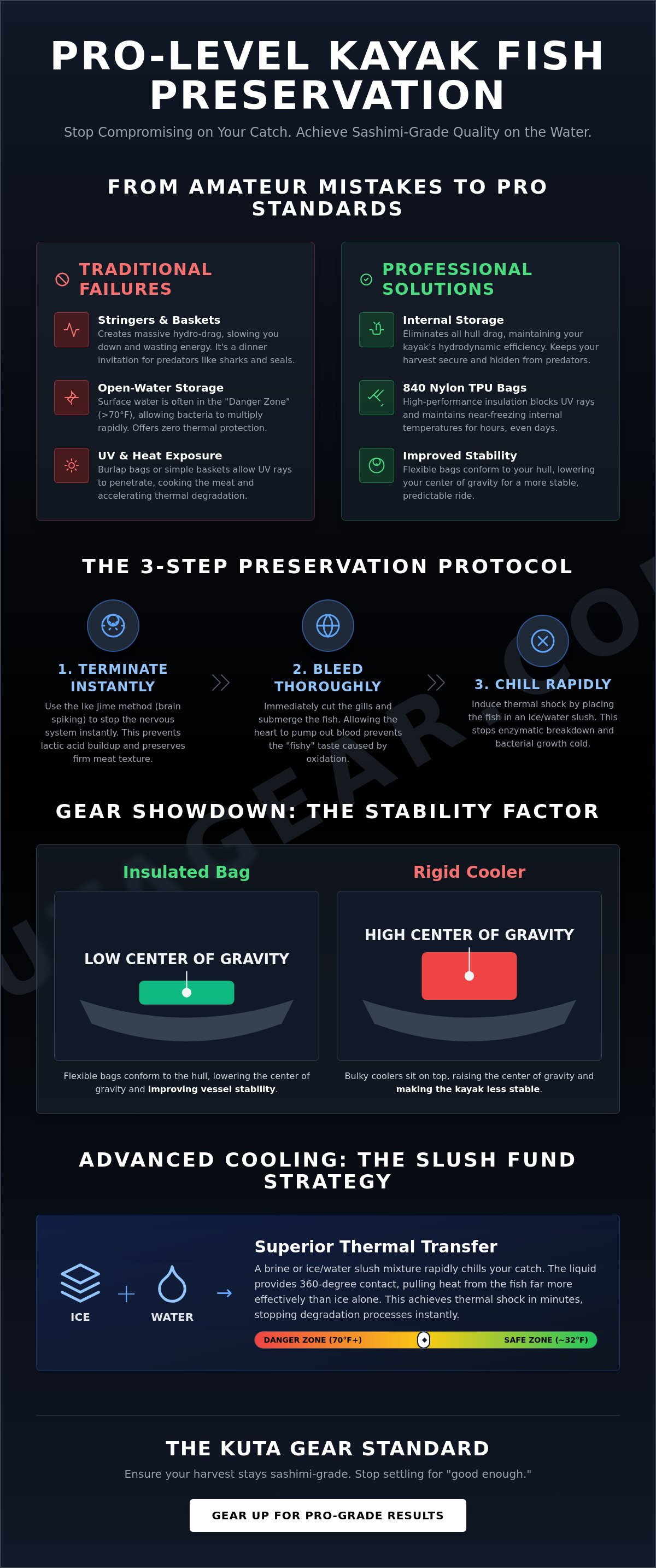
Most kayak anglers start with a metal stringer or a wire basket. It's cheap. It's traditional. It's also a tactical mistake. If you're serious about keeping catch fresh on a kayak, you have to stop dragging your dinner through the water. The moment a fish is caught, the clock starts. Traditional methods ignore that clock. They prioritize convenience over quality. They invite failure. Professional standards in 2026 demand better than a "good enough" approach that ruins meat before you hit the dock.
The Drag Factor: Why Stringers Slow You Down
Kayaks are precision tools. They rely on hydrodynamics to move efficiently. Attaching a stringer of fish to the side of your hull creates massive hydro-drag. It's like trying to paddle with your brakes on. On a long-range trip, energy conservation is everything. Every extra pound of drag forces your muscles or your motor to work harder. Dead weight in the water disrupts your vessel's tracking. Your kayak pulls to one side. You waste effort correcting your course. You need a streamlined profile to stay effective. If it's hanging outside the hull, it's holding you back.
Thermal Degradation and Meat Quality
Surface water isn't a refrigerator. In many regions, surface temperatures often exceed 70 degrees. That is the heart of the "Danger Zone" for raw protein. Bacteria doesn't wait for you to reach the boat ramp. It starts multiplying immediately. Burlap bags and wire baskets offer zero protection. UV rays penetrate thin materials with ease. They cook the meat while the fish is still "stored." Mastering the art of keeping catch fresh on a kayak requires moving past these amateur mistakes.
Understanding The Science of Freshness means recognizing that thermal degradation is a relentless chemical process. Once it starts, you can't reverse it. Open-water storage also turns your kayak into a chum line. Seals, sea lions, and sharks don't care about your bag limit. They see a free meal tethered to your hull. Dragging fish is an invitation for a dangerous encounter. You lose your catch. You risk your safety. It's a failure of preparedness. Thermal shock in fish preservation is the immediate reduction of a fish's internal temperature to a near-freezing state to stop metabolic processes and bacterial activity.
- Stringers: Create massive hydro-drag and invite predators.
- Baskets: Offer no thermal protection and disrupt tracking.
- Burlap: Allows UV penetration and rapid bacterial growth.
- Surface Water: Typically resides in the bacterial danger zone.
The Science of Freshness: Bleeding and Cooling
A clean catch is only half the battle. The real work begins the second that fish hits your deck. If you want professional results, you must understand the biochemistry of spoilage. Keeping catch fresh on a kayak isn't just about ice. It's about stopping the clock on cellular breakdown. Stress, blood, and heat are your primary enemies. You defeat them with a precise kill and immediate thermal shock. Clean meat starts with a clean kill. There are no shortcuts here.
High-performance meat starts with Ike Jime. This is the Japanese method of brain spiking. When a fish fights, it burns through ATP. This creates lactic acid. If the fish dies slowly, that acid stays in the muscle. The meat turns soft and sour. Spiking the brain terminates the nervous system instantly. It stops the signal for the body to consume its energy stores. You get firm, high-quality fillets. Following NOAA's guidelines for handling seafood ensures you're meeting the highest standards for safety and quality from the moment of capture.
Step-by-Step: The Professional Kill Process
Termination must be fast. Use a dedicated spike or a sharp knife. Locate the soft spot above and behind the eye. Drive the spike into the brain. The fish will shudder and then go limp. Immediately cut the membrane behind the gills. Submerge the head in a bleed bucket. Let the fish drain for five to ten minutes. You want the heart to pump the blood out of the vessels and into the bucket. This keeps your storage environment clean. It prevents the "fishy" taste caused by oxidized blood. Once the blood is gone, move the fish to the ice. This is the only way to ensure keeping catch fresh on a kayak isn't wasted effort.
Managing Lactic Acid and Enzymes
Heat is a catalyst for enzymatic breakdown. Enzymes are naturally present in fish tissue. At room temperature, they begin "digesting" the meat from the inside out. This process creates the mushy texture found in poorly handled fish. You must drop the internal temperature to sub-40 degrees immediately to stall these enzymes. Rapid cooling preserves cellular integrity. It locks the pH at an optimal level. You're looking for a firm, translucent fillet. If the meat looks white and opaque before it hits the pan, you've failed the thermal test. Sub-40 degree storage isn't a suggestion. It's a requirement for sashimi-grade results. Utilizing a high-grade insulated fish bag provides the thermal barrier needed to lock in that quality before the sun does its damage.
- Ike Jime: Prevents stress-induced lactic acid and meat softening.
- Immediate Bleeding: Removes blood that carries heat and bacteria.
- Enzyme Control: Sub-40 degree temperatures stop tissue self-digestion.
- Cellular Integrity: Rapid cooling prevents "gaping" in the muscle fibers.
Why Insulated Bags Outperform Rigid Coolers
Rigid coolers are built for flat decks and wide beams. Kayaks are narrow, unstable, and short on space. If you're serious about keeping catch fresh on a kayak, you need gear that adapts to your vessel. A rotomolded box is a dead weight that sits high and catches the wind. An insulated bag is a tactical advantage. It conforms. It stays low. It works. Professional standards in 2026 have shifted away from bulky plastic toward streamlined, high-performance soft storage.
- Conformity: Bags fit the V-hull of the bow or the taper of a tank well.
- Stability: A lower center of gravity prevents tipping in heavy swells.
- Efficiency: Superior ice retention per pound compared to air-heavy hard boxes.
- Portability: Folds flat when the trip is over; stores in a garage without taking up a shelf.
Space Optimization: The 18" x 36" Footprint
The 18" x 36" dimensions are the industry gold standard for a reason. Most modern fishing kayaks have bow hatches or rear tank wells that taper. A hard cooler leaves empty, wasted air in those corners. An 18" x 36" bag fills that void. It maximizes your storage capacity without increasing your footprint. You can tuck it into the bow to balance your weight distribution or secure it in the rear for quick access. For surf launches, a bag can be lashed down tight. It won't slide or bounce like a plastic box. Reliable storage is the backbone of food safety. Following Penn State Extension's guide to fish handling ensures your storage method supports the rapid cooling needed for high-quality meat.
Weight and Stability on the Water
Weight is the enemy of the kayak angler. A high-end rotomolded cooler can weigh 25 pounds empty. That's a significant portion of your weight capacity gone before you add a single bag of ice. An insulated bag weighs a fraction of that. This lower tare weight means you can carry more ice or a heavier catch without swamping your scuppers. Stability is also a safety factor. A tall cooler raises your center of gravity. In a 3-foot swell, that's a recipe for a roll. Soft-sided bags also have a stealth advantage. They dampen "hull slap." They don't rattle when you drop a pliers or move your feet. You stay quiet. You stay stable. You stay out longer. Keeping catch fresh on a kayak requires gear that doesn't compromise your safety or your stealth. Every pound saved is more energy for the paddle home.
Advanced Ice Management for Kayak Anglers
Ice is a finite resource. You manage it like fuel. Most anglers dump a bag of cubes and wonder why their harvest is warm by noon. Keeping catch fresh on a kayak requires a two-stage thermal strategy. You need block ice for the long haul and crushed ice for the immediate shock. If you don't have a plan for your ice, you don't have a plan for your fish. Professional standards demand more than just "using ice." They demand thermodynamics.
Block ice has less surface area. It melts slowly. It serves as your thermal foundation. Crushed ice is for the "Slush Fund." It melts rapidly to create a liquid heat-sink. Under ideal packing conditions, ice can stay solid in a quality insulated fish bag for up to 3 days. You won't get that performance with a cheap bag and a handful of cubes. You need volume. You need density. You need the right mixture.
Creating the Perfect Saltwater Slurry
The goal is a 2:1 ratio of ice to saltwater. This brine creates a sub-freezing liquid bath. A slurry provides 100% surface contact with the catch, pulling heat from the core faster than any air-cooled environment. Brine cools faster than air because liquids are significantly more efficient at thermal conduction than gases. When you drop a bled fish into a slurry, the internal temperature plummets. This is how you lock in sashimi-grade quality. Don't let the fish sit in stagnant "fish soup." Drain bloody meltwater occasionally and refresh the ice. Keep the environment clean and cold.
Maximizing Ice Longevity
Pre-chill your gear. Put a sacrificial bag of ice in your storage bag the night before the launch. This cools the insulation so your primary ice doesn't waste energy cooling the bag itself. Use frozen half-gallon jugs as reusable blocks. They keep the core cold without diluting your slurry. Placement matters. Keep the bag out of direct sunlight. If your tank well is exposed, throw a light-colored, wet towel over the bag to use evaporative cooling. A heavy-duty, airtight zipper is non-negotiable. If air leaks in, your ice dies. If the zipper fails, the trip is over. Keeping catch fresh on a kayak is a battle against the sun. Every minute the bag is open is a minute of cooling lost. Open it. Drop the fish. Zip it tight. Move on.
Get the gear that holds the cold under the Pacific sun. Shop the 18" x 36" Insulated Fish Bag for professional-grade ice retention and industrial durability.
- Pre-chilling: Reduces thermal shock to your primary ice supply.
- Frozen Jugs: Provide long-term cooling without excessive meltwater.
- Saltwater Slurry: The fastest way to drop internal fish temperatures.
- Zipper Integrity: Prevents air exchange and preserves the internal micro-climate.
The Kuta Gear Standard: Built for the Hunt
Professional results require professional equipment. We didn't build our gear in a boardroom; we built it on the water. Kuta Gear was born from Hawaii-born experts who understand that the Pacific sun is a relentless enemy of quality meat. When you're miles from the launch, you don't need marketing fluff or prestige branding. You need industrial-grade insulation that works. Our standard for keeping catch fresh on a kayak is simple: zero compromise on durability and thermal performance.
The 18" x 36" footprint is our answer to the logistical failures of rigid coolers. It's built for the hunt. It's built for serious pelagics that won't fit in a standard lunch box. We've stripped away the corporate retail margins to deliver a product that outperforms high-priced competitors while surviving the grit and salt of real-world use. If you're tired of gear that fails when the bite gets hot, you're ready for a higher standard.
Durability That Matters
We use heavy-duty, puncture-resistant skins that shrug off dorsal spines and gaff tips. This isn't the thin vinyl found in big-box stores. Our technical manufacturing process prioritizes environmental resistance. We use industrial insulation designed to lock in sub-freezing temperatures for days, not hours. By focusing on function over aesthetics, we provide professional-grade materials at recreational prices. Our bags are warranted for the rigors of the marine environment. They are built to be tossed into truck beds, dragged across sand, and stuffed with ice and salt. This is the gear you buy once because it's built to last a decade of abuse.
Your Mission-Ready Setup
Integrating the 18" x 36" bag into your rig is straightforward. For maximum stability, tuck it into the bow hatch to balance your motor or battery weight. If you're running a clean deck, lash it into the rear tank well using heavy-duty bungees. Maintenance is the secret to longevity. To keep your bag scent-free for years, rinse it with fresh water and a mild biodegradable soap after every trip. Leave it unzipped to air dry completely before storage. A clean bag is a stealthy bag. It doesn't alert predators and it doesn't stink up your garage. Stop settling for mediocre storage and start keeping catch fresh on a kayak like a professional.
Ready to secure your harvest? Upgrade your kayak setup with a Kuta Gear 18" x 36" bag and experience the difference of gear built for the hunt.
- Hawaii-Born Design: Engineered for extreme heat and high-stakes fishing.
- Industrial Materials: Puncture-resistant skins that survive gaffs and spines.
- Economic Advantage: Professional performance without the corporate price tag.
- Scent Control: Easy-clean surfaces that stay fresh trip after trip.
Secure Your Harvest with Professional Standards
The days of dragging mushy fillets home are over. You now have the tactical blueprint for professional preservation. You've mastered the science of immediate bleeding and the power of the saltwater slurry. You understand why rigid coolers fail in the surf and why flexible, industrial-grade insulation wins on the deck. Keeping catch fresh on a kayak isn't a matter of luck. It's a matter of disciplined preparation and the right equipment.
We are a Hawaii-born brand. Our gear is Pacific-tested to survive the most punishing environments on Earth. We don't waste your time with marketing fluff or bloated retail markups. We deliver direct-to-consumer value that puts industrial strength in your tank well. You've put in the work to find the fish. Don't let the sun take the reward at the boat ramp.
Get the 18" x 36" Insulated Fish Bag Built for Performance and protect your harvest with gear that won't quit. The water is waiting. Go get yours.
Frequently Asked Questions
How long can I keep fish in an insulated bag?
You can keep fish fresh for up to 3 days if you pack the bag correctly with sufficient ice. High-quality insulation maintains sub-40 degree temperatures even when sitting under the Pacific sun. For sashimi-grade results, aim to process your catch within 24 to 48 hours. Always monitor your ice levels and refresh the slush if you see significant melting. Your harvest is an investment; don't let it sit in warm water.
Will an 18x36 bag fit on my specific kayak model?
An 18" x 36" bag fits almost every modern fishing kayak on the market today. We designed this specific footprint to conform to the tapered bows of offshore vessels and the rectangular tank wells of pedal drives. Measure your deck space before you launch to confirm placement. If you have a narrow hull, the flexible sides allow the bag to squeeze into tight corners where rigid coolers fail. It's built for versatility.
Do I need to put ice inside the fish bag?
You must use ice if you're serious about keeping catch fresh on a kayak. Insulation is a thermal barrier, not a refrigerator. Without a cold source like block ice or a saltwater slurry, the internal environment will eventually reach ambient temperature. Pack at least 10 to 20 pounds of ice for a full day on the water. More ice means better retention and firmer meat when you hit the dock.
What is the best way to clean a fish kill bag?
Rinse the bag with fresh water and a mild biodegradable soap immediately after every use. Scrub the internal corners to remove blood and scales that cause permanent odors. Don't use harsh bleach because it can degrade the technical coatings over time. Hang the bag upside down with the zipper open to air dry completely. A bone-dry bag stays scent-free and ready for your next hunt.
Can I use dry ice in an insulated fish bag?
Don't use dry ice in these bags. The extreme sub-zero temperatures can make the internal liner materials brittle and prone to cracking. Dry ice also releases carbon dioxide gas as it sublimates. In a sealed environment, this creates pressure that can blow the zipper or the seams. Stick to frozen water blocks or a heavy brine for safe, effective cooling. It's simpler and more reliable for marine use.
Does the Kuta Gear bag leak in my truck?
Our bags are engineered to stay sealed during transport. The heavy-duty liner and airtight zipper prevent meltwater from escaping into your vehicle or across your deck. Check the zipper track for debris like sand or scales before you pull it shut. A clean seal is a waterproof seal. You can transport your catch with confidence knowing your upholstery is safe from fish slime and salt spray.
How do I secure a fish bag to a kayak in rough water?
Use heavy-duty bungees or cam straps to lash the bag to your deck loops. Don't rely on gravity alone. In high swells or surf launches, an unsecured bag becomes a projectile or a lost investment. Thread your straps through the reinforced handles for a rock-solid connection. This keeps the bag centered, maintains your vessel's stability, and ensures your harvest stays exactly where you put it during the paddle.
Is a fish bag better than a floating basket?
A fish bag is superior in every tactical category. Floating baskets create massive hydro-drag and leave your catch exposed to warm surface water and opportunistic predators. Keeping catch fresh on a kayak requires an internal, controlled environment. A bag provides the insulation needed to stop spoilage and maintain meat texture. Baskets are for amateurs who don't mind eating mushy meat. Professionals use bags to lock in quality.

Also in Contact

Portable Fish Storage for Pier Fishing: The Rugged Guide to Catch Preservation

The Best Way to Chill Fish Quickly After Catch: A Professional Guide
