

Keeping Fish Fresh for Shore Lunch: The Ultimate Field Storage Guide
A mushy, smelling fillet isn't a rite of passage. It's a failure of field storage. You spend hours hunting the perfect structure. You perfect your presentation. Then you let the midday sun ruin the meat before the oil even gets hot. We've all been there. You're fighting for deck space against a bulky plastic cooler that's mostly lukewarm water by noon. Keeping fish fresh for shore lunch requires more than a bucket of lake water. It requires a professional approach to temperature control.
Stop settling for soft meat. Start demanding restaurant-quality results. You need a system that survives the heat and fits your boat. This guide delivers the professional techniques for maintaining ice-cold quality from the moment the hook sets until the fillets hit the pan. We will cover the critical 2:1 ice-to-fish ratio. We'll explain why draining meltwater is non-negotiable. We'll show you how to use insulated gear to save space. You'll gain the confidence to handle your catch safely and the gear setup to keep every bite firm and clean.
Key Takeaways
- Stringers ruin meat. Learn why warm lake water invites bacteria and ruins texture before the oil even gets hot.
- Master the 4-step protocol for keeping fish fresh for shore lunch, beginning with immediate bleeding to flush out heat.
- Ditch bulky plastic. High-density kill bags provide better insulation and reclaim your deck space for actual fishing.
- Control the core temperature. Rapid cooling halts enzymatic breakdown and ensures your fillets stay firm and clean.
- Choose gear that survives the hunt. Rugged 18" x 36" dimensions provide the perfect field storage for most shore lunch species.
The Critical Window: Why Shore Lunches Fail Before the Pan
The battle for a perfect shore lunch starts the second the fish breaks the surface. Most anglers wait too long to start the cooling process. They focus on the recipe while the sun destroys the meat. The 40°F (4°C) rule is absolute. Above this temperature, bacterial growth is exponential. Bacteria don't just grow; they explode. This rapid multiplication is the primary cause of that "fishy" smell and soft texture. If you aren't fighting the ambient temperature, you're losing the meal.
Boat decks are heat sinks. Aluminum and fiberglass soak up midday radiation. They can easily reach 120°F. If your catch sits on that deck for even ten minutes, the core temperature spikes. This heat triggers enzymatic breakdown. It turns firm muscle into mush. To succeed at keeping fish fresh for shore lunch, you must break the heat cycle immediately. Understanding the science of fish preservation is the difference between a restaurant-quality meal and a wasted catch.
The Myth of the Stringer
A stringer is a death trap for flavor. It keeps the fish in the warmest part of the water column. Surface temperatures in mid-summer often exceed 70°F. That isn't preservation; it's a slow cook. When a fish is tethered, it enters a state of extreme stress. This stress burns through glycogen stores and creates massive lactic acid buildup. This acid lowers the pH level of the meat. It ruins the flavor profile and creates a sour, metallic aftertaste. Predators are another reality. Turtles, snakes, and larger fish see a stringer as a free buffet. "Alive" does not mean "fresh." A stressed, warm fish on a stringer is already decomposing before you even beach the boat.
Bacterial Timelines in the Sun
Time is your scarcest resource. In a 70°F environment, spoilage happens fast. Without active cooling, you have less than an hour before the quality drops significantly. You can spot the failure early if you know where to look. Watch for these signs:
- Clouding eyes: Clear eyes mean a fresh catch. If they turn milky, the fish is warming up.
- Dulling slime coats: Fresh fish have a thin, clear coating. Bacteria turn this slime thick and opaque.
- Gills turning gray: Gills should be vibrant red. Gray or brown gills indicate oxygen loss and heat damage.
Mushy fillet syndrome is the final stage. It's the direct result of poor temperature control. Once the muscle fibers lose their integrity, no amount of breading or oil can save them. Stop the clock by dropping the temperature immediately.
The Science of Cold: Maintaining Peak Fillet Texture
Catch preservation is not a suggestion. It is the technical process of rapidly lowering core body temperature to halt enzymatic breakdown. You are fighting a war against heat. The goal is to drop the internal temperature of the fish to 32°F as fast as possible. Thermal mass is your primary weapon. While more ice provides more cooling potential, insulation determines the outcome. Without a proper thermal barrier, you are just melting money. High-performance insulation keeps the cold focused on the meat rather than fighting the ambient air of a 90°F boat deck. For keeping fish fresh for shore lunch, you need a system that prioritizes conduction over simple air cooling.
The material of your storage gear matters. Closed-cell foam is the professional choice for a reason. It consists of millions of tiny, independent bubbles that block radiant heat and prevent water absorption. Open-cell foam is a sponge. It absorbs moisture, harbors bacteria, and loses its R-value the moment it gets wet. Slush ice is the gold standard for rapid cooling. Mix two parts ice with one part water to create a sub-freezing bath. This liquid medium surrounds the fish completely. It pulls heat from the core significantly faster than air-gapped ice cubes. Following safe handling tips for fresh fish ensures your lunch stays edible and firm. A high-performance insulated fish bag provides the closed-cell barrier needed to maintain this slush for the duration of your trip.
Enzymatic Breakdown Explained
Fish protein is fragile. When the meat stays above 50°F, natural enzymes within the fish begin a process of self-digestion. This is not bacterial rot; it is structural failure at the cellular level. Fresh fillets have tight, resilient cellular structures that hold their shape. Degraded fillets are loose, watery, and lose their integrity. Enzymatic breakdown in fish is the primary cause of soft meat texture. You cannot reverse this damage. You can only prevent it with immediate, aggressive cooling.
Rigor Mortis and Meat Quality
Rigor mortis is the natural stiffening of muscles after death. You want this process to occur while the catch is submerged in ice. When rigor happens in the sun, the muscle fibers contract violently and then collapse. Rapid cooling creates a "cold-cured" fillet. This preserves the distinct "flake" that defines a high-quality shore lunch. A cold-cured fillet appears translucent and feels firm to the touch. If the meat looks opaque and limp before it hits the pan, the temperature control failed hours ago.
Kill Bags vs. Hard Coolers: Which Belongs on the Shore?
Hard coolers belong in the truck bed. They don't belong on a remote shoreline. A 65-quart rotomolded cooler is a dead-weight anchor in a small skiff. It occupies 30% of your usable deck space before you even land a fish. Insulated kill bags solve this problem. They are pliable. They tuck into the bow or under a bench. When the bag is empty, it stays flat. As you catch, it expands to fit the haul. This is the only logical way to manage limited space while keeping fish fresh for shore lunch.
Thermal efficiency isn't just about wall thickness. It's about air gaps. Many hard coolers rely on hollow plastic walls that lose their R-value if the seal is compromised. High-quality kill bags utilize dense closed-cell foam. This material doesn't just hold the cold; it rejects radiant heat. It maintains a tighter thermal envelope around your slush ice. This ensures your catch stays at 32°F even when the bag sits on sun-baked granite. This level of proper care and handling of fish is what separates a professional field lunch from a food safety risk.
The Portability Factor
A loaded hard cooler requires a two-man lift. That's a liability when you're navigating slippery rocks or steep banks. Insulated bags are built for solo operators. They feature heavy-duty shoulder straps and reinforced handles. You can carry your gear and your catch in a single trip. Weight comparisons are lopsided. An empty 18" x 36" insulated bag weighs a fraction of a comparable hard cooler. You aren't fighting a rigid box. You're using a tool designed for the terrain.
Durability in Marine Environments
The field is brutal. Salt, UV rays, and sharp fins destroy inferior gear. You need a bag with a UV-resistant outer shell to prevent cracking and fading. Puncture resistance is non-negotiable. Northern pike and walleye have sharp dorsal fins and aggressive teeth. A thin plastic liner will fail and leak. You need a rugged interior that handles hooks and spines without a breach. Heavy-duty zippers are the industrial standard. Plastic latches on hard coolers snap under pressure. A high-tensile zipper keeps the cold in and the heat out. It works every time.
Cleanup is the final hurdle. Hard coolers have deep corners that trap blood, scales, and bacteria. They develop a permanent stench by mid-season. Most insulated bags are easy to flip inside out. Spray them down with a hose. Use a mild soap. Hang them to dry. This utilitarian design makes maintenance fast. You spend less time scrubbing and more time at the frying pan.
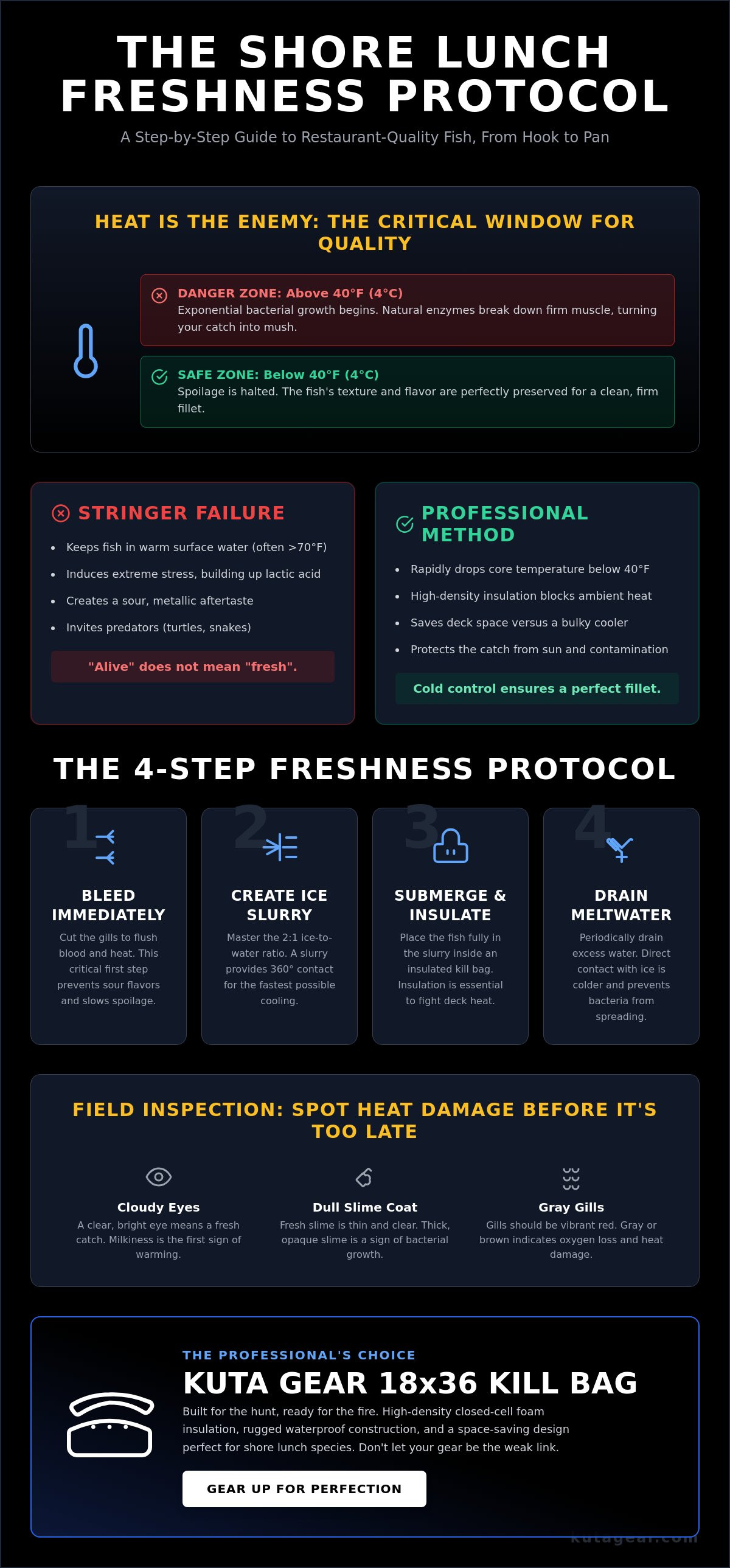
The 4-Step Freshness Protocol for Shore Lunch
Professional results require a repeatable process. You don't leave your catch to chance. You follow a protocol that stops decomposition at the source. Keeping fish fresh for shore lunch is about speed and thermal management. If you wait until the boat is docked to start cooling, you've already lost the battle. Follow these four steps to ensure every fillet is firm, clean, and safe for the frying pan.
- Step 1: Immediate Dispatch and Bleeding. Kill the fish quickly. A stressed fish builds up lactic acid. Cut the gills immediately to remove heat-carrying blood. This lowers the core temperature and improves meat color.
- Step 2: The 60-Second Pre-Chill. Get the catch into the bag within one minute. Every second on a hot deck is a temperature spike you can't afford. Immediate immersion in ice slush is the goal.
- Step 3: Internal Ice Distribution. Don't just lay the fish on top of the ice. Pack the belly cavity with crushed ice. Cooling from the inside out is the fastest way to reach the 32°F target.
- Step 4: Zipper Discipline. Seal the bag and leave it. Every time you open the zipper to check your catch, you let out the cold and invite in 90°F air. Trust your gear and keep the thermal barrier intact.
Bleeding the Catch
Clean meat starts with a clean bleed. Use a sharp knife to cut the membrane between the gills and the lower jaw. This severing of the main artery allows the heart to pump the blood out of the muscle. This process removes the primary source of "fishy" flavors and ensures a white, restaurant-quality fillet. Once the bleeding stops, perform a clean water rinse. Use lake water to remove surface slime and bacteria before placing the fish in your bag. This prevents the ice slush from becoming a bacterial soup.
Ice Management Strategies
Your ice choice determines your range. Crushed ice is superior for rapid cooling because it offers maximum surface area contact. Block ice is the endurance king. It resists melting in the midday sun. The professional move is the "ice sandwich" technique. Use block ice at the bottom for longevity and crushed ice on top for immediate cooling. Draining excess water is vital for maintaining the lowest possible temperature. Standing water acts as a heat conductor once it rises above 32°F. Upgrade your field setup with the 18" x 36" Insulated Fish Bag to execute this protocol perfectly.
Field Dressing for the Fire
Shore lunch environments are dirty. Sand, pine needles, and dirt are the enemies of a clean fillet. Keep your fish whole and on ice until the very moment the oil is hot. If you must fillet early, use the "bag-on-bag" method. Lay your insulated bag flat and use the clean outer surface as your cutting board. This prevents ground contact. Dispose of remains far from your lunch site. Entrails attract bears, turtles, and flies. Keep your kitchen clean and your catch cold.
The Kuta Gear 18x36: Built for the Hunt, Ready for the Fire
The 18" x 36" Insulated Fish Bag isn't a luxury accessory. It is a piece of industrial equipment. We designed this specific footprint for the practical reality of the field. It is the "Goldilocks" size for the species that define the tradition. Walleye, northern pike, and large perch fit without folding. You don't need a six-foot ocean bag for a lake limit. You need a tool that maximizes internal volume while minimizing the external footprint. Keeping fish fresh for shore lunch becomes a streamlined process when your gear matches your target. This bag thrives in the chaos of a wet boat deck. It survives the vibration of a truck bed. It holds its ground on a jagged, rocky shoreline.
Durability is our baseline. We use high-tensile materials that reject the environment. The outer shell is built to resist UV degradation and abrasion. Inside, the dense insulation creates a thermal vault. It maintains your ice slush for hours in the direct sun. You aren't just buying a bag. You're buying the certainty that your catch won't degrade before the wood turns to coals. This is professional-grade performance delivered without the corporate markup. We don't fund expensive athlete endorsements. We fund better materials. We prioritize the integrity of the weld and the strength of the zipper over flashy marketing campaigns.
Designed for the Practical Angler
Space is a finite resource in a boat cockpit. Our low-profile design ensures you aren't tripping over your gear while landing a fish. It tucks under casting decks or stays tight against the transom. Maintenance is equally efficient. The easy-clean liners are non-porous. They don't absorb blood or harbor "last week's" fish smell. Spray it out. Wipe it down. It's ready for the next run. We reinforced the handles with heavy-duty stitching. They are built to handle the combined weight of a full limit and the necessary 2:1 ice ratio. It won't fail when you're hauling it up a steep bank to the fire.
The Disruptive Value Proposition
You have a choice. You can pay for a prestige logo and a massive retail margin. Or you can pay for the foam. We position Kuta Gear against high-priced alternatives by focusing strictly on utility. Our bags provide the same closed-cell thermal protection as the "status" brands at a fraction of the cost. We believe quality should be accessible to every angler who respects the harvest. Stop letting the sun steal your flavor. Upgrade your shore lunch game with a Kuta Gear 18" x 36" Insulated Fish Bag and experience the difference of a cold-cured catch.
Secure the Harvest. Perfect the Plate.
Shore lunch is a tradition that demands respect for the harvest. You've learned that temperature control starts the moment the fish breaks the surface. Immediate bleeding removes heat. Rapid cooling in a slush bath stops enzymatic breakdown. This isn't just about food safety. It's about preserving the firm, flaky texture that defines a successful trip. Keeping fish fresh for shore lunch is a technical process that requires the right protocol and the right gear.
Don't let a bulky, inefficient plastic cooler ruin your deck space or your meat. Professionals demand gear that survives the boat, the bank, and the heat. You need a system engineered for maximum ice retention and industrial durability. Our heavy-duty 18" x 36" construction provides the perfect field storage for your catch. It's time to stop settling for soft fillets and start demanding field performance.
Get the 18" x 36" Insulated Fish Bag built for the rugged outdoors
Get out there. Fill the bag. Fire the pan. Your best shore lunch is waiting.
Frequently Asked Questions
How long can fish stay in an insulated bag before they spoil?
Fish stay fresh for up to 24 hours if you maintain a 32°F environment. The core temperature must stay below 40°F to stop bacterial growth. For a standard shore lunch, your catch will remain in peak condition for the duration of the morning as long as the bag stays zipped and properly iced.
Do I need to put ice inside the fish's stomach?
Yes. Packing the belly cavity with crushed ice is a professional requirement. The stomach area holds the most heat and the highest concentration of bacteria. Cooling from the inside out protects the thickest part of the fillet from softening and prevents internal enzymatic breakdown.
Is it better to bleed the fish before putting it in the bag?
Absolutely. Bleeding is the most important step for keeping fish fresh for shore lunch. It flushes out heat-carrying blood and metabolic waste. This process results in the clean, white meat you expect at a restaurant. It also lowers the core temperature faster than cooling alone.
How much ice do I need for a 4-hour shore lunch trip?
Follow the 2:1 ratio. You need two pounds of ice for every one pound of fish you intend to keep. For a typical 4-hour trip, starting with 10 to 20 pounds of ice ensures you have enough thermal mass to survive the midday sun and maintain a cooling slush.
Can I use dry ice in an insulated fish bag?
Don't use dry ice for shore lunch catches. It is too cold for fresh consumption. It will flash-freeze the meat and destroy the cellular structure, leading to a mushy texture when thawed. Stick to a mix of crushed ice and water for professional-grade cooling.
What is the best way to clean a fish bag after a shore lunch?
Flip the bag inside out and use a mild detergent with a garden hose. Scrub the corners where scales and blood collect to prevent bacterial buildup. Air dry the bag completely in a shaded area before you fold it for storage to avoid mold.
Why is my fish mushy even though I kept it in a cooler?
Your fish likely sat in warm meltwater. Water above 32°F acts as a heat conductor rather than a coolant. If you don't drain the bag frequently, the water pulls cold out of the fish and triggers structural failure. Keep the meat on the ice, not submerged in a lukewarm bath.
Do insulated bags work better than hard coolers for ice retention?
They do in most field scenarios. High-density closed-cell foam provides a superior thermal barrier compared to the hollow-wall plastic found in standard coolers. Bags also collapse as ice melts. This removes the dead air space that accelerates melting in a rigid hard box.

Also in Contact

Portable Fish Storage for Pier Fishing: The Rugged Guide to Catch Preservation

The Best Way to Chill Fish Quickly After Catch: A Professional Guide
