

Leak Proof Fish Bag for Car Transport: Protect Your Interior and Your Catch
Your vehicle's resale value shouldn't die because of a successful day on the water. You've been there. You're halfway home when the smell hits. A sharp dorsal fin shredded that flimsy plastic liner. Now, bloody ice water is soaking into your SUV’s upholstery. It's a mess that lingers for weeks. You need a dedicated leak proof fish bag for car transport that acts like armor for your interior. Plastic trash bags and cheap coolers aren't the answer. They fail when the road gets rough. They leak. They smell. They ruin your ride.
We agree that gear should work as hard as you do. You want your catch to stay fresh and your car to stay clean. You deserve equipment that survives more than one season. This article teaches you how to transport your haul without sacrificing your vehicle or the quality of your dinner. We will look at heavy duty materials, high frequency welded seams, and the thermal stability required to survive the long haul. It's time to stop gambling with your trunk carpet. Get the facts on gear built for the professional environment.
Key Takeaways
- Stop trusting stitched seams that fail under pressure. Molecularly bonded heat-welded seams are the only way to ensure water stays inside the bag.
- A dedicated leak proof fish bag for car transport uses 1000D industrial materials to prevent sharp fins from shredding your vehicle's interior.
- Maximize your trunk space with flexible storage. Soft-sided bags fit where rigid coolers won't and make solo loading much more efficient.
- Maintain fish quality with proper packing techniques. Learn the right ice-to-fish ratios to keep your catch fresh without creating a watery mess.
- Rely on gear built for the professional environment. The Kuta Gear 18" x 36" bag offers the durability needed for heavy hauls and rugged use.
What defines a truly leak proof fish bag for car transport?
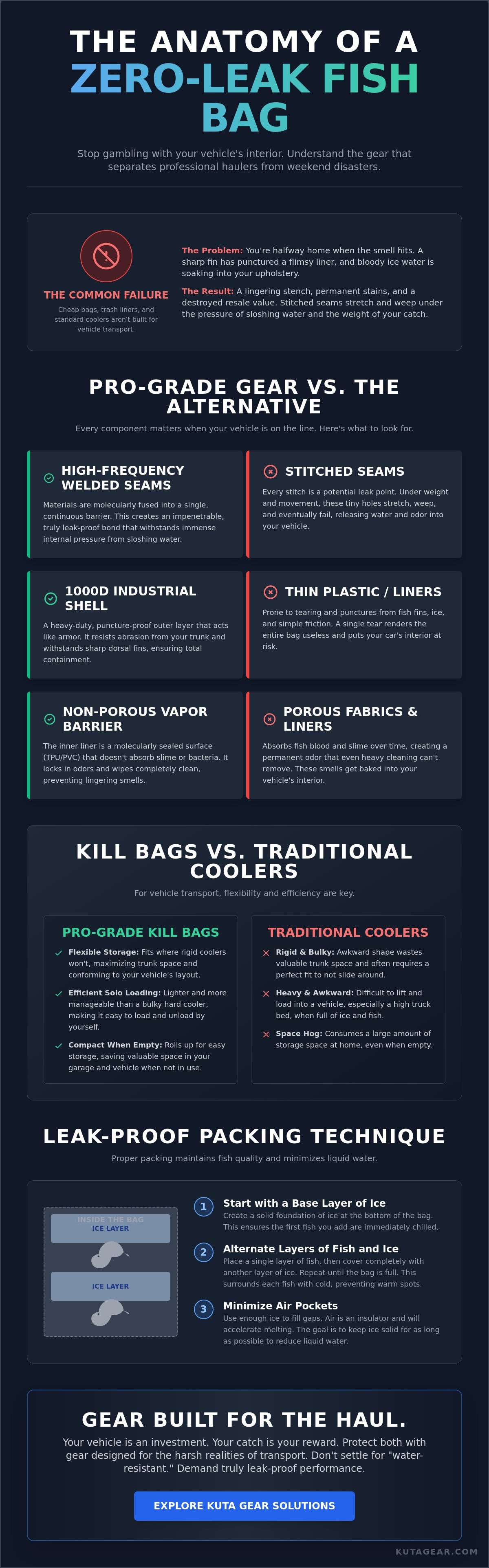
A real leak proof fish bag for car transport isn't just a thick plastic sack. It's a containment system. It must prevent liquid escape through every possible exit point. This means seals, zippers, and the material itself must be impervious. Many products claim to be "water-resistant." That's a marketing gimmick. Water-resistant means it holds back a splash. Watertight means it holds back a flood. A leak-proof bag is defined by zero exit. It means liquid stays inside the bag until you open the drain plug. Most cheap alternatives fail because they use porous materials. Over time, fish blood and slime seep into the fabric. This creates a permanent smell that no detailing job can fix. A professional-grade bag uses non-porous TPU or PVC coatings. These materials are molecularly sealed. They aren't just coated; they are transformed into a single, unified barrier.
Transporting fish in a vehicle is the ultimate stress test. Unlike Traditional coolers, which rely on rigid walls and gravity, a bag must handle dynamic movement. If the bag isn't puncture-proof, it isn't leak-proof. One dorsal fin from a snapper or a walleye will turn a 3 mil plastic bag into a sieve. You need industrial-strength armor. You don't need a disposable liner. Car transport is a brutal environment for fishing gear. You have sharp fins, heavy ice, and constant vibration. Traditional plastic bags from big-box stores are thin. They fail. A real bag for car transport needs to be puncture-proof armor that survives the ride home.
The physics of the car ride: Why bags leak
Your vehicle acts like a shaker. Every turn creates centrifugal force. This force pushes gallons of ice water against the side seams. If those seams are stitched, they will stretch. Stretched stitches leak. It's a physical certainty. The weight of the catch also creates massive pressure on the bottom seal. As the day warms up, temperature spikes accelerate ice melt. This increases the internal hydraulic pressure. A weak bag fails exactly when you're ten miles from home. You need seams that are welded, not sewn. You need a base that can support the weight of a full limit without bowing or bursting.
Vapor barriers and odor control
A leak is bad. The smell is worse. A truly leak proof fish bag for car transport acts as a vapor barrier. It locks in the organic compounds that create that "dead fish" stench. Non-porous liners are mandatory here. They don't absorb slime or bacteria. They wipe clean. High-density insulation does more than keep things cold. It provides a structural layer. This prevents moisture from sweating through the outer shell and onto your carpet. You want a clean interior. You want a fresh catch. You need gear that actually performs in the real world. Don't let a cheap bag ruin your upholstery.
The anatomy of a rugged, zero-leak kill bag
A high-performance leak proof fish bag for car transport starts with the outer shell. You don't want thin plastic. You want 1000D material. This isn't just about weight. It's about abrasion resistance. Cheap bags use metallocene polyethylene resin liners. They claim tear resistance. But a single layer of plastic is a gamble. Industrial-strength shells provide the first line of defense against the sharp edges of your vehicle's trunk and the weight of the haul.
Seams are the next failure point. Standard bags use needles and thread. Every stitch is a hole. Over time, these holes stretch. They weep. A rugged bag uses heat-welded seams. This process uses molecular bonding to fuse the materials together. It creates a single, continuous piece of fabric. If the seam isn't welded, it isn't truly leak-proof. This is the difference between a bag that lasts a month and one that lasts a decade.
Insulation thickness is often overlooked. It's not just about keeping the fish cold for dinner. It's about thermal stability. Thick insulation, typically between 1/2 inch and 2 inches of closed-cell foam, keeps ice solid for longer. Solid ice doesn't leak. Liquid water does. By maintaining ice integrity, you reduce the volume of standing water sloshing against your seals during every turn.
Lifting a sixty-pound bag into a high truck bed puts massive stress on the handles. If the handles are just stitched to the outer shell, they will eventually rip. This creates a puncture that leads straight to a leak. Look for handles that are reinforced with webbing that wraps entirely around the bag. This distributes the weight. It prevents catastrophic failure during loading. For a reliable solution, choose an insulated fish bag designed for heavy use.
Zipper technology: The weak point of most bags
Zippers are where most gear fails. A water-resistant zipper might stop a spray, but it won't stop a submerged leak. You need a fully waterproof zipper with a T-handle for leverage. These zippers require regular maintenance. Use a zipper lubricant to prevent salt-creep and ensure the teeth lock tight every time. Rugged, oversized zippers prevent jamming even in sandy or salty environments.
Inner liner durability
Inner liners must be puncture-proof. Fish like snapper and grouper have fins like needles. They will pierce a thin liner in seconds. A smooth, non-porous surface is also vital. It prevents bacterial growth. It makes cleanup fast. Industrial liners serve as the primary defense against vehicle contamination. This secondary barrier ensures that even if a fin manages to poke through, the liquid stays contained.
Kill bags vs. Traditional coolers for vehicle transport
Rigid coolers have their place on a boat deck, but the back of your SUV is a different story. They're bulky. They're heavy. They don't move. A leak proof fish bag for car transport offers a level of flexibility that a plastic box simply can't match. It fits into the irregular corners of a trunk. It collapses when it's empty. It stays exactly where you put it. Most importantly, it doesn't require a team of three people to load it into a truck bed.
Weight is a massive factor for solo anglers. A 100-quart rotomolded cooler can weigh 40 pounds before you add a single scoop of ice. By the time it's loaded with a limit of fish, it's a liability for your lower back. Soft-sided bags are light. They're designed for one person to handle. You can hoist the haul into your vehicle without a struggle. This is equipment designed for the person doing the work, not for someone looking for a status symbol to sit on the dock.
Drainage control is the final frontier of car transport. Most cheap bags use plastic caps that strip or leak after three trips. You need commercial-grade drain plugs. These must be oversized and threaded to provide a positive seal that won't vibrate loose on the highway. Thermal performance for a four-hour car ride is easily handled by high-density foam. You don't need ten days of ice retention to get home from the marina. You need stability. You need a bag that keeps the ice solid long enough to prevent a watery mess in your cargo area.
The "Slosh" Factor: Stability in the trunk
Rigid coolers are top-heavy and prone to tipping. When a boxy cooler slides during a sharp turn, the lid seal often fails because it isn't designed for total submersion. A fish bag has a naturally low center of gravity. It sits flat on the floorboards. The flexible sides allow you to "wedge" the bag against other gear or the wheel wells. It won't slide. It won't tip. It survives the commute because it conforms to the environment instead of fighting it.
Long-term storage vs. transport
Keep the massive rotomolded box at the house or on the boat. Use the bag for the ride home. Insulated bags built with professional-grade liners don't "sweat" like cheap plastic containers. This prevents exterior condensation from soaking into your carpets and creating a mildew problem. When you look at the price-to-performance ratio, Kuta Gear disrupts the market. You get the same industrial durability as premium rigid brands without paying for their bloated retail margins. It's a tool that works as hard as you do.
How to pack your catch for a leak-proof car ride
You have the gear. Now you need to use it correctly. A leak proof fish bag for car transport only performs as well as the person packing it. Start by pre-chilling the interior. Throw a sacrificial bag of ice inside while you're clearing the deck. Drain that initial melt-water before the actual catch goes in. Cold walls keep your fresh ice solid for the duration of the drive. Solid ice stays inside the bag. Liquid water looks for an exit.
Ice-to-fish ratios are critical for stability. For a standard ride home, use a 1:1 ratio by weight. If you're hauling twenty pounds of fish, you need twenty pounds of ice. Layer the load. Place a bed of ice on the bottom. Lay the fish in the middle. Cover them with the remaining ice. This sandwiches the catch in a thermal pocket. It also prevents the fish from sliding and creating pressure spikes against the seams during transport. If the fish can't move, the bag won't tip.
Securing the load is the difference between a clean car and a disaster. Don't just toss the bag in the trunk. Use your vehicle's cargo anchors. Most SUVs and trucks have D-rings or tie-down points. Run a bungee cord or a small ratchet strap through the reinforced handles of the bag. Tighten it until the bag is stationary. If the bag stays level, the internal hydraulic pressure remains even. This reduces the stress on the zipper seal during hard braking or acceleration. To secure your catch with confidence, invest in a heavy-duty 18" x 36" insulated fish bag built for the haul.
The "Burping" technique for airtight seals
Air is a heat conductor. It melts ice fast. It also creates a "balloon" effect that can force water through the zipper under pressure. Before you finish zipping the bag, press down firmly on the top. Force the excess air out. Close the zipper completely while the bag is still compressed. This "burping" technique creates a vacuum-like environment. It improves thermal retention. It makes the seal more secure against the "slosh" factor. A bag with less air is a bag that doesn't leak.
Positioning for success
The best spot for your bag is the center of the cargo area, pushed against the back of the rear seats. This is the most stable part of the vehicle. Never place a fish bag on the actual car seats. Even the best gear can have exterior moisture from the boat deck. Use a rubber cargo mat as a secondary insurance policy. It's easier to hose off a mat than to steam clean your upholstery. Once you're home, hose the bag out with mild soap and hang it upside down to dry. Proper maintenance ensures your gear survives more than one season.
Kuta Gear: Built for the haul, not just the catch
Kuta Gear doesn't build gear for the showroom. We build it for the back of your truck. Most brands focus on flashy logos and inflated price tags. They cater to the weekend warrior who wants a status symbol on the dock. We cater to the angler who wants a clean car. Our 18" x 36" Insulated Fish Bag is the definitive leak proof fish bag for car transport. It's a tool designed for performance, not prestige. It's built to withstand the grime, the weight, and the sharp edges of a real fishing trip.
The market is flooded with overpriced alternatives. Some competitors charge nearly 500 dollars for large capacity bags. Others are stuck in a cycle of backorders and logistical failures. We disregard social status in favor of value. We cut the retail margins that bloat corporate pricing. You get industrial-grade construction without the corporate markup. Our gear is in stock and ready for immediate deployment. You shouldn't have to wait months for a bag that protects your vehicle's interior today.
The 18" x 36" Advantage
Size matters when you're loading a vehicle. A bag that's too large becomes a liability in a standard trunk. The 18" x 36" dimensions are the sweet spot for versatility. This bag fits perfectly in most standard vehicle trunks and SUV cargo areas. It's large enough to handle a heavy limit of reef fish or medium-sized pelagics. It's small enough to manage solo. Kuta Gear uses industrial-grade insulation to stop exterior condensation from ever reaching your carpets. This thermal barrier keeps your catch at the right temperature while keeping the outside of the bag bone dry.
Rugged reliability you can trust
We believe in function over flashy marketing. Our bags are constructed for those who prioritize results. We use technical manufacturing processes like high-frequency welding to ensure every seam is a permanent bond. This isn't just a container; it's a partner for the hardworking angler who values their vehicle interior. It's a rebellious approach to an industry that often prioritizes aesthetics over utility. If you want gear that survives more than one season and keeps your car smelling fresh, you've found it. Shop the 18" x 36" Insulated Fish Bag at Kuta Gear and get the protection your vehicle deserves. It's time to stop paying for the logo and start paying for the performance.
Stop Gambling with Your Vehicle's Interior
You put in the work on the water. Don't let a failed bag ruin the ride home. We've established that heat-welded seams and 1000D materials are the only real defense against sharp fins and heavy ice. You now know that flexible storage fits where rigid boxes won't. You've learned the "burping" technique to ensure thermal stability and a dry trunk. These aren't just tips. They're the difference between a successful haul and a costly detailing bill.
Investing in a high-quality leak proof fish bag for car transport is a necessity for any serious angler. It's about being prepared for the professional environment. Kuta Gear offers 1000D industrial-strength construction designed for extreme marine environments. We prioritize performance over flashy marketing. This allows us to provide competitive pricing vs. big-box brands without sacrificing durability. Our gear is built for the person doing the heavy lifting.
Get the Rugged 18" x 36" Fish Bag Today. Stop worrying about your upholstery and start focusing on your next catch. Your vehicle stays clean. Your fish stays fresh. Get out there and bring home the limit with confidence.
Frequently Asked Questions
Will a fish bag really keep my car from smelling?
Yes, if the bag features a non-porous liner and a true vapor barrier. Odors are caused by organic compounds and bacteria found in fish slime and blood. A high-quality bag locks these compounds inside the containment system. If the liquid cannot escape, the smell cannot reach your upholstery. Cheap, porous materials absorb odors over time, but industrial-grade liners wipe clean and remain scent-neutral.
How do I stop my fish bag from sliding around in the trunk?
Utilize the reinforced handles and your vehicle's cargo tie-down points. Most SUVs and trucks have D-rings built into the floor or side panels. Run bungee cords or small ratchet straps through the bag handles to pull it tight against a bulkhead or seat back. This prevents the bag from shifting during sharp turns or hard braking. A stationary bag ensures the internal hydraulic pressure stays even and prevents tipping.
Can I use dry ice in an insulated fish bag for car transport?
No, avoid using dry ice in your fish bag. The extreme sub-zero temperatures of dry ice can make the internal liner brittle and lead to cracking. It also releases carbon dioxide gas as it sublimates, which can create dangerous pressure buildup inside a sealed, airtight bag. Stick to standard crushed ice, block ice, or reusable gel packs. These are safer for the bag's materials and your vehicle's environment.
What is the best way to clean a fish bag to prevent leaks and mold?
Hose the bag out with fresh water and mild soap immediately after every use. Use a soft-bristled brush to scrub the corners and seams where slime can collect. Rinse the bag until the water runs clear. The most critical step is drying. Hang the bag upside down in a shaded, well-ventilated area until it is completely dry. Storing a damp bag is the primary cause of mold growth and seam degradation.
How long will ice stay frozen in a Kuta Gear bag during a hot car ride?
Ice will remain largely solid for the duration of a standard ride home, even in high temperatures. Our insulation is designed for extreme marine environments and features high-density foam barriers. For a four-hour commute, a proper 1:1 ice-to-fish ratio ensures your catch stays at food-safe temperatures. Pre-chilling the bag before use further extends the life of your ice during the transport phase.
Is a fish bag better than a plastic bin for transporting my catch?
Yes, a bag is superior because it provides thermal insulation and a watertight seal. Plastic bins have no insulation and lids that splash or leak when the vehicle moves. A leak proof fish bag for car transport also conforms to the shape of your trunk. This flexibility allows it to fit in tight spaces where a rigid bin would slide or tip. It keeps your catch colder and your interior drier.
Do I need to double-bag my fish inside the kill bag?
You don't need to double-bag when using professional-grade gear. Our 1000D industrial-strength construction is built to withstand sharp dorsal fins and heavy loads without puncturing. Double-bagging is a tactic used to compensate for thin, low-quality liners. Trust the puncture-proof armor of your bag to handle the catch directly. This simplifies the packing process and reduces unnecessary plastic waste on the water.
What happens if the zipper on my fish bag leaks?
A leaking zipper usually means the teeth are dirty or the seal is dry. Clean the zipper track with fresh water to remove salt or sand that might prevent a full closure. Apply a dedicated zipper lubricant to maintain a positive, watertight seal. If the zipper is not specifically rated as waterproof, it should not be trusted for vehicle transport. Always ensure the zipper is pulled completely to the end of the track to lock the seal.

Also in Contact

Portable Fish Storage for Pier Fishing: The Rugged Guide to Catch Preservation

The Best Way to Chill Fish Quickly After Catch: A Professional Guide
