

Offshore Fishing Catch Storage Solutions: The Professional Guide to Meat Quality
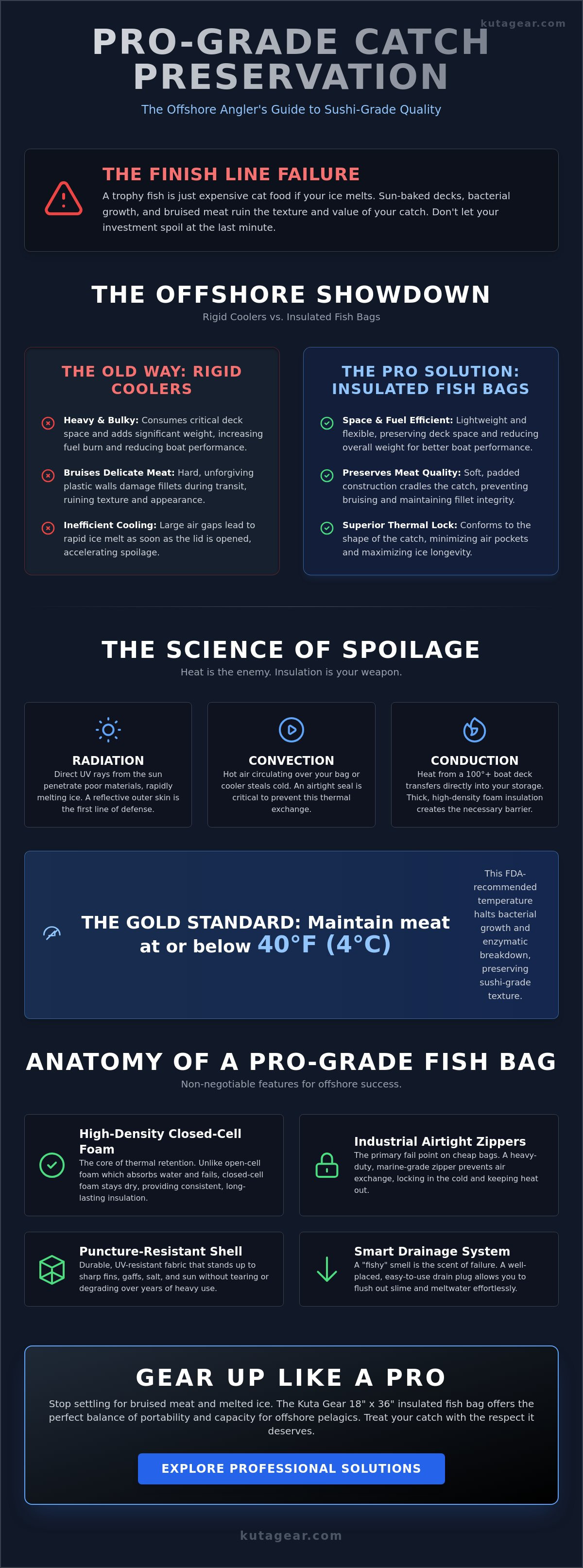
A prize tuna is just expensive cat food if your ice melts before you hit the inlet. You've fought for hours to land a trophy. Watching that meat turn mushy in a sun-baked, rigid cooler is a failure you can't afford. Most traditional boxes are heavy; they hog deck space and bruise delicate fillets during the run home. Professional anglers know that the battle doesn't end at the gaff. It ends at the cleaning table.
Finding the right offshore fishing catch storage solutions is about more than just convenience. It is about maintaining sushi-grade quality in a brutal environment. You need gear that stands up to salt, sun, and scales without compromising your boat's ergonomics. We've seen too many high-priced market alternatives fail under real-world pressure. This guide shows you how to choose a rugged, insulated strategy that keeps your catch below the FDA-recommended 40°F. You will learn how to maximize your deck space, preserve meat texture, and invest in gear that lasts for years of heavy use. Stop settling for bruised meat and melted ice. It is time to treat your catch with the respect it deserves.
Key Takeaways
- Stop the clock on spoilage. Learn how closed-cell foam insulation halts bacterial growth and enzymatic breakdown to preserve meat texture.
- Optimize your boat's performance. Discover why fish bags are the superior choice for offshore fishing catch storage solutions by saving deck space and reducing fuel burn.
- Master professional cooling techniques. Use the brine slurry method and pre-chilling strategies to lock in freshness the moment the fish hits the deck.
- Choose the right footprint. See why the 18" x 36" insulated design offers the perfect balance of portability and capacity for offshore pelagics.
- Demand industrial durability. Identify the technical specifications, from puncture-resistant materials to heavy-duty zippers, that define a professional-grade storage system.
Defining Professional Catch Storage for Offshore Success
You spent thousands on fuel, tackle, and electronics. Don't waste it all at the finish line. Catch storage isn't just a box. It's a critical system designed to halt bacterial growth and stop enzymatic breakdown. Most guys confuse tackle organization with actual preservation. One keeps your hooks sharp. The other keeps your dinner edible. Professional offshore fishing catch storage solutions prioritize the meat. They turn a dead fish into a high-value asset. If you aren't thinking about the temperature of your fillets, you aren't fishing like a pro.
Offshore environments are brutal. Inshore trips are quick; you're back at the dock in a few hours. Offshore, you're looking at twelve hours of salt spray and 90-degree heat. The thermal load on a fiberglass boat deck is massive. If you don't have a dedicated system, you're just hauling around expensive fertilizer. Proper storage directly impacts the market value and the taste of your haul. Sushi-grade isn't a marketing term. It's a temperature requirement. Using effective fish_preservation techniques is the only way to ensure your hard work doesn't end up in the trash.
The Anatomy of an Offshore Storage System
Insulation is the heart of the system. Thick, closed-cell foam is the non-negotiable metric. It creates a thermal barrier that radiation can't penetrate. Then there's drainage. A "fishy" smell is just the scent of failure. Smart design ensures you can flush out scales and slime easily. Finally, you need industrial durability. The marine environment is a meat grinder for gear. If your zippers seize or your fabric punctures, your system is dead. You need materials that resist salt and punctures from sharp fins.
Why "Good Enough" Leads to Spoiled Meat
Anglers often think a standard cooler is fine. They're wrong. A 2-degree shift in core temperature can ruin the texture of a tuna. Ice melt is the enemy. When ice turns to water, heat transfer accelerates. The FDA Food Code states that seafood must be held at or below 41°F to stay safe. Physical damage is another killer. Tossing a heavy mahi into a plastic bucket is a rookie mistake. It causes bruising that ruins the fillet. You also need UV protection. The sun doesn't just melt ice; it degrades the very materials holding your catch. Don't settle for "good enough" when your reputation is on the line.
The Science of Thermal Retention: Why Insulation Matters
Heat is a predator. It starts hunting your catch the second the fish hits the deck. To win the battle for meat quality, you must understand the physics of your storage environment. Insulation isn't just padding; it is a thermal barrier. Most cheap bags use open-cell foam. This is a mistake. Open-cell foam acts like a sponge. It absorbs moisture and salt. Once insulation gets wet, it loses its ability to hold cold. It becomes a conductor instead of a barrier. Professional offshore fishing catch storage solutions rely on high-density, closed-cell foam. These sealed air pockets stay dry and maintain their structure under the weight of heavy ice and large pelagics.
Thermal retention is a fight against three forces: conduction, convection, and radiation. Your boat deck is a heat radiator, often reaching temperatures well over 100 degrees. This is conduction. Without a thick insulated base, that heat moves directly into your ice. Convection occurs as hot air blows over the bag. Radiation is the direct hit from UV rays. The "Skin Effect" is your defense here. High-quality bags use reflective outer materials to bounce solar energy away before it penetrates the foam. If your bag is absorbing heat, your ice is already losing. Choosing a professional insulated fish bag ensures these environmental forces don't ruin your haul.
The seal is your primary fail point. If air can move, ice will melt. Zippers and closures must be industrial-grade to prevent air exchange. Even the best foam fails if the zipper leaks. Official research into fisheries technology confirms that maintaining a consistent, airtight environment is the only way to prevent rapid bacterial growth. You aren't just looking for a bag that zips; you are looking for a system that seals.
Understanding R-Values in Marine Storage
R-value measures thermal resistance. In the world of flexible fish bags, R-value is determined by the density and thickness of the internal foam. A higher R-value means heat takes longer to travel through the material. For offshore trips, you need a high-density core that can withstand direct sunlight for 10 to 12 hours. Density also prevents the foam from collapsing under the weight of a 40-pound tuna, which would create "cold spots" where ice melts faster.
Material Durability: Beyond the Insulation
Insulation is useless if the outer shell fails. You need industrial-strength abrasion resistance. Non-skid boat decks are like sandpaper. Cheap materials will shred in one season. Puncture-proof linings are equally vital. A tuna's dorsal fin or a stray hook can easily pierce thin fabric, leading to leaks and rot. UV-resistant coatings are the final layer of defense. They prevent the salt and sun from making the material brittle. You need a rugged solution that stays flexible and airtight after years of exposure.
Rigid Coolers vs. Insulated Fish Bags: The Offshore Comparison
Rigid coolers are the old standard. They're bulky. They're heavy. They're always in the way. On a midsize center console, every square inch of deck is a premium. A massive rotomolded box is a permanent obstacle. It doesn't move. It doesn't yield. For serious anglers, offshore fishing catch storage solutions must be more adaptable. You need a system that works with your boat, not against it. Insulated fish bags offer a smarter path. They fit the storage to the fish, not the fish to the box.
Weight matters for your wallet. Rotomolded coolers often weigh 40 to 60 pounds before you even add ice. Add 80 pounds of ice and a limit of snapper. Now you're burning extra fuel just to haul plastic. A fish bag weighs a fraction of that. It's efficiency at every level. The "Dead Space" problem is another silent ice killer. In a large cooler, empty space is filled with air. Air holds heat. Air melts ice. A bag collapses around the catch. It removes the air. It locks the cold in. This is why the quality assessment of fish often hinges on how quickly you can eliminate thermal gaps and stop the clock on spoilage.
Ergonomics and Boat Layout
Deck safety is about visibility and clearance. A rigid box is a trip hazard in a rolling sea. A bag is different. You can lash it to the gunwale or tuck it into a corner. It stays where you put it. You can position the storage near the point of landing. No more dragging a bloody mahi across the entire cockpit. When the day is done, you fold it. You stow it. Your deck is clear for the washdown. It's a utilitarian approach that respects your workspace.
Thermal Performance and Ice Usage
Bags excel at the "Slurry Factor." You can create a saltwater ice bath that coats every inch of the fish. This drops core temperatures faster than ice cubes alone. The ice-to-fish ratio is more efficient because there's no wasted volume. Long-term maintenance is also simpler. You don't need to climb inside a giant box to scrub the corners. You turn the bag inside out. You spray it. You dry it. It's a no-nonsense way to manage odors and keep your gear ready for the next run.
Practical Ice Management and Deck Strategy
Preparation is the difference between a professional haul and a cooler full of mush. You don't wait until the first hook-up to think about temperature. You start at the dock. Pre-chilling your offshore fishing catch storage solutions is a mandatory step. If your bag is sitting in the sun at 95 degrees, it will eat your first five pounds of ice just to cool the lining. Throw a sacrificial bag of ice inside while you're running to the grounds. When you hit the numbers, your storage system is already a cold-retention machine.
Ice management is a game of surface area. Cubes alone leave air pockets. Air is a thermal bridge. To stop bacterial growth and lock in quality, you need a total thermal envelope. The Brine Slurry Method is the industry standard for a reason. It surrounds the fish in a liquid sub-zero bath. It drops core temperatures in minutes, not hours. For the best results, you need a rugged insulated fish bag that can handle the weight and pressure of a high-volume slurry without leaking into your bilge.
The Perfect Brine Slurry
Creating the perfect slurry is a three-step process. First, fill the bottom third of your bag with clean, crushed ice. Second, add clean seawater until the ice is just floating. Aim for a 2:1 ice-to-water ratio. Third, add a handful of rock salt if you need to drop the freezing point further for pelagics like tuna. This liquid environment ensures 100 percent contact with the fish's skin.
A slurry prevents bruising because the fish floats in the liquid rather than banging against a hard surface. It maintains vibrant skin color and prevents the "freezer burn" look that occurs when meat sits directly against dry ice for too long. For snapper and grouper, a standard 1:1 ratio works. For tuna, go heavy on the ice. You want a thick, slushy consistency that stays cold for the entire run back to the inlet.
On-Deck Workflow
The clock starts the moment the gaff hits. Bleeding the fish is the first critical step. It removes body heat and prevents blood from tainting the meat. Once bled and rinsed, get the fish into the bag immediately. Orientation matters. Keep the heaviest part of the catch, the head and shoulders, low and centered in the bag. This maintains boat balance and keeps the core submerged in the coldest part of the slurry.
Secure the bag to the deck or gunwale using heavy-duty straps. Offshore swells will turn a 100-pound bag of fish and ice into a sliding wrecking ball. Managing drainage is the final piece of the strategy. Don't let bloody water sit in the bag for days, but don't dump it on a clean deck either. Use the integrated drain plugs to clear the bag once you reach the cleaning station. This keeps your boat sanitary and your catch tournament-grade.
The Kuta Gear Advantage: Rugged 18" x 36" Insulated Solutions
Size matters in a cockpit. A bag that is too big becomes a trip hazard. A bag that is too small is useless when the big pelagics start hitting the deck. The 18" x 36" footprint is the offshore sweet spot. It fits a limit of snapper or a heavy mahi without hogging your workspace. We don't do corporate fluff. We do gear that works. This is the industrial-grade answer to flimsy, mass-produced bags that fail after one season. When you invest in offshore fishing catch storage solutions, you need a system built for the grind. Our bags are designed by people who actually spend their weekends in the salt.
We built this brand because we were tired of the corporate markup. You shouldn't pay a premium for a logo. You should pay for the materials and the engineering. We are anglers who know the offshore environment. We know that salt, sun, and scales destroy cheap gear. That is why we use industrial zippers and puncture-resistant materials. Our direct-to-consumer model gives you a clear economic edge. You get high-performance storage that respects your budget. We don't hide behind retail margins. We focus on durability and immediate availability.
Technical Specs of the 18" x 36" Bag
- Insulation thickness: Engineered for maximum ice retention in high-heat environments. It holds ice when the sun is trying to bake your deck.
- Reinforced handles: Built to carry the weight of a full limit. They won't rip or fray when you're hauling 100 pounds of meat and ice to the cleaning station.
- Easy-clean liner: Spend less time scrubbing slime and more time fishing. The puncture-resistant inner layer resists odors and rinses clean in seconds.
Why Professional Anglers are Switching to Kuta Gear
Professional anglers are switching because they need reliability in the field. They want gear that withstands the environment without the prestige pricing of larger competitors. Our 18" x 36" Insulated Fish Bag is a utilitarian tool. It acts as a reliable partner that disregards social status in favor of performance. It's a rugged solution that lasts multiple seasons. We understand the specific needs of the field. We know the frustration of logistical failures and high costs. It's time to Upgrade your offshore catch storage with Kuta Gear and experience the difference on your own deck. Stop settling for gear that can't handle the heat. Invest in a solution that is built as tough as your boat.
Protect Your Haul and Your Workspace
The battle for meat quality is won before you leave the dock. You've seen how thermal retention depends on high-density insulation and the elimination of air pockets. You know that deck space is a premium resource that shouldn't be wasted on bulky, rigid boxes. A flexible, industrial-strength strategy is the only way to maintain sushi-grade freshness while keeping your boat safe. Professional results require professional gear. It is about preparedness and the right tools for the job.
Don't let your hard work spoil in the sun. Kuta Gear offers the offshore fishing catch storage solutions that seasoned anglers rely on every weekend. Our industrial-strength 18" x 36" design is engineered for extreme ice retention in the most brutal marine environments. It is a system trusted by professional offshore anglers who value performance over corporate hype. It's time to stop settling for gear that fails when the heat is on. You need a partner that is built for the grind.
Get the Rugged 18" x 36" Insulated Fish Bag for Your Next Trip and lock in the quality your catch deserves. Your next trophy shouldn't end up as cat food. Get out there and fill the bag.
Frequently Asked Questions
How long will ice last in an insulated fish bag compared to a hard cooler?
Ice retention in a high-quality bag often rivals premium hard coolers for single-day offshore trips. Because the bag is flexible, you can squeeze out the warm air that usually melts ice in a rigid box. A 36-inch bag holds up to 40 lbs of ice. This is plenty to keep a heavy haul below 40°F until you hit the dock.
What is the best way to clean an insulated fish bag to prevent odors?
Use a mild soap and fresh water immediately after every trip. Turn the bag inside out to reach every corner where scales or slime might hide. Rinse it thoroughly and hang it to dry in a shaded area. Don't use harsh bleach, as it can degrade the puncture-resistant lining over several seasons.
Can I use dry ice in a Kuta Gear insulated bag?
No, you shouldn't use dry ice in these bags. Dry ice is cold enough to make the vinyl and foam brittle, which leads to cracking and failure. Stick to crushed ice or a saltwater slurry for safe, professional-grade offshore fishing catch storage solutions. These methods provide superior cooling without damaging your gear.
How many fish can I realistically fit in an 18" x 36" bag?
You can fit several medium-sized pelagics or a full limit of reef fish in this footprint. It's designed to handle a 30-pound tuna or multiple 10-pound snappers while leaving room for a proper 2:1 ice-to-fish ratio. It is the ideal size for most center console decks where space is limited.
Do insulated fish bags leak in the back of a truck or on the deck?
High-quality bags with heat-sealed seams are designed to be water-resistant. They won't leak through the fabric or the base during normal use. However, they aren't 100 percent waterproof if they are flipped or laid on their side. Keep the bag upright and use the integrated drain plug to manage excess meltwater safely.
What is a saltwater slurry and why is it better than just ice?
A saltwater slurry is a mix of seawater and ice that creates a sub-zero liquid bath. It's better than dry ice because it provides total surface contact with the fish. This drops the core temperature faster than air-cooled ice. It also prevents bruising because the fish floats in the liquid instead of resting on hard cubes.
Are these bags puncture-resistant against sharp fins like snapper or tuna?
Yes, the inner lining is engineered to be puncture-resistant against dorsal fins and gill plates. While no material is indestructible, industrial-grade offshore fishing catch storage solutions are built to handle the sharp reality of offshore species. The heavy-duty interior layer ensures that a stray spine won't ruin your thermal barrier or cause a leak.
How do I store the bag when it is not in use?
Store the bag flat or folded once it is completely dry. Never store it while it's still damp, as this will lead to mold and permanent odors. Tucking it into a cool, dry hatch or a garage shelf keeps it out of the sun. This prevents UV degradation and ensures the bag is ready for your next run.

Also in Contact

Portable Fish Storage for Pier Fishing: The Rugged Guide to Catch Preservation

The Best Way to Chill Fish Quickly After Catch: A Professional Guide
