

Offshore Fishing Cooler Alternatives: Choosing the Right Gear for Your Deck
Your $600 hard cooler is a deck-space thief. It robs you of fuel money and fishing room. It's heavy. It's bulky. It's built on marketing hype that ignores the reality of a cramped cockpit. You need offshore fishing cooler alternatives that actually work. Hard-sided coolers have their place; however, they shouldn't dictate how much room you have to fight a fish. Most of that plastic is just dead weight until the bite turns on.
We know the frustration of tripping over an oversized plastic box that loses its chill under the midday sun. Performance shouldn't cost a mortgage payment or a disc in your back. You can maintain catch quality without the dead weight. It's about industrial-strength materials and smart design. This guide breaks down rugged, professional-grade gear that outclasses the big names in portability and price. We'll show you how to reclaim your deck, save on fuel, and keep your catch prime for the table. Get ready to ditch the overpriced marketing and focus on what matters: the fish.
Key Takeaways
- Reclaim your deck space with collapsible storage that outperforms bulky, traditional plastic boxes.
- Discover how rugged offshore fishing cooler alternatives provide professional-grade ice retention without the back-breaking weight of rotomolded gear.
- Identify critical features like closed-cell insulation and marine-grade hardware that withstand the brutal saltwater environment.
- Master the 2:1 ice-to-fish ratio and pre-chilling techniques to keep your catch tournament-ready for days.
- Stop paying for overpriced marketing hype and start investing in gear built for utility, not status.
Why Offshore Anglers are Ditching Traditional Hard Coolers
Space is the most valuable currency on a boat. Traditional hard coolers are space thieves. They feature thick, rotomolded walls that look impressive but reduce internal volume. You're carrying a massive box that holds less than it should. This is why professional anglers are moving toward offshore fishing cooler alternatives that prioritize performance per square foot. We want tools, not trophies.
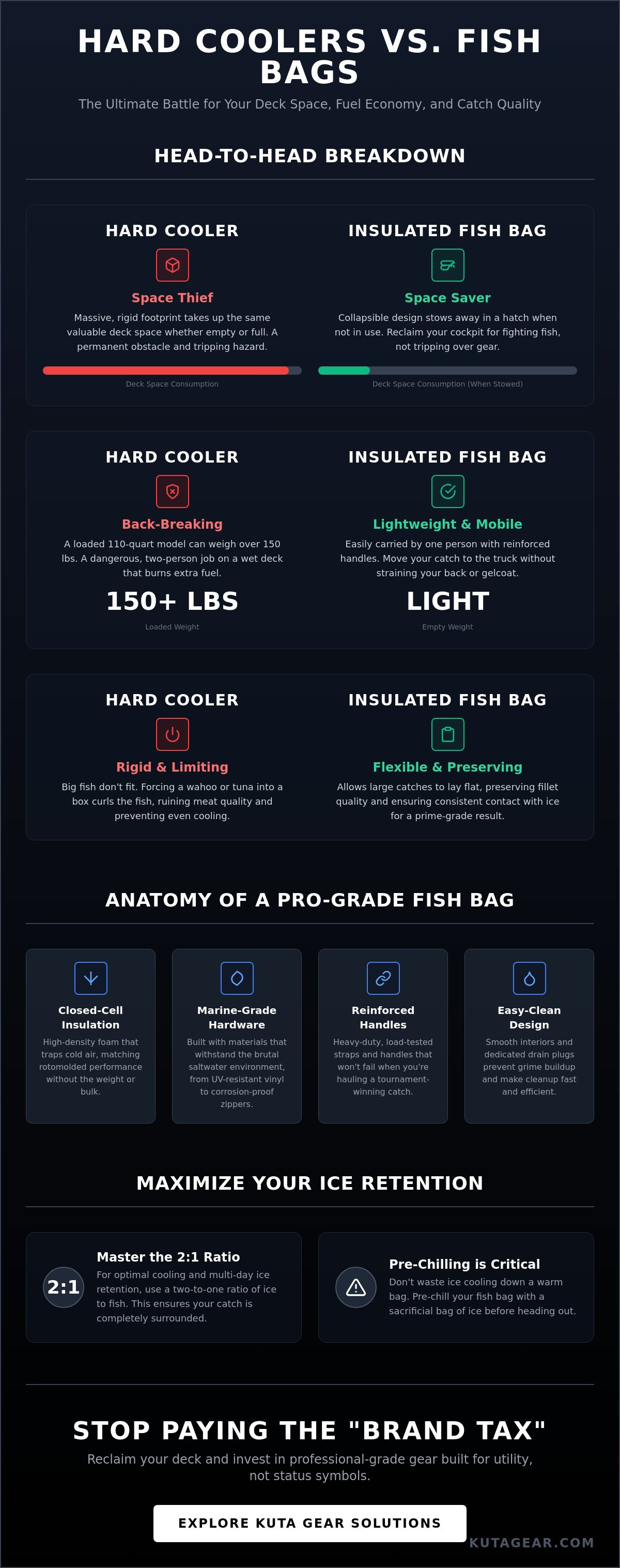
Excess weight ruins performance. A loaded 110-quart hard cooler can weigh over 150 pounds. That is a passenger you didn't invite. It throws off the boat's balance. It burns extra fuel every mile. On a long run to the canyons, that weight adds up to real dollars lost at the pump. Cleaning a rigid cooler is also a constant headache. Fish slime and blood get trapped in molded corners and around plastic drain plugs. Flexible storage solutions are easier to scrub, rinse, and dry. They don't harbor the same microbial buildup that leads to permanent odors.
You're also paying a "Brand Tax." High-end cooler companies charge a premium for marketing campaigns and lifestyle branding. That extra $300 doesn't make the ice colder. It pays for a logo on the lid. Rugged offshore fishing cooler alternatives focus on industrial-strength materials instead of showroom aesthetics. We need gear that survives the salt, not gear that looks good in a catalog.
The Real Cost of Rigid Storage
Footprint matters. A rigid cooler takes up the same amount of room whether it is full of tuna or completely empty. It is a permanent obstacle. Securing these beasts in a 4-foot swell requires heavy-duty tie-downs. If those straps fail, you have a 200-pound projectile in the cockpit. While rotomolding offers durability, it creates a massive exterior for a modest interior. Effective methods of preserving fish require consistent contact with ice, not just thick plastic walls. You need storage that conforms to the catch. Our gear is built for the deck, not the showroom.
Managing Small Deck Real Estate
Tripping hazards end fishing trips. An oversized cooler in the middle of the deck is a liability during a chaotic hookup. You need a clear path to follow a running fish. Flexible storage solutions solve this problem. They sit flush against the gunwale. They can be moved as the bite shifts. When the day is done and the fish are processed, you can stow them away in a hatch. Don't let your gear dictate your boat's layout. Choose gear that adapts to the mission and keeps the deck clear for the fight.
Evaluating the Alternatives: Fish Bags vs. Hard-Sided Coolers
Choosing between a bag and a box isn't about preference. It's about the mission. Hard-sided coolers offer structural rigidity. They're heavy. They're permanent. High-performance insulated fish bags offer flexibility. They're light. They stow away. When evaluating offshore fishing cooler alternatives, you must weigh physical strain against total utility. A heavy box is a liability in a pitching sea. A bag adapts to the deck and the catch.
Ice retention is the primary concern for most. Modern bags utilize high-density, closed-cell insulation. This material traps cold better than the hollow-fill found in cheap retail coolers. Scientific data regarding ice use on small fishing vessels proves that insulation quality, not wall thickness, determines success. A well-constructed bag can hold ice for days. It matches rotomolded performance without the weight penalty. You're not sacrificing freshness for the sake of convenience.
Portability is where the bag wins every time. Dragging a 100-pound plastic box across a wet deck is dangerous. It damages your gelcoat. It strains your back. A bag has reinforced handles. You can carry it like a duffel. One man can move a limit of snapper to the truck. A hard cooler requires a team or a cart. If you're looking for offshore fishing cooler alternatives that save your spine, the choice is clear.
When an Insulated Fish Bag Wins
Big fish don't fit in boxes. A 50-pound wahoo or a schoolie tuna will curl in a hard cooler. This ruins the meat. The 18" x 36" Insulated Fish Bag allows the catch to lay flat. This preserves the fillet quality and ensures even cooling. Cleaning is straightforward. Most bags feature a smooth interior and a dedicated drain plug. You spray it out, hang it up, and you're done. For those prioritizing catch care and deck space, a professional-grade fish bag is the logical choice.
When a Hard-Sided Cooler is Non-Negotiable
Sometimes you need a seat. If your boat lacks a leaning post or enough gunwale seating, a hard cooler serves a dual purpose. It's a bench. It's a casting platform. It won't compress under your weight. Hard coolers are also better for protecting delicate supplies. Bread, electronics, or dry goods shouldn't be crushed. If you're running a multi-day trip where the cooler stays stationary, the structural integrity is a benefit. It becomes part of the boat's furniture. It provides a solid base in a rough environment.
Key Features to Look for in Offshore Storage
Don't get distracted by flashy colors or celebrity endorsements. Real offshore performance comes down to technical specifications. When you're 40 miles out, you need gear that resists the elements. You need offshore fishing cooler alternatives designed for industrial-strength utility. Every component must serve a purpose. If a part doesn't contribute to ice retention or durability, it's just extra weight.
Start with the insulation. Closed-cell foam is the professional standard. It doesn't absorb water. It doesn't collapse. Cheap alternatives use hollow air pockets that fail the moment the sun hits the deck. Look for marine-grade hardware. Saltwater destroys standard zippers and hinges in a single season. You need oversized, corrosion-resistant zippers and UV-stabilized materials. If the sun can rot the fabric, the gear is useless. Drainage is equally critical. A fast-flowing plug or a gusseted bottom ensures you aren't fighting a pool of bloody water at the end of the day. Choosing the right offshore fishing cooler alternatives requires looking past the brand name and focusing on the core materials.
Insulation Quality and Wall Thickness
Wall thickness is a common marketing trap. Thick walls don't matter if the core is low-quality. Pressure-injected foam provides a dense thermal barrier that air-filled plastic cannot match. High-quality lid gaskets are also essential. They create an airtight seal that prevents heat transfer. R-value is the quantitative measure of a material's thermal resistance, dictating how effectively your storage solution prevents ambient heat from compromising your ice supply. Better R-value means more ice at the end of the trip. It's that simple.
Durability and Material Construction
High-performance bags, like the 18" x 36" Insulated Fish Bag, rely on heavy-duty vinyl and reinforced stitching. This construction handles the thrashing of a large pelagic without tearing. For hard coolers, rotomolded construction offers superior impact resistance. It survives drops and rough handling on the dock. Non-skid bottoms are a final, non-negotiable feature. Your gear must stay where you put it. A sliding cooler is a danger to your boat and your crew. Professional gear stays planted, even when the deck is covered in scales and slime.
Standout Kuta Gear Solutions for Your Deck
Kuta Gear doesn't sell logos. We sell industrial-strength storage. If you're tired of paying for a corporate marketing budget, you need offshore fishing cooler alternatives that prioritize the mission. We've engineered our lineup to handle the brutal reality of the open ocean. No fluff. No retail markups. Just rugged gear that keeps your ice frozen and your catch prime. We focus on utility because we know that performance is the only thing that matters when you're miles from the dock.
Our hard-sided coolers are built for the long haul. We use rotomolded construction to withstand impacts that would shatter cheap retail boxes. We offer compact 20qt to 45qt options. These are perfect for bait, drinks, or lunch. They fit in tight corners. They don't move. For the serious offshore haul, our 75qt+ capacity models provide the volume you need for a limit of snapper or grouper. Every unit features heavy-duty latches and airtight gaskets. Cold stays in. Heat stays out. This is the professional standard for gear that actually works.
The Hard-Sided Collection: Rugged and Reliable
Reliability is non-negotiable. You can't have a latch fail when you're 50 miles out. Our Kuta Hard-Sided Cooler Collection uses reinforced hardware designed for high-stress environments. We've included built-in tie-down points. Your cooler stays secured to the deck during rough transport. It won't slide. It won't tip. The airtight seals ensure maximum cold retention, even in direct tropical sun. You get the same performance as the big-name brands for a fraction of the cost. We cut the retail margins so you can buy more fuel.
The Hybrid Approach: Bag and Cooler Synergy
Pros don't just pick one. They use a system. This is the ultimate strategy for offshore fishing cooler alternatives. Use a hard-sided cooler for your primary ice storage and refreshments. Keep it closed to preserve the core temperature. When you land a fish, it goes into the 18" x 36" Insulated Fish Bag. This combination maximizes your deck space. You aren't opening your main ice source every time you catch a fish. The bag stays out of the way until it's needed. It's a high-efficiency workflow that keeps your catch tournament-grade. This synergy ensures you have room to fight the next fish without tripping over a massive plastic box. Ready to upgrade your boat's storage? Shop the Kuta Gear lineup today and experience professional-grade utility.
Making the Switch: Maximizing Your Ice Retention
Don't waste money on ice just to watch it melt. Even the best offshore fishing cooler alternatives fail without proper technique. It's about thermodynamics, not brand names. Pre-chilling is the #1 rule for any serious run. If your cooler or bag is hot when you load it, the first 20 pounds of ice will melt just cooling the walls. That's a rookie mistake that costs you catch quality. Start cold and stay cold.
Use the "Sacrificial Bag" method. Load a bag of cheap ice the night before your trip. Let it sit. Dump the water and the melted slush right before you head to the ramp. Now, your insulation is already at temperature. Your "real" ice will last twice as long. This is how pros maintain catch quality in the 100-degree sun. It's a simple step that separates the experts from the amateurs.
Follow the 2:1 ice-to-fish ratio. It sounds like a lot of ice. It is. But if you want tournament-grade fillets, you can't skimp. Pack the ice around the fish. Eliminate air pockets. Air is the enemy of cold. If you're using offshore fishing cooler alternatives like a high-performance bag, the flexible walls help you squeeze out that extra air. This maximizes contact between the ice and your catch. It ensures the core temperature drops fast and stays there.
Manage your drainage with purpose. Don't dump the cold water unless you're adding fresh ice. Chilled saltwater is an incredible heat sink. It keeps the entire catch at a uniform temperature. Get rid of the water only once it gets bloody or reaches room temperature. A gusseted bottom or a high-flow drain plug makes this process fast. You don't want your fish swimming in lukewarm soup.
Pro Tips for Longer Ice Life
Block ice is for endurance. Crushed ice is for surface area. Use blocks at the bottom of your storage for a multi-day run. Use crushed ice to pack between the fish. This combination provides both longevity and immediate cooling. Keep the lid closed. Every time you open it, you lose cold air. Plan your moves. Get what you need and seal it back up. This discipline extends your ice life by hours.
Cleaning and Maintenance
Salt and slime destroy gear. Don't just rinse it. Use a mild, non-toxic soap and a soft brush. Pay attention to the gaskets and zippers. If you store your gear wet, it will mold. If you store a hard cooler with the lid latched, the gaskets will compress and lose their seal. Prop the lid open. Let it breathe. The Kuta Gear collection features smooth surfaces and accessible drains to make this process fast. We build gear for the fisherman, not the weekend warrior. Clean it. Dry it. Ready it for the next run.
Take Command of Your Deck Space
Stop letting overpriced gear dictate how you fish. You've seen how offshore fishing cooler alternatives like high-performance bags and streamlined boxes reclaim your cockpit. It's about efficiency. It's about catch quality. You now have the technical blueprint to maximize ice retention and minimize dead weight. Don't let a brand tax rob you of fuel money or fighting room. Professional fishing requires professional tools, not lifestyle accessories.
It's time to equip your boat for the reality of the salt. You need gear that survives the sun and the swell. Kuta Gear delivers industrial strength without the retail markup. Our products feature rugged rotomolded construction and professional-grade ice retention. They're engineered for demanding marine conditions because we know what the offshore environment does to inferior equipment. Upgrade your offshore storage with Kuta Hard-Sided Coolers. Get back on the water with gear that works as hard as you do. Tight lines.
Frequently Asked Questions
Is an insulated fish bag better than a hard cooler for offshore fishing?
It depends on your boat's layout and your target species. Bags are the superior choice for space management and large pelagics like tuna that won't fit in a standard box. They stow away when empty to clear your deck. Hard coolers are better if you need a casting platform or extra seating. Most pros use both as part of a high-efficiency storage system.
How long will ice last in a Kuta Gear hard-sided cooler?
You can expect multi-day ice retention even in direct tropical sun. Performance depends on pre-chilling the unit and minimizing lid openings. Our pressure-injected insulation and airtight gaskets are engineered to match the performance of high-priced market leaders. It provides the thermal barrier you need for long runs to the canyons without the unnecessary brand markup.
Can I use a regular cooler for offshore fishing?
You can, but it won't survive the environment. Standard retail coolers use hollow walls and cheap plastic hinges that fail in saltwater. They lack the UV resistance required for constant sun exposure. Professional offshore fishing cooler alternatives are built with marine-grade hardware and rotomolded shells to handle the physical abuse and corrosive nature of the open ocean.
What is the best way to clean a fish bag after a trip?
Rinse the bag immediately with fresh water and use a mild, non-toxic detergent to scrub away blood and scales. Pay close attention to the seams and the drain plug area. Always hang the bag upside down with the zipper open to air dry completely. This prevents mold growth and ensures the bag is ready for your next trip without harboring foul odors.
How much ice do I need for a full day of offshore fishing?
Adhere to the 2:1 ice-to-fish ratio to ensure maximum freshness. If you expect to bring home 50 pounds of catch, you need at least 100 pounds of ice. This volume ensures the fish stay completely submerged in a chilled environment. Skimping on ice is a fast way to ruin expensive fillets and waste a successful day on the water.
What happens if my cooler latches break while offshore?
A broken latch is a safety hazard and a thermal failure. It allows cold air to escape and turns the cooler into a sliding projectile. Kuta Gear uses heavy-duty, corrosion-resistant latches to prevent this. If a cheap latch snaps while you're out, use a heavy-duty bungee cord as a temporary fix to maintain the seal until you return to the dock.
Are Kuta Gear coolers bear-resistant or just for fishing?
Our coolers are built for industrial-strength durability across all outdoor applications. While we prioritize the marine environment, the rotomolded construction and reinforced seals make them suitable for hunting and camping. They are designed to withstand extreme impact and external pressure. Whether it's a shifting boat or a curious animal, the gear is built to hold its ground.
Do fish bags leak in the back of my truck?
Professional bags like the 18" x 36" Insulated Fish Bag feature heat-sealed seams designed to contain fluids. They won't leak if the drain plug is secured and the zipper is closed properly. However, you should always wipe down the exterior to remove any slime or scales before loading. It's smart to place the bag on a mat to prevent accidental mess from external debris.

Also in Contact

Portable Fish Storage for Pier Fishing: The Rugged Guide to Catch Preservation

The Best Way to Chill Fish Quickly After Catch: A Professional Guide
