

Preserving Sushi Grade Fish on the Boat: The Professional Angler's Protocol
Sushi grade is not a label you buy at the store. It is a rigorous on-boat manufacturing process that begins the moment your hook sets. If you wait until you hit the dock to think about meat quality, you have already lost. Mastering the protocol for preserving sushi grade fish on boat is the only way to transform a raw catch into a restaurant-ready masterpiece. Amateurs settle for mushy fillets and "burnt" meat. Professionals control the chemistry of the kill.
You know the frustration of opening the hold to find "yakimi" tuna or a bloodline that has ruined the entire loin. It's a waste of effort and a waste of a world-class resource. We are going to fix that. This guide provides the technical blueprint for on-boat handling and thermal management. You'll learn the Ike Jime method, the exact ratios for a -4°C saltwater slurry, and the thermal protocols needed to maintain firm texture and clean flavor. We're moving past marketing fluff. We're focusing on the industrial-strength reality of keeping fish cold in high-heat environments to maximize the value of every catch.
Key Takeaways
- Understand that sushi grade is a handling standard. Execute the protocol on deck to prevent meat degradation and "burnt" flesh.
- Master the Ike Jime protocol. Spike, bleed, and destroy the nerves to stop stress hormones and lock in restaurant-quality flavor.
- Use a saltwater slurry for preserving sushi grade fish on boat. Achieve temperatures lower than freshwater ice to chill catch rapidly.
- Eliminate insulating air pockets and meat bruising. Discover why flexible insulated bags outperform rigid coolers in high-heat environments.
- Maintain professional-grade storage. Apply technical thermal management to keep your catch pristine from the strike to the table.
The Sushi Grade Myth: Why Handling Starts on the Deck
The term "sushi grade" is a marketing label. It is not a legal FDA classification. The government does not inspect your boat and hand out stickers for raw-safe fish. In the professional world, sushi grade is a manufacturing standard. It is the result of a rigorous, time-sensitive process that happens on your deck. If you wait until you reach the dock to think about meat quality, you have already failed. Preserving sushi grade fish on boat starts with the understanding that you are a technician, not just an angler. You are managing a biological product under extreme environmental stress.
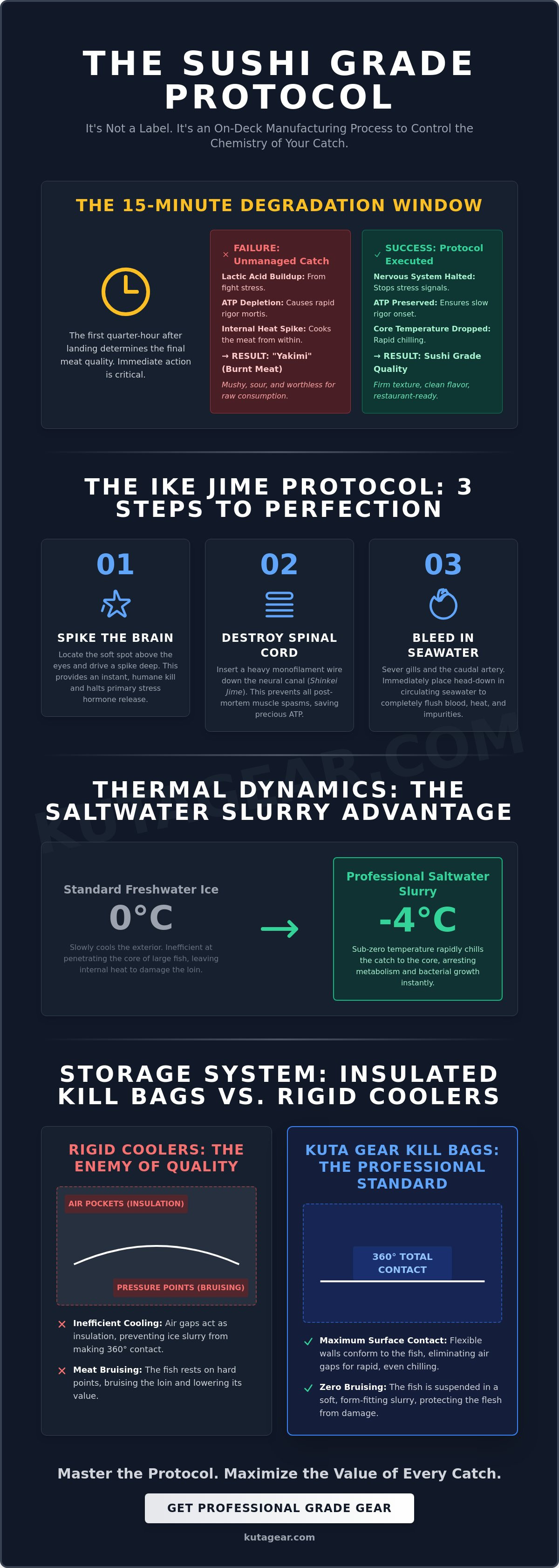
When a fish fights the line, it is a chemical bomb. Lactic acid floods the muscles. Body temperatures spike. This post-catch stress leads to "yakimi," also known as burnt meat. The flesh turns pale, sour, and mushy. It becomes worthless for raw consumption. Immediate intervention is the only way to arrest this anaerobic metabolism. You must stop the chemical chain reaction before it destroys the texture and flavor of the loin. There is no middle ground. You either control the chemistry or the chemistry controls the catch.
Biology of Meat Degradation
A struggling fish consumes its ATP (Adenosine Triphosphate) rapidly. ATP is the energy source that keeps muscles flexible. When ATP is depleted, rigor mortis sets in almost immediately. You want a slow onset of rigor. Fast rigor results in tough, dry meat that leaks moisture. During a long fight, a tuna's body temperature can rise 10 to 15 degrees above the surrounding water. This internal heat literally cooks the protein structures from the inside out. In scombroid species like tuna and mackerel, this stress also triggers histamine buildup. This is not just a quality issue; it is a safety hazard. High histamine levels can cause scombroid poisoning. You must kill the heat to kill the risk.
The 15-Minute Window
You have fifteen minutes. That is the timeline to determine the final grade of the meat. The first quarter-hour after the fish hits the deck is the most critical period of the day. This is where you execute the Ike Jime Protocol to shut down the nervous system. You aren't just dispatching the animal. You are stopping all stress signals and chemical releases.
Professional anglers establish a zero-tolerance policy for deck heat exposure. Every second the fish sits on a hot fiberglass deck, the quality drops. Identify your "sushi-potential" species early. If a fish is too small or was fought to total exhaustion, it may only be standard table fare. For the prize catches, the protocol must be flawless. Preserving sushi grade fish on boat requires a clinical environment. Keep the deck wet. Keep the tools ready. Move fast. The sun is your primary enemy, and it never stops working against you.
The Ike Jime Protocol: Neurological and Vascular Management
Don't just kill the fish. Shut down the system entirely. The Ike Jime protocol is the industrial gold standard for preserving sushi grade fish on boat. It is a calculated, three-step execution: spike, bleed, and nerve destruction. Most anglers stop after the spike. That is a failure of technique. Spiking the brain stops the immediate stress signals, but the peripheral nerves are still active. If the muscles keep twitching, they continue to burn ATP. You need a total neurological blackout to lock in the texture and prevent the meat from tightening up prematurely. This isn't about aesthetics; it's about chemistry.
Spiking and Spinal Cord Destruction
Locate the brain's soft spot. On most pelagic species, this is a small indentation slightly above and behind the eyes. Drive your spike deep and angle it toward the tail. You'll see the fins flare and the body give a final shudder. That is the brain shutting down. Now, you must address the neural canal. Insert a stainless steel wire or heavy monofilament into the spike hole and run it down the full length of the spine. This "Shinkei Jime" phase destroys the spinal cord. It prevents post-mortem muscle firing and saves every bit of remaining ATP. Look for an immediate color change and a total relaxation of the body. If the fish is still stiff, you missed the canal.
Vascular Bleeding Techniques
Blood is the enemy of clean flavor. It carries internal heat and metallic impurities that ruin a delicate loin. Once the nerves are dead, sever the gills on both sides. Make a deep cut at the caudal artery near the tail. Do not let the fish bleed out on a hot deck. Drop the catch head-first into a bucket of circulating seawater. This is a critical principle in White Fish Handling Aboard Fishing Vessels because seawater immersion prevents premature clotting. The water pressure assists in flushing the vascular system completely. If you leave blood in the fish, you are leaving the primary source of spoilage behind.
Let the fish bleed for roughly ten minutes. The water will turn deep crimson. Once the drainage stops, the meat is clean and the core temperature has already started to drop. You have successfully managed the biological systems. The next step is environmental control. Move the catch immediately into professional-grade insulated storage to ensure the thermal management phase begins without delay. Every minute spent on the deck is a minute of quality lost.
Thermal Dynamics: The Saltwater Slurry Method
Air is an insulator. In the world of thermal dynamics, air is the enemy. Standard ice cubes create air pockets. These pockets trap heat against the skin and allow internal temperatures to remain in the danger zone. Water conducts heat 25 times faster than air. To master preserving sushi grade fish on boat, you must eliminate the air entirely. You need a medium that wraps the entire catch in a uniform thermal blanket. This is the saltwater slurry method. It is the only way to move heat out of a large pelagic fish before the meat begins to degrade.
A saltwater slurry is not just cold water. It is a super-cooled environment. Salt lowers the freezing point of water. While freshwater ice melts at 32°F, a proper brine can maintain a temperature of -4°C. This rapid core cooling is the only way to stop internal bacterial growth and arrest the production of histamines. Standard refrigeration is too slow. It cannot penetrate the thermal mass of a warm-blooded tuna fast enough to save the grade. You need the aggressive heat transfer of a liquid to lock in the quality.
Creating the Perfect Slurry
Start with clean offshore seawater. Do not use dock water. Surface bacteria and fuel runoff will contaminate your catch before you even start. Use a 2:1 ice-to-water ratio. You want a thick, slushy consistency that flows into every cavity and ensures total surface contact. This physics-based approach maximizes the surface area of the cooling medium. Monitor the temperature closely. You are aiming for maximum chill without freezing the meat. Partial freezing destroys cellular integrity. It turns firm sushi into a mushy, watery mess once the fish is processed.
Core Temperature Reduction
Target a core temperature of 32°F (0°C) immediately. Large fish act like heat sinks. They stay warm for hours if you just throw them on a bed of ice. A 50lb tuna requires sustained immersion to stabilize the internal temperature and stop the "cooking" process from within. Keep the fish in the slurry until the core heat is gone. Once the temperature is stabilized, transition the catch to long-term storage in a dedicated insulated environment. This ensures the meat stays at the threshold of freezing without the risk of ice crystal damage. Professional results require professional thermal management. Amateurs use ice; pros use physics.
Eliminating Air Pockets: Kill Bags vs. Rigid Coolers
Rigid coolers are built for beer and sandwiches. They are not built for preserving sushi grade fish on boat. A rigid box has fixed dimensions. When you put a 30-inch tuna in a 40-inch cooler, you create a cavern of dead air. As the boat moves, that air circulates. It carries heat. It melts your ice. A flexible kill bag is different. It conforms to the shape of the catch. It collapses to eliminate air pockets. You are creating a vacuum-sealed thermal environment. This is industrial-grade efficiency. It ensures every square inch of the fish stays in contact with the cooling medium.
Bruising is the second failure point of rigid coolers. A hard plastic wall has zero give. In heavy seas, your fish slides. It slams against the sides. This causes internal bruising and blood spots in the loin. A kill bag acts as a shock absorber. It pins the fish in place. It protects the delicate flesh from impact. This is how you maintain the visual and structural integrity required by high-end sushi chefs. When the bag is empty, it rolls up. It takes up zero deck space. It stays out of the way until it is needed. That is utilitarian design.
Why Insulation Thickness Matters
Closed-cell foam is non-negotiable. Open-cell foam acts like a sponge. It absorbs blood, saltwater, and bacteria. Once it's contaminated, it's garbage. Professional bags use dense, closed-cell insulation. It stays dry. It stays light. It holds ice for days; even in direct tropical sun. The zipper is your thermal seal. A cheap plastic zipper leaks air and fails under pressure. An industrial-grade, heavy-duty zipper locks the cold in and keeps the environment stable. If you are serious about your catch, upgrade to an 18" x 36" Insulated Fish Bag built for the demands of the open ocean.
Storage Orientation and Protection
Keep the fish straight. If a fish sets in a curve during rigor mortis, the muscle fibers stretch on one side and compress on the other. This ruins the texture and makes slicing impossible. Lay the catch flat. Use a plastic barrier or a dedicated liner bag to prevent direct contact with melting freshwater ice. Freshwater contact causes osmotic pressure changes. It turns the skin dull and the meat watery. Stacking matters too. Put your largest, heaviest fish at the bottom. Don't crush your prize loins under the weight of the day's limit. Use the bag's flexibility to layer your catch properly. Maintain the protocol until you hit the cutting board.
The Kuta Gear Standard: Professional Grade Storage
The protocol is only as strong as its weakest link. You can spike the brain and bleed the gills perfectly. If your storage leaks heat, the meat still turns mushy. The Kuta Gear 18" x 36" Insulated Fish Bag is the industrial solution. It is built for the professional angler who disregards social status in favor of performance. This bag is designed to maintain the thermal integrity required for preserving sushi grade fish on boat. It doesn't just hold ice. It creates a stable, insulated environment that halts biological decay. It's a tool. It's built for work. It's the final piece of the sushi-grade puzzle.
Marine gear fails. It's a fact of life on the water. Most bags tear at the seams or the zippers seize after one season of salt exposure. We use heavy-duty components designed for the harshest marine conditions. Our insulation isn't just a thin layer of foam. It is high-performance material tailored for long-duration temperature sensitivity. You are buying a tool that works as hard as you do. It's a seasoned expert's choice. Reliability over aesthetics. Every single time. We don't do marketing hype. We do results.
Engineered for Performance
Punctures are inevitable on a working deck. Fins, gaffs, and knives are everywhere. Our materials are selected for extreme durability and environmental resistance. They resist the tears that ruin the thermal seal of standard bags. The 18" x 36" footprint is the tactical sweet spot. It handles the most common sushi targets with ease. It's large enough for a quality yellowtail but compact enough to manage on a crowded center console. Cleaning is simplified because hygiene is non-negotiable for raw fish. The surfaces are slick. They don't harbor bacteria or 'old fish' odors. You start every trip with a sterile field and professional-grade utility.
Reliability for Every Angler
We don't build for the hobbyist who wants a pretty logo. We build for the captain who needs the fish to stay pristine until it hits the cutting board. We offer immediate availability. You won't find backorders or logistical failures here. We focus on utility and value. We cut the retail fluff to give you a competitive edge. If you want restaurant-quality results, you need professional-grade equipment. Upgrade your catch care with the Kuta Gear 18" x 36" Insulated Fish Bag. It’s time to stop settling for standard coolers. Start protecting your investment with a bag that is as hardworking and adventurous as you are.
Master the Protocol for Restaurant-Quality Results
Mastering the biological and thermal variables is the difference between a wasted trophy and a world-class meal. You have the technical blueprint now. Use the Ike Jime method to shut down the nervous system. Deploy a saltwater slurry to crash the core temperature. These aren't suggestions; they are the industrial requirements for preserving sushi grade fish on boat. If you skip a step, you sacrifice the grade. It is that simple.
Amateurs hope for the best. Professionals eliminate the variables. Your gear must be as reliable as your technique. Don't let a generic plastic cooler ruin a day of hard work. You need a system engineered for maximum ice retention and marine-grade durability. It is time to treat your catch with the respect it deserves. Every strike is an investment of time and fuel. Protect that investment with the right tools.
Secure your catch with the Kuta Gear 18" x 36" Insulated Fish Bag. It is built with heavy-duty 18" x 36" construction to survive the harshest environments on the planet. Get back on the water and turn your next catch into a masterpiece.
Frequently Asked Questions
What exactly makes a fish 'sushi grade'?
Sushi grade is a marketing term that signifies a rigorous handling standard. It is not a legal FDA classification. It means the fish was dispatched using Ike Jime, bled immediately, and rapidly chilled to prevent parasite activity and bacterial growth. If you don't follow the protocol for preserving sushi grade fish on boat, the label is meaningless. Quality is manufactured on the deck through chemistry and temperature control.
How long can sushi-grade fish stay in an insulated bag?
Your catch will stay in pristine condition for 24 to 48 hours if you maintain a constant 32°F environment. The key is monitoring your ice levels. If the slurry turns into lukewarm water, the grade is lost. High-performance bags allow for extended storage, but for restaurant-quality sushi, you should process and properly freeze the loins as soon as you hit the dock.
Is it safe to use tap water ice for preserving sushi fish?
Yes, but you must prevent direct contact between the fish and melting freshwater. Freshwater ice is fine for creating a saltwater slurry with offshore seawater. However, direct contact with melting freshwater causes osmotic pressure changes that turn the flesh mushy and dull. Always use a plastic barrier or keep the fish submerged in a proper brine to protect the cellular integrity of the meat.
Why is bleeding the fish so important for raw consumption?
Blood is a primary source of spoilage and off-flavors. It carries internal heat and metallic impurities that sour the meat. When you bleed the fish head-first in seawater, you flush the vascular system and lower the core temperature. This ensures the loins remain clean, translucent, and free of the "fishy" taste associated with poor handling. Clean bloodlines result in clean flavor.
Do I need to gut the fish on the boat for sushi?
You should gut larger species to arrest internal decay. The viscera hold immense heat and digestive enzymes that begin eating the meat from the inside out the moment the fish dies. Removing the guts allows the saltwater slurry to cool the core from both sides. It is a necessary step for preserving sushi grade fish on boat when dealing with high-mass pelagics like tuna or swordfish.
Can I use a regular cooler instead of a fish kill bag?
A regular cooler is an inferior tool for this job. Rigid walls create air pockets that trap heat and allow the fish to slide and bruise during transit. A flexible bag conforms to the catch, eliminates air, and pins the fish in place. If you want professional results, stop using recreational coolers. Use a tool designed for the specific dimensions and thermal needs of a large catch.
How do I clean my Kuta Gear bag to ensure food safety?
Hygiene is mandatory for raw food safety. Scrub the bag with mild soap and freshwater after every trip. Use a 10% bleach solution to sanitize the interior surfaces and kill any lingering bacteria. Rinse thoroughly and hang the bag open to dry completely in the sun. Our closed-cell foam and easy-clean liners are designed to prevent odors, but only if you do the work.
What is the best way to spike a tuna for Ike Jime?
Locate the soft spot on the forehead slightly above the eyes. Drive your spike at a 45-degree angle toward the rear of the head. You are targeting the brain to shut down the nervous system instantly. You'll know you hit the mark when the fins flare and the body relaxes. Follow this immediately with spinal cord destruction to stop all residual muscle firing and ATP consumption.

Also in Contact

Portable Fish Storage for Pier Fishing: The Rugged Guide to Catch Preservation

The Best Way to Chill Fish Quickly After Catch: A Professional Guide
