

Puncture Resistant Fishing Bags: Why Durability is Your Only Real Metric
Most "heavy duty" fish bags are just glorified grocery sacks waiting to be gutted by a bottom-dweller's dorsal fin. You haul a solid catch over the gunwale, slide it into the insulation, and ten minutes later, a trail of blood is leaking across your deck. The fins went through the liner. The zipper is already jamming from salt spray. It's a failure of engineering, not a lack of luck. You need a puncture resistant fishing bag that treats durability as a structural necessity, not an optional feature.
We know the frustration of gear that quits before the season ends. You want equipment that handles the rigors of offshore fishing without turning your truck bed into a crime scene. This article reveals the industrial-grade engineering required to stop fish fins and hooks from destroying your gear. We examine the technical specifications of TPU liners and sonic-welded seams. You'll learn how to identify a bag that keeps the catch cold and the boat clean for years of heavy use.
Key Takeaways
- Understand why a true puncture resistant fishing bag requires specialized liners to stop sharp dorsal fins and stray hooks from causing leaks.
- Discover why 1000D fabrics and TPU liners outperform standard PVC for long-term gear reliability in harsh marine environments.
- Learn the critical difference between surface abrasion and internal punctures to ensure your storage handles both boat decks and thrashing fish.
- See how industrial-grade construction maintains its integrity under high-pressure impacts and extreme temperature shifts during offshore trips.
- Identify the specific engineering requirements needed to keep your catch cold and your boat deck clean season after season.
What Defines a Truly Puncture Resistant Fishing Bag?
Durability is often used as a marketing buzzword, but in the offshore environment, it is a technical requirement. Real performance isn't about how a bag feels in a showroom. Puncture resistance is defined as a material's ability to withstand sharp objects under concentrated pressure. For an angler, the enemies are specific: needle-sharp dorsal fins, jagged gill plates, and stray 7/0 hooks. A true puncture resistant fishing bag doesn't rely on just being "thick." It relies on the density of the weave and the industrial-grade chemistry of the layers. High-performance gear uses a multi-layered approach to stop penetration before it reaches the core insulation. If a bag relies on a single layer of plastic, it isn't a tool; it's a liability.
The "Fin Test": Why Standard Bags Fail
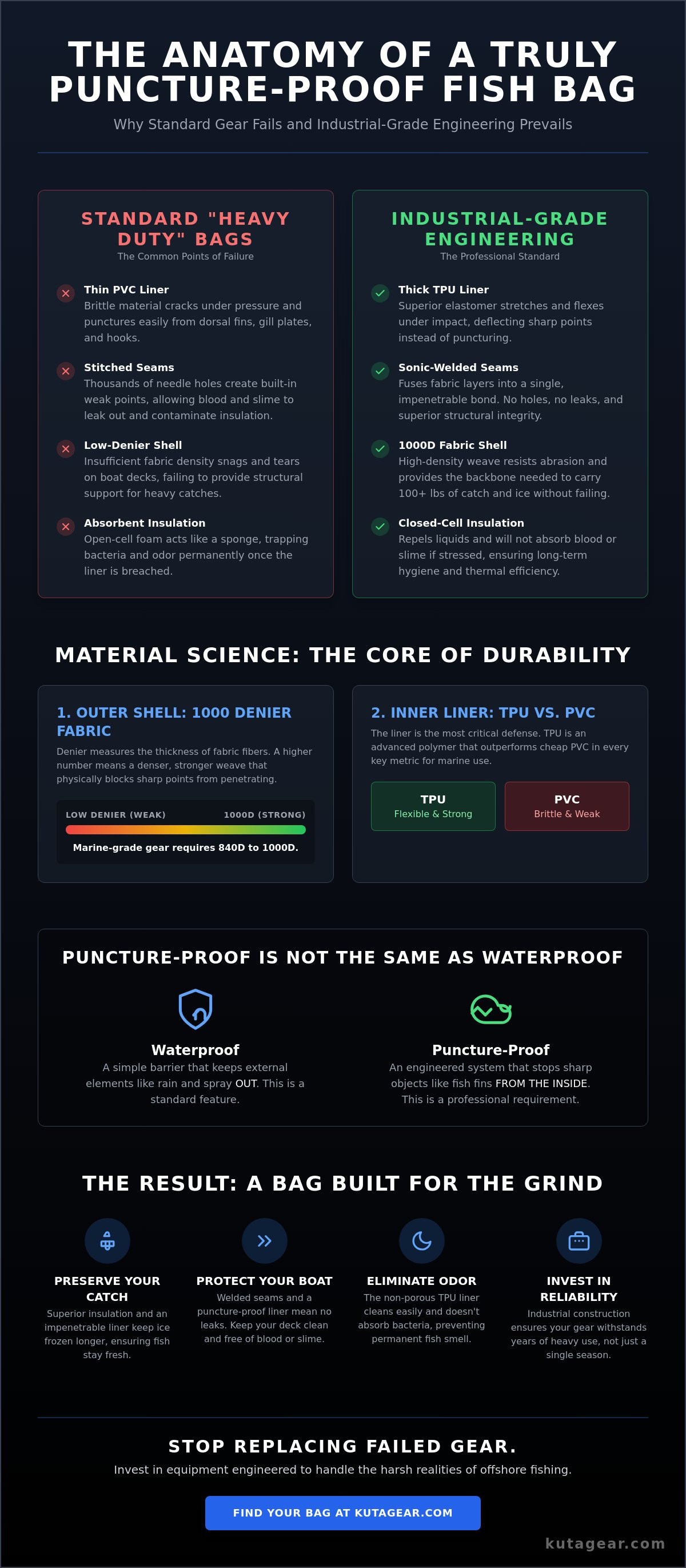
Standard bags fail because they ignore basic physics. When a heavy fish thrashes inside a bag, it concentrates its entire weight onto the microscopic tip of a single fin. This creates massive pressure on a tiny surface area. Cheap PVC bags or thin nylon shells crack under this repetitive stress. They develop pinholes that are invisible to the eye but devastating to your boat deck. There is a critical distinction between a bag that is marketed as "waterproof" and one that is engineered to be puncture-proof. Waterproofing keeps rain out. Puncture resistance keeps the fish from gutting the bag from the inside out. Without that structural integrity, your expensive "insulated" bag is just a leaking sack of warm ice.
The Role of Lining in Catch Preservation
The inner liner is the most vulnerable part of your storage system. It has to be as tough as the outer shell, or the bag will fail during the first heavy haul. When a fin pierces the liner, it destroys the vacuum seal of the insulation. This leads to rapid ice melt and a ruined catch. Beyond temperature control, the material choice matters for long-term utility. We prioritize non-porous materials because hygiene is non-negotiable in professional fishing. A punctured liner traps bacteria, fish slime, and blood in the insulation foam. Once that happens, the smell is permanent. A high-grade puncture resistant fishing bag uses liners that stay slick and impenetrable. This ensures your catch stays cold and your gear stays clean enough to store in a truck bed without the lingering stench of a failed season.
The Anatomy of Industrial-Strength Fish Storage
Stop looking at the color. Start looking at the fiber density. A professional puncture resistant fishing bag is an assembly of industrial materials designed to survive a hostile environment. It isn't a retail product. It's a tool. The foundation of this tool is the Denier rating of the shell. Marine gear requires a threshold between 840D and 1000D. Anything less is a compromise. High-denier fabrics provide the structural backbone needed to hold heavy catch while resisting the serrated edges of a trophy fish.
Material Science: Why Denier Counts
Denier is a unit of weight for fabric fibers. Specifically, it measures the mass of 9,000 meters of the thread used in the weave. A higher number means a thicker, heavier fiber. For an 18" x 36" insulated fish bag, high Denier is mandatory. This size often carries 50 to 100 pounds of catch and ice. The weave must be dense enough to prevent sharp hooks and dorsal spines from snagging between the threads. When the weave is tight, the force of a spine is deflected. It can't penetrate because there's no path through the fiber.
The coating matters as much as the fiber. Most legacy bags use PVC. It's cheap. It's also brittle. PVC cracks after repeated folding or exposure to UV rays. We utilize TPU (Thermoplastic Polyurethane) because it's a superior elastomer. It maintains flexibility in extreme cold. It has higher tensile strength. It stretches slightly under the pressure of a thrashing fish instead of puncturing. It's the difference between a material that survives the season and one that ends up in a landfill.
Internal structure provides the final layer of defense. Closed-cell insulation is the industry standard for a reason. Unlike open-cell foam, it doesn't act like a sponge. It doesn't absorb fish blood or water if the liner is stressed. It stays rigid. This rigidity supports the outer shell, giving the puncture resistant fishing bag the structural integrity to hold its shape against the weight of large pelagic species.
Reinforced Points: Handles and Zippers
Puncture resistance is useless if the bag falls apart at the seams. Every stitch is a potential failure point. Industrial-strength bags use heat-sealed or sonic-welded seams. This process fuses the layers into a single, impenetrable bond. No needle holes. No leaks. No weak spots for a fin to find. The hardware must match the shell. We use heavy-duty nylon webbing for handles. They're built to support 100lb+ loads without tearing away from the bag body. Zippers are the final line of defense. They must be corrosion-resistant to survive the salt. A jammed zipper makes the best insulation irrelevant. Every component is selected for one purpose: reliability under pressure.
Puncture Resistance vs. Abrasion Resistance
Don't confuse surface durability with structural integrity. They are different battles. Abrasion is the constant grind of the external environment. It's your bag sliding across a non-skid deck or rubbing against the bed liner of a truck. Puncture is the sharp, sudden penetration from the inside out. A bag that survives a drag across concrete might still be gutted by a snapper's dorsal fin. A professional puncture resistant fishing bag must defeat both threats simultaneously. We prioritize a balance between shell hardness and material flexibility. This ensures the bag is tough enough to resist a hook but pliable enough for easy storage in tight boat lockers.
Deck Survival: Handling the Grind
The bottom of your boat is a belt sander. Rough fiberglass and metal hardware destroy weak fabrics in a single season. We address this with reinforced exterior shells that handle the friction of a moving vessel.
- Non-skid protection: High-friction bases prevent the bag from sliding, reducing the total surface wear during transit.
- Hardware defense: Thick outer layers stop metal deck hinges or bait tank edges from sawing through the insulation.
- The Drag Test: A full 18" x 36" insulated fish bag can weigh over 100 pounds. It needs to survive being moved from the deck to the dock without the bottom shredding.
Internal Integrity: Managing the Catch
The interior of the bag faces the "Ice Pick" effect. Frozen ice chunks with sharp edges act like daggers against the liner. Combine this with the thrashing of large pelagic species, and you have a recipe for disaster. Smooth internal surfaces are critical here. If a fin or hook can't find a grip, it can't apply the concentrated pressure needed to pierce the material. We use thick, slick liners that allow the catch to slide rather than snag. The relationship between insulation thickness and puncture protection is direct. The foam acts as a shock absorber. It distributes the force of a fin strike across a wider area, preventing the point from breaking through. This internal armor is what keeps your boat clean and your catch prime. A high-quality puncture resistant fishing bag protects your investment from the inside out.
Field Testing: How Heavy-Duty Bags Handle Real-World Abuse
Field testing isn't a laboratory simulation. It's a high-pressure impact from a large pelagic species in the middle of the Gulf. When a tuna thrashes, it isn't just weight; it's kinetic energy. A puncture resistant fishing bag must absorb that energy without failing. Cheap bags become brittle. They lose their resistance after a single summer of UV exposure. We test for the grind of real offshore use. This means looking at how material science holds up when the sun is beating down and the ice is melting. If a bag can't handle a thrashing wahoo in 90-degree heat, it doesn't belong on your boat.
Extreme Temperature Performance
Heat is the enemy of low-grade plastics. Standard PVC bags soften when deck temperatures rise. This makes them significantly easier to pierce. A dorsal fin that might slide off a cool bag will punch straight through a heat-softened one. UV-treated coatings are mandatory. They prevent the molecular degradation that leads to sun-rotted gear. On the other end, cold storage presents a different risk. Brittle materials crack when folded or stressed. High-quality TPU liners maintain flexibility. They don't shatter under the weight of a frozen catch. They stay ready for the next haul regardless of the thermometer.
Maintenance for Long-Term Durability
Durability requires consistent maintenance. Salt is a crystal. When salt water dries in the weave of a bag, it leaves behind microscopic jagged edges. These crystals act like sandpaper against the fibers. Rinse your gear with fresh water after every trip. It isn't just for the smell. It's to stop the internal abrasion that weakens the puncture-resistant barrier. A puncture resistant fishing bag is an investment that needs to be protected from the elements when not in use.
- Inspect for micro-punctures: Fill the bag with a few inches of water and check for weeping. Small leaks today are blowouts tomorrow.
- Storage: Never store your bag under heavy gear. Avoid sharp creases. Creases create stress points where the material is most likely to fail.
- Cleaning: Use mild soap. Harsh chemicals can strip the UV-resistant layers from the outer shell.
A bag that is treated as a professional tool lasts for years. If you want gear that survives the professional grind, invest in the 18" x 36" insulated fish bag. It is built to handle the abuse that sends tournament-branded retail bags to the trash. Don't settle for gear that quits when the season gets tough.
The Kuta Gear 18" x 36" Insulated Bag: Built for the Grind
The Kuta Gear 18" x 36" Insulated Fish Bag is the antidote to disposable gear. We don't chase trends. We don't add features that don't help you catch and keep fish. Every design choice is a response to a specific field failure. We know that a broken zipper or a punctured liner ends your day. Our bag is engineered for the specific dimensions needed by serious offshore and coastal anglers. It prioritizes cold retention and puncture defiance over everything else. This is a minimalist tool. No unnecessary frills. No weak points. Just rugged construction that handles the grind. It's built for environments where gear failure isn't an option. If you're 40 miles out, you need gear that works as hard as you do.
Why the 18" x 36" Footprint is Optimal
Serious anglers need versatility. A rigid cooler is great until you need to move it or store it. The 18" x 36" footprint is the professional standard for a reason. It fits perfectly in most truck beds. It slides into boat consoles or under leaning posts. You get maximum internal volume for medium to large species without taking up half the deck. You get the storage capacity of a large cooler with the portability of a soft-sided bag. It's easy to transport when full of ice and catch. It's easy to wash down at the dock. It's the optimal size for a solo trip or a small crew targeting snapper, grouper, or mahi. We focus on this footprint because it's the most useful dimension for the widest range of coastal fishing scenarios.
The Kuta Gear Commitment to Value
We operate differently. We eliminate the retail markups that inflate the prices of "prestige" brands. You aren't paying for a corporate logo or a multi-million dollar ad campaign. You're paying for a puncture resistant fishing bag that actually stops fins. We focus on manufacturing perfection in this specific specialty. This allows us to provide industrial-grade gear at a price that makes sense for the working fisherman. It's a direct comparison. You get more material density, better liners, and higher durability for less money than the big-box competitors. We don't compromise on the specs. We just compromise on the price.
- Industrial Materials: We use the same high-denier fabrics and TPU liners found in bags costing twice as much.
- Direct-to-Angler: By cutting out the middleman, we keep our margins tight and our gear accessible.
- Proven Performance: Our bags are built for the salt, the sun, and the sharpest fins in the ocean.
Get the 18" x 36" Insulated Fish Bag built for the grind at Kuta Gear. Stop wasting money on "insulated" bags that leak after one trip. Invest in a puncture resistant fishing bag that's as tough as the fish you're chasing.
Upgrade Your Catch Management
Durability isn't a luxury in the offshore world; it's a baseline requirement for every trip. We've covered why industrial material science, from high-denier fabrics to TPU liners, is the only way to stop sharp fins from gutting your gear. A true puncture resistant fishing bag protects your investment by keeping blood off the deck and ice in the bag. It's the difference between a successful haul and a leaking mess in your truck bed. When you're miles out, you need gear that doesn't quit before you do.
Kuta Gear provides that reliability without the corporate price tag. Our industrial-strength 18" x 36" footprint is specifically designed for maximum ice retention in extreme conditions. We eliminate retail markups to offer direct-to-consumer value that beats the "prestige" brands on every metric. You get professional-grade construction that's built to survive the grind of heavy coastal use. It's time to stop settling for disposable gear and start using tools that last.
Order the Kuta Gear 18" x 36" Insulated Fish Bag Today. Get back on the water with the confidence that your gear is ready for the next big catch.
Frequently Asked Questions
What is the best material for a puncture-resistant fishing bag?
TPU (Thermoplastic Polyurethane) is the gold standard for a puncture resistant fishing bag. It offers superior tensile strength and flexibility compared to standard PVC. When combined with a 1000D nylon shell, it creates a barrier that resists penetration from sharp fins and hooks. This material doesn't become brittle in cold storage or soften in the sun. It maintains its structural integrity season after season.
Can a fish fin actually puncture a heavy-duty kill bag?
Yes, a thrashing fish can easily gut a low-quality bag. Dorsal fins and gill plates concentrate massive force onto a tiny surface area. Standard bags rely on thin liners that pinhole under this pressure. Heavy-duty bags use reinforced TPU liners specifically engineered to deflect these strikes. If your bag isn't built with industrial-grade materials, one trophy catch is all it takes to cause a permanent leak.
How do I know if a bag is truly "industrial-grade"?
Look at the technical specifications. Industrial-grade gear uses 840D to 1000D fabrics and TPU coatings. Check the seams. Truly rugged bags use sonic-welded or heat-sealed seams instead of traditional stitching. Stitched seams create needle holes that invite punctures and leaks. If the manufacturer doesn't list the Denier or the liner material, it's likely a retail-grade product designed for casual use, not offshore abuse.
Are puncture-resistant bags also leakproof?
Puncture resistance and leakproof performance go hand in hand. A bag that stops fins from piercing the liner prevents the blood and slime from escaping. High-quality bags also feature waterproof zippers and welded seams to ensure the boat stays clean. If the puncture resistant fishing bag maintains its internal integrity, you won't have to worry about leaking fish blood in your truck bed or boat deck.
Does the thickness of the insulation affect puncture resistance?
Insulation thickness plays a critical role. Thick, closed-cell foam acts as a shock absorber for the internal liner. It distributes the concentrated force of a sharp fin across a larger surface area. This reduces the chance of the material reaching its breaking point. While the shell provides the primary defense, the internal foam provides the structural backing necessary to keep the liner from failing under pressure.
How long should a high-quality puncture-resistant bag last?
A high-quality bag should last for years of heavy use. Industrial materials like TPU and 1000D nylon are built for long-term environmental resistance. They handle UV exposure and salt spray without degrading. If you rinse the bag with fresh water after every trip and avoid storing it under heavy gear, it will remain a reliable partner for multiple seasons. Cheap bags usually fail within one summer.
Can I use a puncture-resistant bag for kayak fishing?
These bags are ideal for kayak fishing. They provide the volume needed for large species without the bulk of a rigid cooler. The flexible shell allows you to fit the bag into tight deck spaces or tank wells. Since kayaks often involve more gear contact and tight quarters, the puncture resistance is essential to prevent hooks or deck hardware from damaging your storage system during a trip.
How do I repair a puncture in an insulated fish bag?
Minor punctures can be repaired using specialized TPU or PVC patch kits. Clean the area thoroughly with alcohol to remove salt and fish slime. Apply the adhesive and patch according to the kit instructions. However, preventing the puncture is always better than fixing a leak. Investing in a bag with a reinforced liner reduces the need for field repairs and ensures your catch stays cold until you hit the dock.
Also in Contact

Portable Fish Storage for Pier Fishing: The Rugged Guide to Catch Preservation

The Best Way to Chill Fish Quickly After Catch: A Professional Guide
