

Saltwater Fish Bag Maintenance: Protecting Your Catch and Your Gear
Saltwater isn't just a nuisance. It's a gear-killer. It eats through metal and turns high-performance liners into breeding grounds for bacteria. You bought an insulated bag to protect your catch. Without proper saltwater fish bag maintenance, that investment is already rotting from the inside out. Seized zippers and permanent odors aren't just annoying. They are signs of equipment failure that will eventually force a replacement you shouldn't have to buy.
We understand the frustration. Nobody wants to fight a stuck slide or scrub a bag that still smells like last month's tuna. This guide delivers the rugged, no-nonsense protocols required to stop saltwater corrosion and mold growth. You'll learn how to strip away salt spray, disinfect the lining, and protect the insulation performance your ice retention depends on. We are breaking down the exact steps to keep your bag functional for multiple seasons. It's time to treat your gear with the same respect you give your catch.
Key Takeaways
- Blast away corrosive salt crystals and slime immediately. Stop the salt from eating into the webbing and destroying the liner.
- Protect mechanical integrity. Clean the zipper teeth and slider to stop salt from acting like sandpaper on your most vulnerable gear.
- Kill the bacteria. Use a dedicated disinfection protocol to eliminate deep-seated odors that ruin your catch and your storage space.
- Master saltwater fish bag maintenance to prevent mold growth and ensure your insulation retains ice for multiple seasons.
- Preserve the materials. Dry the interior completely and store the bag away from direct sunlight to prevent UV damage and material degradation.
The Saltwater Threat: Why Basic Rinsing Fails Your Gear
Most anglers think a quick spray with the hose is enough. It isn't. Saltwater is a relentless gear-killer. It doesn't just sit on the surface. It eats. Basic rinsing ignores the microscopic reality of the ocean environment. Effective saltwater fish bag maintenance requires understanding that salt is a physical and chemical threat. It is a slow-motion wrecking ball for your equipment. If you don't treat the salt, the salt treats your gear like a meal.
Blood, slime, and scales are more than just a mess. They are organic glue. They trap salt against the fabric and deep inside the seams. As the water evaporates, salt crystals grow. They expand. They wedge themselves into the webbing and between zipper teeth. This expansion causes micro-tears in the material and mechanical stress on the hardware. A simple rinse won't dislodge these embedded crystals. They stay behind, waiting to grind down your gear the next time you open the bag.
The Chemistry of Corrosion on the Water
Salt spray is a chemical catalyst. When it hits metal zipper pulls and sliders, it triggers immediate oxidation. This isn't just about surface rust. It's about total mechanical seizure. UV rays accelerate the destruction. Sunlight breaks down the chemical bonds in standard PVC and vinyl linings. Combine that with salt, and you get brittle, cracked gear that leaks at the worst possible moment. Dry salt is actually more dangerous than wet salt. Wet salt is in solution. Dry salt is a solid abrasive. It acts like sandpaper on every moving part of your fishing tackle and storage gear. If you aren't removing every crystal, you are letting the ocean destroy your investment from the inside out.
Meat Quality and Bacterial Contamination
Your bag's primary job is protecting the meat. Cheap bags use porous linings that look smooth to the eye but hide microscopic pits. Fish slime and bacteria thrive in these micro-pores. If you don't disinfect, you're just marinating today's catch in last week's rot. Old residue ruins the flavor profile of fresh fillets. It is a cross-contamination nightmare. High-end gear uses non-porous, antimicrobial surfaces for a reason. They don't give bacteria a place to hide. If your bag smells like a dock, it’s already failing. Proper maintenance ensures that the only thing you taste is the fish you just pulled from the water. You don't work this hard for a catch just to let a dirty bag ruin the quality of the harvest.
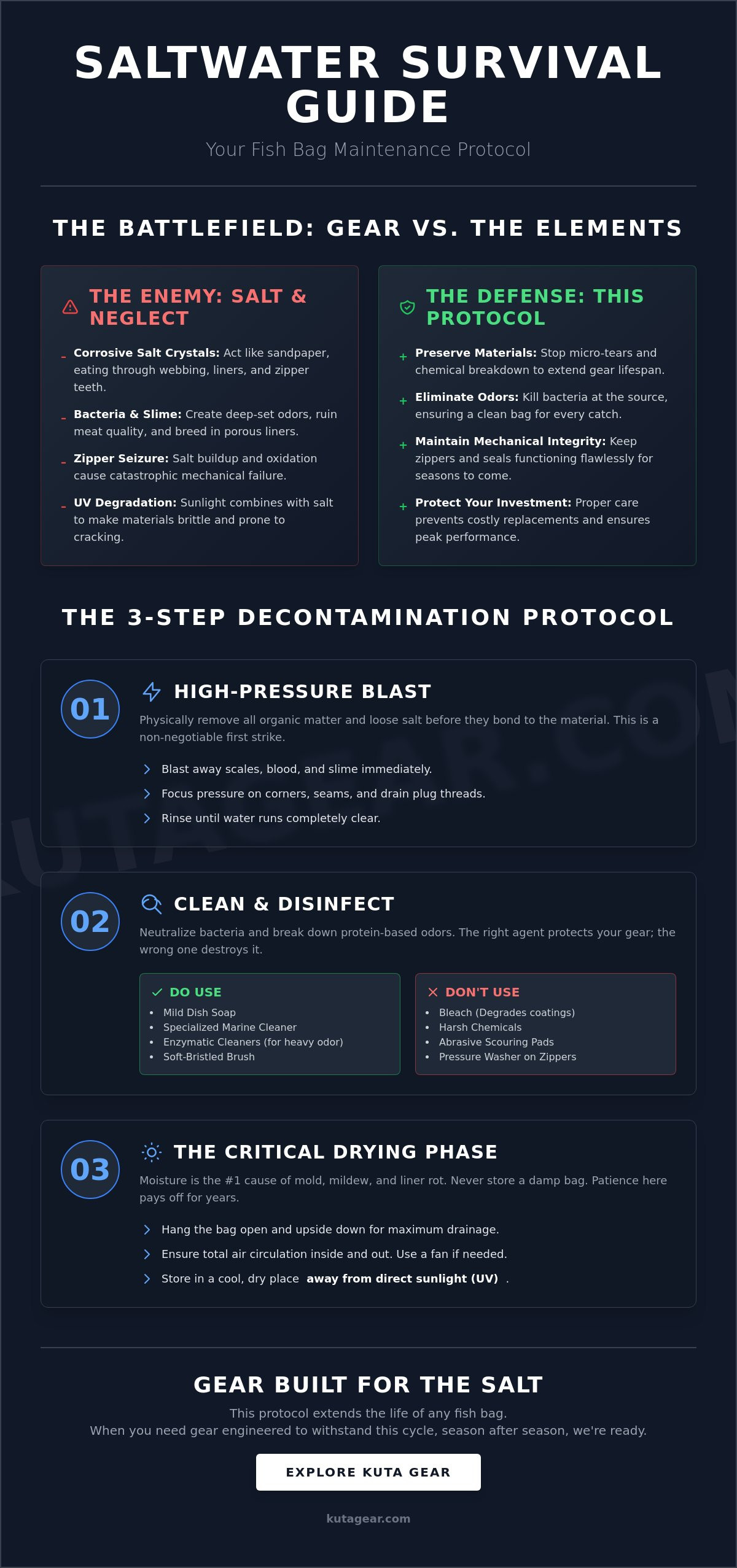
The 3-Step Post-Trip Decontamination Protocol
You're back at the dock. Your back hurts. You're exhausted. The temptation to drop the gear and deal with it tomorrow is high. Don't do it. Tomorrow is when the salt sets and the bacteria bloom. Effective saltwater fish bag maintenance doesn't have to be a multi-hour ordeal. It just needs to be systematic. You need a fast, tactical workflow that protects your gear without wasting your limited energy. If you skip the protocol now, you'll pay for it in gear failure later.
Step 1: The High-Pressure Internal Blast
Open the bag fully. Don't be shy with the water pressure. You need to blast the scales and slime out before they have a chance to dry into organic glue. Focus your attention on the corners where blood pools. These are the primary breeding grounds for odors. Flush the drain plug threads specifically. Salt buildup in these threads will eventually cause the plug to seize or leak. Clear every bit of loose debris before you introduce any cleaning agents. This isn't just a rinse; it's a decontamination phase. If you want to maintain and store your fishing equipment like a professional, you start with a clean slate.
Step 2: Choosing the Right Cleaning Agent
Stop reaching for the bleach. It's a rookie mistake that destroys high-performance gear. Bleach is too aggressive. It degrades the waterproof TPU coatings and weakens the structural integrity of the seams over time. Use a mild dish soap or a specialized marine cleaner instead. For bags that have seen heavy use, enzymatic cleaners are the standard. Enzymatic cleaners work best because they physically break down the protein chains found in organic fish odors rather than just masking the smell with chemicals. Use a soft-bristled brush to work the solution into the liner. Avoid abrasive pads. They create micro-scratches that give bacteria a place to hide during your next trip.
Step 3: The Critical Drying Phase
Never store a wet bag. That is how mold wins. Gravity is your best friend for drainage. Hang the bag upside down with the zipper completely open. Air circulation is mandatory. Ensure the insulation core is bone-dry before you even think about folding it for storage. Folding a damp bag traps moisture in the creases, leading to liner rot and permanent odors. If you need gear that handles this rugged cycle trip after trip, the Kuta Gear fish bags are engineered for exactly this kind of heavy-duty use. Once the bag is dry to the touch, give it another hour. True saltwater fish bag maintenance ends only when the moisture is 100% gone.
Zipper and Seal Integrity: Preventing Mechanical Failure
The zipper is the most common point of failure on any fish bag. It is a mechanical system operating in a hostile environment. Saltwater doesn't just corrode; it crystallizes. These crystals act like sandpaper on the slider and teeth. Every time you pull a salt-encrusted zipper, you are grinding down the components that keep your catch cold and contained. Neglecting this part of your saltwater fish bag maintenance leads to mid-trip blowouts. A failed zipper turns a high-performance tool into a useless tarp. You can't afford that when you're miles offshore with a limit of fish.
Lubrication is not optional. It is a tactical necessity for gear survival. Many anglers make the mistake of using generic penetrants like WD-40. Don't do it. These products can attract grit and eventually degrade the plastic components of the zipper assembly. You need dedicated marine-grade protection. Just as you focus on Preventing Rusty Tackle, you must prioritize the mechanical health of your bag. Regular inspection and treatment prevent the corrosion that leads to permanent seizure.
Removing Salt Crust from Zipper Teeth
Fresh water alone isn't always enough to dislodge deep-seated crystals. Use a toothbrush and warm water to scrub the teeth. The heat helps dissolve the salt while the bristles reach into the gaps. Cycle the zipper multiple times while rinsing. This movement helps flush out debris trapped inside the slider body. Never force a stuck zipper. If it resists, stop. Forcing a slider leads to misaligned teeth or a broken pull tab. Scrub again. Patience at the dock saves you from a broken bag on the water.
Marine-Grade Lubrication Standards
Stick to silicone-based sprays or paraffin wax lubricants. These materials provide a slick barrier without attracting sand and salt. Apply the lubricant directly to the slider. This is where the most friction occurs. Run the slider back and forth to distribute the coating evenly across the teeth. Always wipe away the excess. You want a thin, protective film, not a sticky mess that traps contaminants. This level of detail in your saltwater fish bag maintenance ensures the seal stays airtight and the hardware remains functional for years, not just months. Reliability is built through consistent care.
Odor Elimination and Long-Term Storage
A bag that looks clean can still smell like a dock after three days. Visual cleanliness isn't the goal. Chemical neutrality is. If the bag still reeks, your saltwater fish bag maintenance is incomplete. Residual odors are more than a nuisance. They indicate active bacterial breakdown. This rot eventually ruins the flavor profile of fresh fillets. It is a clear sign of gear neglect. You don't want last month's tuna affecting today's harvest.
Storage location determines the lifespan of the insulation. Don't just throw it in a humid garage corner and forget it. Off-season prep is about readiness. It requires a controlled environment. High heat and moisture are the primary causes of delamination. This is when the internal liner separates from the foam core. Once this happens, the bag loses its structural integrity and its ability to hold ice. Proper storage ensures your bag is ready the moment the season opens.
Neutralizing Persistent Fish Smells
Standard soap doesn't always cut through deep-seated organic compounds. Use a baking soda paste for stubborn hot spots in the bag. Apply it to the corners and seams where blood pools. Let it sit for 30 minutes before rinsing. Follow this with a vinegar rinse. Vinegar is acidic. It effectively neutralizes the alkaline compounds that create the pungent fish smell. Never use scented masking sprays. They don't eliminate the odor. They just layer perfume over rot. This creates a nauseating chemical-fish hybrid smell that is nearly impossible to remove later.
Safe Storage Practices
Sunlight is a natural disinfectant but a material killer. UV rays break down the polymers in the outer shell. This leads to UV-induced cracking and eventual leaks. Keep your bag out of direct sunlight during storage. Store the bag flat or hanging. Avoid heavy creasing of the insulation. Sharp folds create permanent weak points in the thermal barrier. Verify the bag is stored in a cool, dry environment to prevent mold from gaining a foothold. If your current bag can't handle the heat or the smell, upgrade to the 18" x 36" Insulated Fish Bag built for professional-grade performance. A bag that survives the Pacific needs a maintenance routine that matches its engineering. Don't let a winter in the shed destroy a summer of success.
The Kuta Gear Standard: Built for the Salt
Durability isn’t an accident. It’s engineering. We didn't build a generic storage container. We built a tactical tool for the salt. The Kuta Gear 18" x 36" Insulated Fish Bag is designed for the Pacific. It handles the pressure. It handles the blood. It handles the relentless salt spray that kills lesser gear. While saltwater fish bag maintenance is vital for any equipment, starting with a professional-grade foundation makes the job easier. Our materials resist salt-embedding from the start. You don't need a luxury brand. You need a bag that works.
A specialized fish bag beats a generic cooler every time. Coolers are bulky. They slide on the deck. They are hard to clean. Our bag is streamlined. It stays where you put it. It keeps your catch cold without the dead weight. It’s about efficiency. It’s about readiness. When the bite is on, you don't have time to fight with gear that wasn't built for the environment. You need equipment that matches your work ethic.
Industrial-Strength Construction
The details matter. We use reinforced stitching. It is designed to handle the weight of a full catch without blowing out. Heat-sealed seams are the standard. They prevent blood and slime from leaking into the insulation core. This makes your saltwater fish bag maintenance routine faster. There are no hidden pockets for bacteria to hide. The 18" x 36" footprint is the sweet spot. It is optimized for deck space. It fits the fish you're actually catching. It is a tool, not a trophy.
Value Over Prestige
We don't do retail markups. We don't care about luxury branding. We care about performance gear that works. This bag is ready for recreational boaters. It is ready for professional charters. You get the same technical specifications as the big-name brands without the corporate tax. We prioritize function over aesthetics every single time. It’s about reliability on the water. It’s about preparedness for the next trip. Get the Kuta Gear 18" x 36" Fish Bag and stop overpaying for insulation. Stop paying for a logo and start paying for performance.
Ready for the Next Strike
Salt is a constant adversary. It doesn't take days off. Neither can your maintenance routine. You now have the tactical workflow to stop corrosion and bacteria from claiming your gear. Focus on the corners. Lubricate the sliders. Dry the core completely. Mastering saltwater fish bag maintenance is the difference between a tool that lasts five seasons and one that rots in five months. Don't let a dirty bag compromise the quality of your harvest or the integrity of your boat. Gear failure is a choice. Choose reliability instead.
If your current gear is failing the smell test or leaking ice, it's time for an upgrade. Upgrade to the Kuta Gear 18" x 36" Insulated Fish Bag. Our equipment is built for rugged marine environments. It delivers superior ice retention for long days on the water. You get heavy-duty construction without the corporate markup. We don't build trophies. We build gear that survives the Pacific. Get back out there. The fish are waiting. Your gear is finally ready to handle them.
Frequently Asked Questions
Can I use bleach to clean my saltwater fish bag?
No, you should not use bleach. It is too aggressive for high-performance liners and thermal barriers. Bleach breaks down the waterproof TPU coatings and weakens the heat-sealed seams over time. Stick to mild dish soap or enzymatic cleaners. These options protect the material while effectively eliminating bacteria. Professional saltwater fish bag maintenance requires agents that clean without destroying the bag's structural integrity.
How do I unstick a salt-corroded zipper on my kill bag?
Dissolve the salt crystals with warm water before you attempt to move the slider. Never force a stuck zipper. Use a toothbrush to scrub the teeth and the slider body thoroughly. The warm water breaks down the crystals that act like a mechanical lock. Once the salt is gone, the zipper should move freely. Forcing it only leads to misaligned teeth or a total mechanical failure.
Is it okay to pressure wash the inside of an insulated fish bag?
Yes, pressure washing is an effective way to remove stubborn organic debris. Keep the nozzle at least twelve inches from the liner to avoid damaging the material or the seams. Focus the blast on the corners where scales and blood accumulate. This is a fast way to handle the heavy-duty cleaning required after a successful trip. It ensures a deeper clean than a standard garden hose.
How long can I leave fish in the bag before it starts to smell permanently?
Clean your bag immediately after every trip to prevent odors from setting into the liner. Leaving fish in a bag without sufficient ice for more than a few hours is a mistake. Bacteria begin to bloom rapidly as soon as the internal temperature rises. Even with ice, organic residue starts to bond with the material within 24 hours. Prompt decontamination is the only way to ensure gear longevity.
What is the best lubricant for marine zippers?
Use silicone-based sprays or paraffin wax for the best results on the water. These lubricants provide a slick barrier that doesn't attract sand, salt, or grit. Avoid oil-based products like WD-40. They can degrade plastic components and create a sticky mess that traps contaminants. Proper lubrication is a core part of saltwater fish bag maintenance that ensures your hardware stays functional in harsh environments.
Can I store my fish bag folded up in the garage?
Do not store your bag folded in a hot or humid garage. Heavy creasing creates permanent weak points in the insulation core that ruin ice retention. High heat can also lead to delamination, where the liner separates from the foam. Store your bag flat or hanging in a cool, dry place. This preserves the thermal performance and ensures the bag is ready for the next season.
How do I remove fish scales that are stuck in the seams?
Use a stiff-bristled toothbrush and a high-pressure rinse to dislodge scales from the webbing. Scales act like organic glue once they dry and become much harder to remove. Scrub the seams while the bag is still wet to prevent debris from setting. This prevents the scales from becoming a permanent breeding ground for bacteria. A thorough scrub ensures no residue remains to cause future odors.
Does sunlight help or hurt when drying out my bag?
Sunlight is a double-edged sword for your gear. Short exposure helps kill bacteria and speeds up the drying process through UV disinfection. However, long-term UV exposure is a material killer that causes the outer shell to become brittle and crack. Use sunlight to dry the bag quickly after cleaning. Once the bag is bone-dry, move it to a shaded, cool area for storage.

Also in Contact

Portable Fish Storage for Pier Fishing: The Rugged Guide to Catch Preservation

The Best Way to Chill Fish Quickly After Catch: A Professional Guide
