

Storing Mahi Mahi on a Boat: The Pro Guide to Catch Preservation
Your expensive rotomolded cooler is failing your catch. It's built for long-term ice storage, not the rapid thermal shock required for pelagic fish. You land a lit-up bull, toss it in a dry box, and watch the vibrant gold fade to a dull grey before you even hit the inlet. By the time you're at the cleaning table, the meat is mush. High heat and trapped air pockets destroy quality seafood fast. Storing mahi mahi on a boat requires more than just a pile of cubes. It requires a system that eliminates air and locks in cold instantly.
We understand the frustration of a bloody deck and spoiled meat after a long run offshore. You want firm, white fillets that look as good on the plate as the fish did in the water. This guide breaks down the professional methods for cooling, handling, and storing your catch. We'll show you how to manage your deck space efficiently while maintaining ice for the duration of the trip. From immediate bleeding techniques to the superiority of insulated bags over rigid plastic, you're about to learn how to deliver restaurant-quality results every time you leave the dock.
Key Takeaways
- Rapid thermal shock is mandatory. You'll learn how to stop muscle tissue breakdown immediately after the gaff hits.
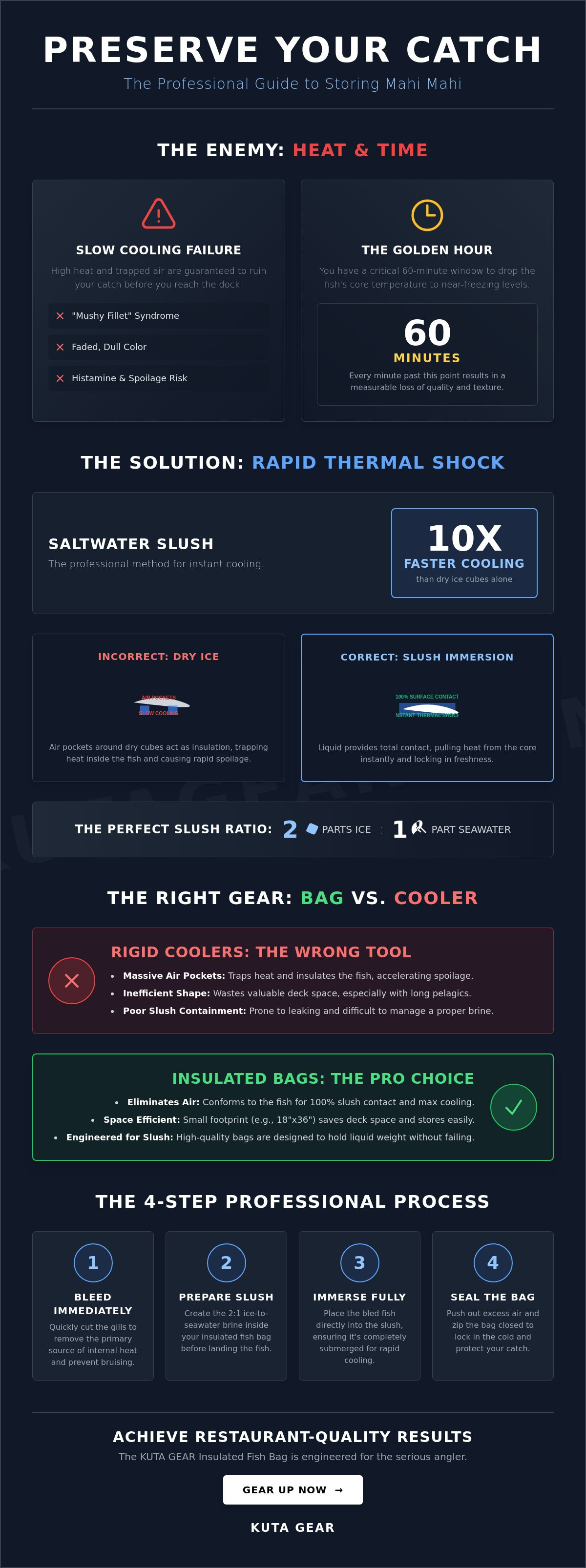
- Stop wasting ice. Master the 2:1 saltwater slush ratio to drop core temperatures ten times faster than dry cubes.
- Rigid coolers fail on long pelagics. We explain why insulated bags are better for storing mahi mahi on a boat by removing air.
- Clean fillets start on the deck. Follow the pro sequence for controlling and bleeding your catch to eliminate bruising and mess.
- Efficiency matters offshore. See how the 18" x 36" insulated bag footprint maximizes your storage without killing your deck space.
Why Immediate Cooling is Critical for Mahi Mahi Quality
Mahi Mahi are high-performance machines. They are high-activity pelagic fish with a metabolism built for speed and endurance. This means they carry significant internal heat. When a Mahi fights the line, its body temperature spikes even further. Tossing a hot fish onto a sun-baked deck is a guaranteed way to ruin your dinner. Rapid cooling is the only way to stop the immediate breakdown of muscle tissue. This isn't a suggestion. It's a requirement for anyone serious about catch preservation.
The "mushy fillet" syndrome is a common complaint among offshore anglers. Most blame the fish or the season. They're wrong. Mushy meat is the direct result of slow cooling. When the core temperature remains high, the texture degrades into a soft, unappealing mess. Storing mahi mahi on a boat requires a plan to combat this heat before the meat is compromised. You aren't just keeping it cold; you're fighting a biological clock that starts ticking the moment the fish is gaffed.
The Biology of Spoilage
Enzymes don't take breaks. They begin breaking down protein structures the moment the heart stops beating. At standard deck temperatures, this process accelerates. This leads to proteolysis, where the firm muscle fibers simply dissolve. Beyond texture, there is a serious safety risk. Scombroid poisoning is a foodborne illness caused by the consumption of fish that have developed high levels of histamine due to improper temperature control. It turns a prize catch into a liability.
Blood plays a major role in this failure. It acts as a primary heat reservoir within the fish. If you don't bleed the catch immediately, that internal thermal mass keeps the core warm even if the skin feels cold. Understanding Mahi-mahi biology and characteristics is vital. These fish are designed for warm water, but their meat is not designed for warm storage. Remove the blood. Drop the temp. Save the meat.
Time vs. Temperature
Success is measured by the "Golden Hour" rule. You have exactly 60 minutes to drive the core temperature down to near-freezing levels. Every minute past that hour results in a measurable loss of quality. Ambient air is your enemy here. Air is a poor conductor of heat. If you throw a fish into a dry cooler, the air pockets around the body act as insulation, keeping the heat trapped inside the meat.
Water conductivity is the solution. Liquid transfers heat significantly faster than air. This is why storing mahi mahi on a boat in a dedicated slush is superior to any dry storage method. Sun exposure is another silent killer. A fish left on the deck for even fifteen minutes absorbs massive amounts of UV energy. That heat sinks deep. It bypasses the surface and cooks the meat from the inside out. Get the fish out of the light and into the cold immediately.
The Saltwater Slush: Master the Art of Thermal Shock
Dry ice is for shipping. A saltwater slush is for catching. If you want to master storing mahi mahi on a boat, you need to understand thermal shock. A proper brine cools fish up to 10 times faster than ice alone. It's simple physics. Ice cubes only touch the fish at specific points. A liquid medium provides 100% surface contact. This total immersion pulls heat from the core instantly. It locks in the vibrant neon greens and yellows of the skin. It keeps the texture firm. Without this shock, you're just inviting decomposition.
This isn't just about aesthetics. It's a safety protocol. According to the FDA advisory on fish handling, Mahi Mahi are highly susceptible to histamine formation. This happens the moment the fish dies if the temperature isn't dropped immediately. A slush is your first line of defense against spoilage and scombroid poisoning. It's the difference between a professional-grade haul and a wasted trip.
Creating the Perfect Slush
Use a 2:1 ratio. That's two parts ice to one part clean seawater. Don't use fresh water from your washdown tank or a hose. Fresh water osmosis causes the meat to bloat. It dulls the skin. It ruins the presentation. Stick to the salt. Crushed or cubed ice works best for this application. It provides the maximum surface area for the water to chill. To maintain the slush throughout a full day of fishing, keep the container closed. Add more ice as it melts. Don't let it become a bag of warm water. Consistency is the key to quality.
Managing the Slush in a Fish Bag
Rigid coolers are the wrong tool for this. They leak. They have massive air pockets. They take up too much deck space. Insulated bags are the professional choice for storing mahi mahi on a boat. They conform to the fish. They eliminate air. A high-quality tool like an 18" x 36" insulated fish bag is engineered to hold this liquid weight without failing. It keeps the cold where it belongs. You need a watertight seal. If your bag leaks, your slush disappears. Drain the excess water only when it's absolutely necessary to add more ice. Keep the core cold. Keep the fish submerged. This is how you ensure restaurant-quality fillets every time you hit the cleaning table.
Insulated Bags vs. Rigid Coolers for Pelagic Storage
Mahi Mahi are built like spears. They are long. They are slender. Your standard rotomolded cooler is built like a cube. This is a fundamental mismatch for storing mahi mahi on a boat. To fit a decent-sized bull into a rigid box, you usually have to bend the tail or leave the lid propped open. Both options are failures. A cracked lid lets cold air escape and heat move in. A bent fish is a nightmare to fillet later. Insulated fish bags solve this by conforming to the actual dimensions of your catch.
Air is the enemy of ice. Rigid coolers are often half-full of dead space. This trapped air acts as a thermal bridge that accelerates ice melt. Insulated bags wrap around the fish. They eliminate those air pockets entirely. This keeps your ice in solid form longer. Beyond thermal performance, you have to consider deck management. Space is a premium offshore. A rigid cooler is a permanent obstacle. It's there when it's full, and it's there when it's empty. A high-quality fish bag is a temporary tool. You deploy it when you need it. You fold it and stow it when you don't. Reclaim your deck space.
The Compression Advantage
Filleting a "curled" fish is difficult and wasteful. When a Mahi Mahi stiffens in a bent position inside a small cooler, the muscle fibers set that way. You lose yield. You lose speed. Bags keep your catch flat. This ensures the spine remains straight for clean, professional-grade cuts at the dock. This compression also allows for better stacking. You can layer multiple fish without the bottom layer getting crushed or bruised by the weight of a rigid lid or shifting ice blocks. It maximizes your ice-to-fish ratio by using every square inch of internal volume for cooling, not air.
Durability and Maintenance
Marine environments destroy cheap gear. You need industrial-grade materials that can handle salt, scales, and UV radiation. The 18" x 36" Insulated Fish Bag is the sweet spot for most recreational and tournament boats. It's large enough for a solid day's limit but compact enough to handle easily. Look for heavy-duty zippers and reinforced skins. If the bag isn't puncture-resistant, a Mahi's dorsal fin will shred it in one season.
Maintenance is non-negotiable. Soft-sided storage can develop a "stink" if you're lazy. Follow these protocols for storing mahi mahi on a boat long-term:
- Rinse the interior with fresh water immediately after unloading.
- Use a mild, non-corrosive soap to break down fish oils.
- Prop the bag open to air-dry completely before folding.
- Check the zipper teeth for salt buildup and apply a marine-grade lubricant.
UV resistance is your final line of defense. Cheap bags crack under the sun. Professional gear uses outer skins designed to reflect heat and resist the degrading effects of constant sun exposure. Buy for durability, not just for the price tag.
Step-by-Step Guide to Storing Mahi Mahi on Your Boat
Landing a lit-up bull is only half the battle. The real work begins the second that fish clears the gunwale. If you're sloppy with your handling, you're wasting fuel and time. Storing mahi mahi on a boat is a chronological process that requires discipline. You need to move fast. You need to be precise. Every second a fish thrashes on a hot deck is a second the meat is degrading. Follow this professional workflow to ensure your catch makes it to the dock in pristine condition.
Gaffing and Handling
Precision starts with the gaff. Aim for the head. A body shot ruins the prime loin meat and creates an entry point for bacteria. Once the fish is on board, control it immediately. Do not let it dance on the fiberglass. A thrashing fish bruises its own flesh and loses its protective scale layer. If you can't get it into the bag instantly, use a wet towel to pin it down. This calms the fish and protects the skin from the blistering heat of the deck. Treat the fish like the high-value protein it is, not like a piece of trash.
The Bleeding Process
Bleed your catch. It's the most effective way to improve flavor and color. Reach under the gill plate and sever the arches. This is the most humane method and it works fast. Bleeding removes the primary heat reservoir from the body. It prevents the blood from "staining" the meat, which leads to those dark, fishy-tasting spots in your fillets. You have a five-minute window to do this before the blood begins to coagulate. Do it over the side or in a dedicated bucket. Keep the deck clean and keep the meat white.
Once the bleeding is finished, rinse the fish with clean saltwater. Remove the slime coat and any remaining surface blood. Slime traps heat and bacteria, so get it off before storage. Now, move to the bag. Open your pre-chilled insulated storage and slide the fish in head-first. For maximum preservation, ensure the fish is fully submerged in your 2:1 saltwater slush. Zip the bag tight to eliminate air exchange. If you want to protect your investment and ensure your hard work pays off, use a professional-grade 18" x 36" insulated fish bag to lock in the cold.
Efficiency on the water leads to quality on the plate. Storing mahi mahi on a boat isn't about luck; it's about following a system.
- Control: Stop the thrash immediately.
- Bleed: Remove the internal heat source.
- Rinse: Clear the slime and debris.
- Store: Submerge in slush and seal the bag.
Maximum Freshness with the Kuta Gear 18" x 36" Insulated Bag
You have the technique. You know the ratios. Now you need the hardware. Storing mahi mahi on a boat is a game of thermal defense. If your storage fails, your effort is wasted. The Kuta Gear 18" x 36" Insulated Bag is built for this specific environment. It's engineered for the rugged demands of offshore pelagic fishing. This isn't a retail-shelf cooler meant for a backyard barbecue. It's a utilitarian tool designed to take a beating on the deck and keep your catch at restaurant-grade quality. Buy it once. Use it forever.
The 18" x 36" footprint is intentional. It's optimized for the long, slender profiles of Mahi Mahi, Tuna, and Wahoo. Most rigid coolers are too short for a quality bull. Most generic bags are too bulky and kill your deck space. This dimension strikes the perfect balance. It provides enough internal volume for a full limit while maintaining a slim profile that stays out of the way during a hot bite. High-priced corporate alternatives focus on marketing fluff and prestige. We focus on heavy-duty insulation. Our design is built for the deck, not for the showroom. It's about performance, not social status.
Why Kuta Gear Stands Out
We cut out the middleman. By selling direct-to-consumer, we deliver more insulation for your dollar. You aren't paying for a massive retail margin or a corporate office's luxury lease. You're paying for industrial-grade materials that survive the salt. The construction is rugged. It handles the immense weight of a full limit and a heavy saltwater slush without sagging or tearing. The zippers are built to resist salt corrosion and won't seize up after one season. The interior is just as tough. It's an easy-clean surface that doesn't hold onto fish odors. Rinse it. Wipe it. It's ready for the next run. This is professional-grade gear for serious anglers who prioritize function over aesthetics.
Prepared for the Strike
Success offshore favors the prepared angler. You shouldn't be scrambling for ice or a place to put a fish when the first line screams. Your bag should be pre-chilled and ready to receive the gaff. Because of its flexible design, the 18" x 36" bag fits into any boat layout. It works on a 20-foot center console or a 60-foot sportfish. It's light enough to move when full. It's tough enough to stay put. Don't settle for mushy fillets and wasted ice. Equip your boat with the Kuta Gear 18" x 36" Insulated Fish Bag. Storing mahi mahi on a boat effectively requires the right equipment. This is that equipment. No compromises. Just cold fish and firm fillets.
Secure Your Catch for the Grill
You've done the hard work of finding the weed line and winning the fight. Don't waste that effort by letting your prize spoil on the deck. Professional-grade preservation is about speed and thermal efficiency. Bleed your fish immediately to drop the internal temperature. Use the 2:1 saltwater slush ratio to eliminate air pockets. Storing mahi mahi on a boat correctly ensures that every fillet you cut is firm, white, and restaurant-quality. The ocean doesn't care about a cooler's social status; it only cares about the cold chain.
You need gear that works as hard as you do. Skip the overpriced corporate coolers that take up half your deck. Choose a tool built for the specific dimensions of pelagic fish. Get the Kuta Gear 18" x 36" Insulated Fish Bag for Your Next Trip. Our gear features industrial-strength construction and is engineered for extreme ice retention. The optimized 18" x 36" size is the perfect fit for Mahi Mahi, Tuna, and Wahoo. Tight lines and cold fish. See you on the water.
Frequently Asked Questions
How long can Mahi Mahi stay in an insulated bag?
Mahi Mahi can stay in a high-quality insulated bag for 24 to 48 hours if you maintain a consistent 2:1 ice-to-fish ratio. The key is ensuring the fish remains submerged in a cold slush or packed tightly in crushed ice. Check the drain plug frequently to ensure you aren't losing your cooling medium. If the ice melts and the water warms, the meat will degrade rapidly.
Is it better to fillet Mahi Mahi immediately or wait?
It is better to wait until the fish is fully chilled before filleting. Attempting to fillet a warm fish results in ragged cuts and poor yield because the muscle fibers haven't set. Storing mahi mahi on a boat in a slush for at least two to four hours firms up the meat. This makes the skinning and portioning process cleaner and more efficient once you hit the dock.
How much ice do I need for a day of Mahi Mahi fishing?
Plan for a minimum of 1 to 2 pounds of ice for every pound of fish you expect to catch. For a standard offshore trip targeting a limit of Mahi, this usually means starting with at least 40 to 60 pounds of crushed or cubed ice. It is better to return to the dock with extra ice than to run out while the sun is still high and the fish are biting.
Can I store Mahi Mahi in a dry bag?
No, you cannot store Mahi Mahi in a standard dry bag. Dry bags are designed to keep water out, not to retain cold or handle the puncture risks of fish fins. They lack the thick closed-cell foam insulation required for catch preservation. Using a non-insulated bag will lead to rapid heat absorption and meat spoilage within an hour on a sunny deck. Use the right tool for the job.
What is the best way to clean a fish kill bag?
Scrub the interior with fresh water and a mild soap immediately after unloading your catch. Pay close attention to the corners and zipper tracks where scales and slime accumulate. Rinse thoroughly and prop the bag open in a shaded area to air-dry completely. Never store a damp bag folded. This creates a breeding ground for mold and permanent odors that will ruin your next trip.
Should I bleed Mahi Mahi before putting them on ice?
Yes, you should always bleed Mahi Mahi before putting them on ice. Cutting the gills allows the heart to pump out blood, which is a primary source of internal heat. This process improves the flavor of the fillets and ensures the meat remains a clean, translucent white. Bleeding takes less than five minutes and is the most effective way to jumpstart the cooling process for better preservation.
Why does my Mahi Mahi meat look gray or mushy?
Gray or mushy meat is a sign of poor temperature control. If the fish stays warm too long, enzymes begin to break down the protein structures. This often happens when storing mahi mahi on a boat without enough ice or by failing to use a saltwater slush. Immediate thermal shock is the only way to prevent this degradation and maintain the firm texture required for restaurant-quality seafood.
What size fish bag do I need for Mahi Mahi?
An 18" x 36" Insulated Fish Bag is the ideal size for most recreational Mahi Mahi trips. This dimension accommodates schoolies and larger bulls without forcing you to bend the fish. It provides enough volume for a vessel limit while remaining manageable on the deck. Larger bags exist, but they often become too heavy to move once filled with ice and a full limit of pelagics.

Also in Contact

Portable Fish Storage for Pier Fishing: The Rugged Guide to Catch Preservation

The Best Way to Chill Fish Quickly After Catch: A Professional Guide
