

UV Resistant Fish Cooler Bags: Why Marine-Grade Protection Matters
The sun is the fastest way to kill your gear. Most bags fail because they aren't built for constant exposure. You see the cracks forming after just a few trips. You feel the heat radiating through thin, cheap walls. A high quality UV resistant fish cooler bag stops that degradation before it starts. It's the difference between a tool that works and a piece of trash taking up space on your boat.
You want ice to stay frozen and blood to stay inside the bag. We know the frustration of a leaking liner ruining a truck bed or a clean deck. This article explains how marine-grade materials prevent material failure and keep your catch fresh in the harshest environments. You'll learn why specific UV resistance ratings matter and how to find a bag that actually holds up to the salt and sun. We're looking at the technical specs that lead to superior ice retention and a leak-proof finish that lasts for years. It's about preparedness and reliability on the water.
Key Takeaways
- Stop the sun from destroying your gear by understanding how marine-grade materials prevent polymer breakdown and "chalking."
- Maximize ice retention through the synergy of UV-reflective skins and industrial-strength closed-cell foam insulation.
- Save deck space and reduce weight without sacrificing capacity by choosing a UV resistant fish cooler bag over bulky rigid coolers.
- Extend the lifespan of your investment with a professional maintenance routine designed for high-sun marine environments.
- See why the Kuta Gear 18" x 36" Insulated Fish Bag is the utilitarian choice for fishermen who demand reliability over hype.
The Science of UV Resistance in Marine Gear
The sun is relentless on the open water. It hits your deck with radiation that destroys standard plastics. UV resistance is the material's ability to fight off ultraviolet radiation without succumbing to polymer breakdown. Without it, your gear has a shelf life measured in weeks. A high quality UV resistant fish cooler bag uses chemistry to survive where others rot. It is not just a marketing buzzword. It is a structural requirement.
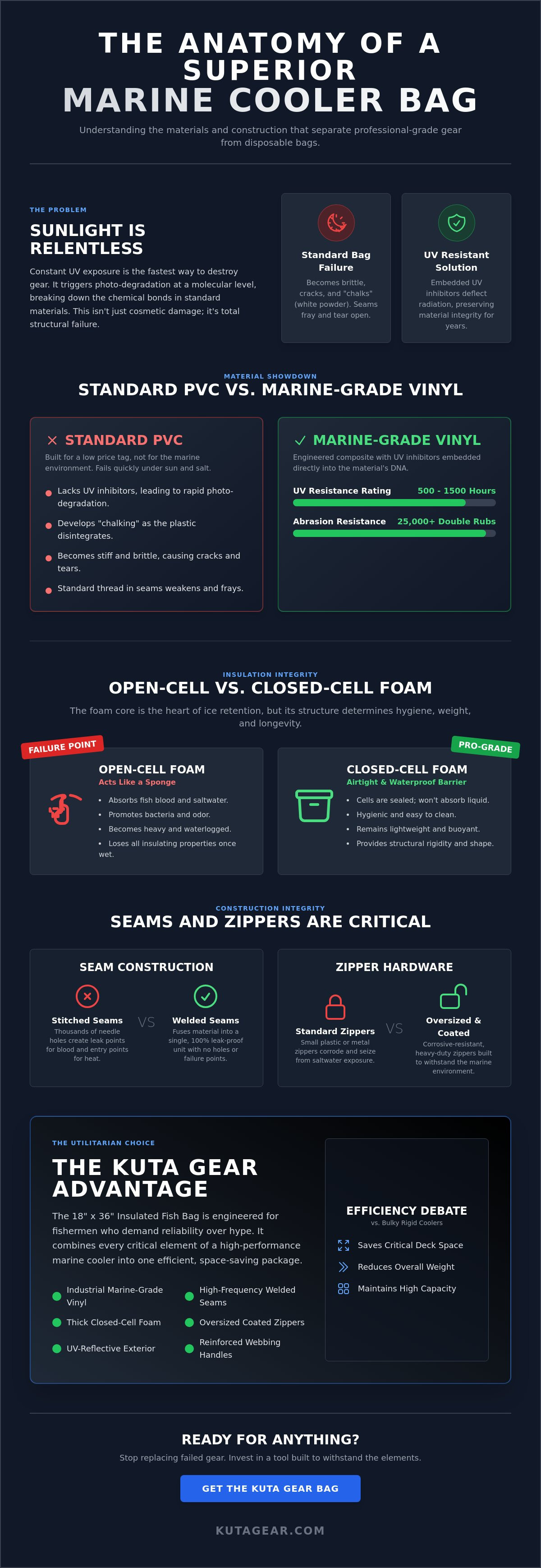
Cheap bags use standard PVC. This material lacks internal protection. When UV rays hit it, they trigger a chemical reaction. You see this as "chalking." It is that white, powdery residue that rubs off on your hands. It means the plastic is literally disintegrating at the molecular level. Soon after, the bag becomes brittle. It loses its flex. One heavy load and the material snaps. Industrial-strength materials are different. They contain UV inhibitors embedded directly into the vinyl during manufacturing. This isn't a spray-on coating that washes off. It's part of the material's DNA.
How Sun Exposure Destroys Standard Bags
At the molecular level, the sun causes photo-degradation. High-energy photons break the chemical bonds holding the material together. You can learn more about this process through The Science of Polymer Degradation. The first signs of failure are subtle. The vinyl feels stiff. You notice micro-cracking around the handles. These cracks aren't just cosmetic. They are entry points for bacteria and salt. Seams are the next to go. Standard thread isn't treated for sun exposure. It weakens. It frays. Eventually, the weight of your catch rips the bag open. By the time you see the leak, the structural integrity is already gone.
The Marine-Grade Vinyl Standard
True marine durability is measured in hours and rubs. Quality marine vinyl is typically rated for 500 to 1500 hours of UV resistance. It's built to last seasons, not months. A good quality marine vinyl should withstand at least 25,000 double rubs. This abrasion resistance is critical when the bag is sliding across a fiberglass deck or being hauled into a truck.
Color choice is functional too. Light-colored, UV-resistant exteriors stay cool to the touch. They reflect heat rather than absorbing it. This protects the insulation inside and keeps your ice from melting in the first hour. Marine-grade vinyl is a heavy-duty composite specifically engineered to withstand constant exposure to saltwater and direct solar radiation. It's built for the job. Big-box store bags are built for the price tag. Don't confuse the two.
Performance Specs: Insulation Meets Material Integrity
Insulation is worthless if the shell fails. A high-performance UV resistant fish cooler bag relies on a synergy between its exterior skin and its internal foam core. When the outer layer reflects solar radiation, the internal temperature stays stable. This isn't just about ice retention. It's about protecting the structural foam from heat-warping and environmental stress. Research confirms the severity of these conditions, with the main driver being UV-induced photodegradation of the outer polymers. If your bag's skin cracks, your insulation follows.
High-density foam is the standard for a reason. It creates a dense thermal barrier that resists heat transfer even in 100-degree weather. This allows for superior ice retention on open-deck boats where shade is non-existent. You need gear that fights back against the environment. Every component must be built for the salt. This includes corrosive-resistant hardware and oversized zippers that won't seize after one week of spray. Reliability is the only metric that matters miles offshore.
Closed-Cell vs. Open-Cell Foam
Don't settle for open-cell foam. It acts like a sponge. It absorbs fish blood, saltwater, and bacteria. Once it's soaked, the bag is ruined. Closed-cell foam is different. The cells are sealed. They won't absorb a drop of liquid. This keeps the bag hygienic and lightweight. Thick, dense insulation also provides the bag with its shape. It gives it the "stand-up" ability needed for easy loading when you're wrestling a heavy catch. For those who prioritize this level of industrial utility, the 18" x 36" insulated fish bag provides the necessary structural rigidity and thermal protection.
Seams and Zippers: The Weak Points
Seams are where most bags fail. Stitched seams create thousands of tiny needle holes. These holes leak bloody water into your boat and allow heat to seep in. High-frequency welded seams are the solution. They fuse the material into a single, leak-proof unit. There are no holes. There is no failure point.
Zippers must be equally rugged. Saltwater is a grinder. It destroys small, plastic zippers in a single season. Look for oversized, corrosive-resistant zippers with heavy-duty pulls. Check the handles too. They should be made from reinforced webbing that wraps around the entire bag. If the handle is only stitched to the outer skin, it will rip. You need a bag that can handle the weight of a full limit without flinching.
UV Resistant Bags vs. Rigid Coolers: The Efficiency Debate
Rigid coolers are a liability on a working deck. They are heavy, bulky, and unforgiving. A high quality UV resistant fish cooler bag offers a superior weight-to-volume ratio that traditional rotomolded boxes can't touch. When you're miles offshore, every pound matters. Standard rigid coolers can weigh 30 to 50 pounds before you even add ice. That's dead weight. A fish bag provides the same insulation with a fraction of the footprint. It's about maximizing your haul, not hauling more plastic.
Bags also solve the air pocket problem. In a rigid cooler, the lid stays the same distance from the ice whether the box is full or empty. That empty space is filled with hot air that eats your ice. A soft-sided bag conforms to the shape of your catch. It collapses as you use ice and expands as you add fish. This "envelope effect" excludes hot air and keeps your ice in direct contact with the meat. It's a more efficient thermal environment. Cleaning is just as direct. You unzip the bag, hose it out, and hang it to dry. There are no deep corners for old blood to hide in.
Maximizing Deck Space
Space is the most valuable commodity on a boat. An 18" x 36" footprint is the sweet spot for most coastal anglers. It's large enough to hold a limit of snapper or mahi, but small enough to stay out of the way. When the bag is empty, it folds flat. You can stow it under a gunwale or in a forward locker. A rigid cooler is a permanent obstacle. It stays in the middle of the deck, creating a tripping hazard during the heat of a hookup. Reducing deck clutter isn't just about organization. It's a safety requirement. A collapsible UV resistant fish cooler bag gives you the storage you need without the permanent bulk.
Thermal Mass and Ice Retention
Thermal mass wins the ice war. A full bag has more thermal mass than a half-empty rigid cooler. Because the bag wraps around the contents, the ice works more effectively. On a standard 8-hour trip, fishermen often report lower ice consumption in a bag compared to a traditional box. The soft walls act as a vacuum seal against the environment. You don't lose cold air every time you crack the lid. The insulation stays tight against the catch. This keeps the core temperature of the fish lower for longer. You get better quality meat at the cleaning table. It's a simple, utilitarian advantage that rigid coolers can't replicate.
Maintenance for High-Sun Marine Environments
Even the best gear dies without maintenance. Salt and sun work together to destroy equipment. Salt acts as an abrasive. UV radiation acts as a slow burn. If you ignore your bag after a trip, you are throwing money away. A high quality UV resistant fish cooler bag is built for abuse, but it isn't invincible. Proper care ensures the material stays flexible and the seams stay sealed. It's about protecting your investment so it's ready for the next run.
The environment doesn't take days off. Neither should your maintenance routine. You need to remove organic matter and salt immediately after every outing. This isn't just about the smell. Fish blood and scales can harbor bacteria that eat away at liners. Salt crystals can act like tiny knives in your zipper track. A disciplined approach to cleaning is the only way to ensure long-term reliability.
The Post-Trip Wash Down
Keep it simple. Use mild dish soap and fresh water. Avoid harsh bleach or industrial solvents. These chemicals are too aggressive for UV-treated surfaces. They can strip away the protective inhibitors embedded in the vinyl. Follow these steps for a professional clean:
- Rinse the interior and exterior with fresh water to remove loose salt and scales.
- Scrub the liner with a soft brush and mild soap to lift organic stains.
- Pay special attention to the zipper track. Use a toothbrush to clear out salt crystallization.
- Rinse again and leave the bag open in a shaded, well-ventilated area.
Never store a wet bag. Moisture trapped in a dark environment is a breeding ground for mildew. Even if the material is mildew-resistant, the organic residue left behind is not. Dry it completely before you tuck it away.
Long-Term Storage Solutions
Storage determines the lifespan of your gear. Many fishermen make the mistake of folding their bags into tight squares to save space. This is a mistake. Tight folds create permanent creases in the marine vinyl. These creases become structural weak points where UV radiation can attack more effectively. Store your bag flat or hang it by the handles in a cool, dry place. Avoid unventilated sheds or the beds of trucks where temperatures can skyrocket. High heat can soften the adhesives and foam over time. Proper storage doubles the life of marine vinyl.
Inspect your gear before every trip. Look for fraying on the handles and lifting at the seams. If you notice the vinyl starting to feel stiff, apply a dedicated marine UV-protectant spray. This adds a sacrificial layer of protection against the sun. If you need a bag that handles the elements without constant babysitting, buy an 18" x 36" insulated fish bag designed for real-world durability. Gear that lasts is gear that gets maintained. Don't cut corners.
The Kuta Gear 18" x 36" Advantage
Kuta Gear doesn't sell status. We sell reliability. The Kuta Gear 18" x 36" Insulated Fish Bag is the utilitarian choice for those who actually work the water. It is built for real-world abuse. We know the marine environment is a grinder. It destroys weak gear. That's why every component of our UV resistant fish cooler bag is selected for industrial strength. This isn't a bag for the occasional hobbyist. It's a tool for the dedicated angler who demands preparedness.
The dimensions are intentional. An 18" x 36" profile is optimized for the most common coastal catches. It handles a limit of snapper, grouper, or mahi without breaking a sweat. It fits where you need it to. It tucks against the gunwale or sits flat in the bed of a truck. This size offers the perfect balance of capacity and portability. You get the storage volume of a massive rigid cooler without the back-breaking weight or the permanent loss of deck space.
Built for Durability, Not Just Aesthetics
Aesthetics are for the showroom. Durability is for the deck. Our UV resistant fish cooler bag features a rugged, industrial-strength exterior that resists punctures and sun damage. The handles aren't just an afterthought. We use heavy-duty handles and reinforced webbing that wraps around the entire body of the bag. This design distributes the weight of a heavy catch across the material rather than putting all the stress on a single stitch point. When you're hauling 50 pounds of fish and ice, those handles won't rip.
The construction is unapologetically direct. We use the high-density, closed-cell foam and UV-inhibited vinyl required to survive the salt. There is no marketing hype here. There are no useless features designed to inflate the price. We prioritize function over everything. The interior liner is easy to clean and resists the organic stains that ruin cheaper alternatives. It's a no-nonsense build for a no-nonsense environment.
Value and Availability
Corporate brands focus on retail margins and prestige pricing. We focus on deck performance. Kuta Gear offers professional-grade specs without the massive retail markup found in big-box stores. You shouldn't have to pay a premium just for a corporate logo. We deliver the same thermal integrity and material resilience as the high-priced competitors for a fraction of the cost. It's a rebellious approach to gear manufacturing that puts the customer first.
We also understand that timing is everything. When the bite is on, you can't wait weeks for a backordered shipment. We maintain immediate availability and fast fulfillment. Our logistics are designed to get the gear to your door before your next trip. You get a reliable partner that understands the urgency of the season. Don't settle for overpriced gear that fails when the sun gets hot. Get the gear that works as hard as you do at kutagear.com.
Gear Up for the Next Run
The marine environment is unforgiving. It demands equipment that doesn't crack under pressure. You now understand that a high-quality UV resistant fish cooler bag is a necessity. It is the foundation of a reliable storage system. This article covered the chemical reality of polymer degradation and the thermal advantages of closed-cell foam. You know that deck space is too valuable to waste on bulky, rigid coolers that act as permanent obstacles. Real reliability comes from industrial-strength materials and a disciplined maintenance routine.
Kuta Gear has provided rugged reliability since 2014. Our heavy-duty 18" x 36" construction is specifically engineered for extreme marine environments. It is built for the fisherman who prioritizes performance over corporate marketing hype. Don't waste another season on equipment that disintegrates in the sun. Shop the 18" x 36" Insulated Fish Bag at Kuta Gear and secure a tool that actually lasts. Focus on the hunt. We'll handle the cold.
Common Questions About Marine-Grade Fish Bags
What makes a fish bag UV resistant?
UV resistance comes from chemical inhibitors embedded directly into the marine-grade vinyl during manufacturing. This isn't a spray-on coating that washes off over time. It is a molecular defense against solar radiation. These inhibitors prevent the polymer breakdown that causes standard PVC to become chalky and brittle. A high quality UV resistant fish cooler bag maintains its flexibility and structural integrity even after years of direct sun exposure on an open deck.
How long will ice last in a UV resistant fish bag?
Ice retention typically ranges from 24 to 48 hours depending on the external temperature and how often the bag is opened. The combination of UV-reflective exteriors and thick closed-cell foam creates a superior thermal barrier. This setup prevents heat transfer more effectively than thin-walled retail bags. Keeping the bag full of fish and ice creates thermal mass. This mass helps maintain sub-freezing temperatures throughout a standard coastal fishing trip.
Can I use bleach to clean a marine-grade fish bag?
No, avoid bleach at all costs. Harsh chemicals and industrial solvents strip away the UV inhibitors and antimicrobial treatments in the vinyl. This leads to premature material failure and cracking. Use mild dish soap and a soft brush instead. This approach removes organic matter without damaging the bag's protective layers. Always rinse thoroughly with fresh water and dry the bag completely before long-term storage to prevent mildew growth.
Is an 18x36 fish bag big enough for tuna or mahi?
The 18" x 36" Insulated Fish Bag is the ideal size for schoolie tuna, average mahi, and limits of snapper or grouper. It provides ample volume for most coastal catches without taking up excessive deck space. If you are targeting trophy-sized pelagics over 40 inches, you may need a larger model. For the majority of daily offshore runs, this footprint offers the best balance of capacity, portability, and ice efficiency.
How do I prevent my fish bag from leaking in my truck?
Leak prevention starts with high-frequency welded seams. These seams fuse the material together to create a single, waterproof unit. Always ensure the zipper is fully closed and the bag is sitting upright during transport. Don't overfill the bag past the zipper line; water can seep through the teeth under heavy pressure. A properly constructed UV resistant fish cooler bag keeps the bloody water inside the bag and out of your truck bed.
Does the color of the fish bag affect ice retention?
Yes, color choice is a functional decision. Light-colored exteriors, such as white or light grey, reflect solar radiation. This keeps the outer skin cool and reduces the heat load on the internal insulation. Darker colors absorb heat and can reach temperatures that accelerate ice melt. By reflecting the sun, a light-colored bag allows the closed-cell foam to work more efficiently. This results in longer ice retention during high-heat summer days.
Can UV resistant bags be repaired if punctured?
Yes, punctures can be repaired using a marine-grade PVC patch kit or specialized flexible adhesives. Clean the area around the hole with isopropyl alcohol to ensure a strong bond. Apply the patch according to the manufacturer's instructions. While the vinyl is rugged and puncture-resistant, accidents happen on a working boat. A proper repair restores the leak-proof integrity of the shell. It allows you to get back on the water without replacing the entire bag.
Why is a fish bag better than a traditional cooler for boating?
Fish bags offer a superior weight-to-volume ratio compared to heavy, rigid coolers. They are collapsible and can be stowed away when empty to clear the deck. Unlike a rigid box, a bag conforms to the shape of your catch. This excludes hot air and keeps ice in direct contact with the fish. It is a more efficient use of space and ice. It is the practical choice for crowded boats and small decks.

Also in Contact

Portable Fish Storage for Pier Fishing: The Rugged Guide to Catch Preservation

The Best Way to Chill Fish Quickly After Catch: A Professional Guide
