

What Fits in an 18x36 Insulated Fish Bag? The Ultimate Capacity Guide
Stop hauling dead weight. A massive hard cooler eats your deck space and adds unnecessary bulk. It's an outdated solution for a serious angler. You want gear that performs. You don't want to pay for a logo or a corporate marketing budget. You need to know exactly what fits in an 18x36 insulated fish bag before you clear the jetty. We agree that spoiled catch and cramped decks are total deal breakers. Most anglers are tired of gear that is hard to transport and even harder to store. This guide delivers the hard facts on ice-to-fish ratios and maximum capacity for your target species. We're proving how this "Goldilocks" size handles a limit of snapper or a 30-inch salmon while keeping your boat functional. It's a rugged, cost-effective storage solution that outperforms oversized plastic chests in every metric. Discover the exact volume limits you need to stay prepared for a full day on the water.
Key Takeaways
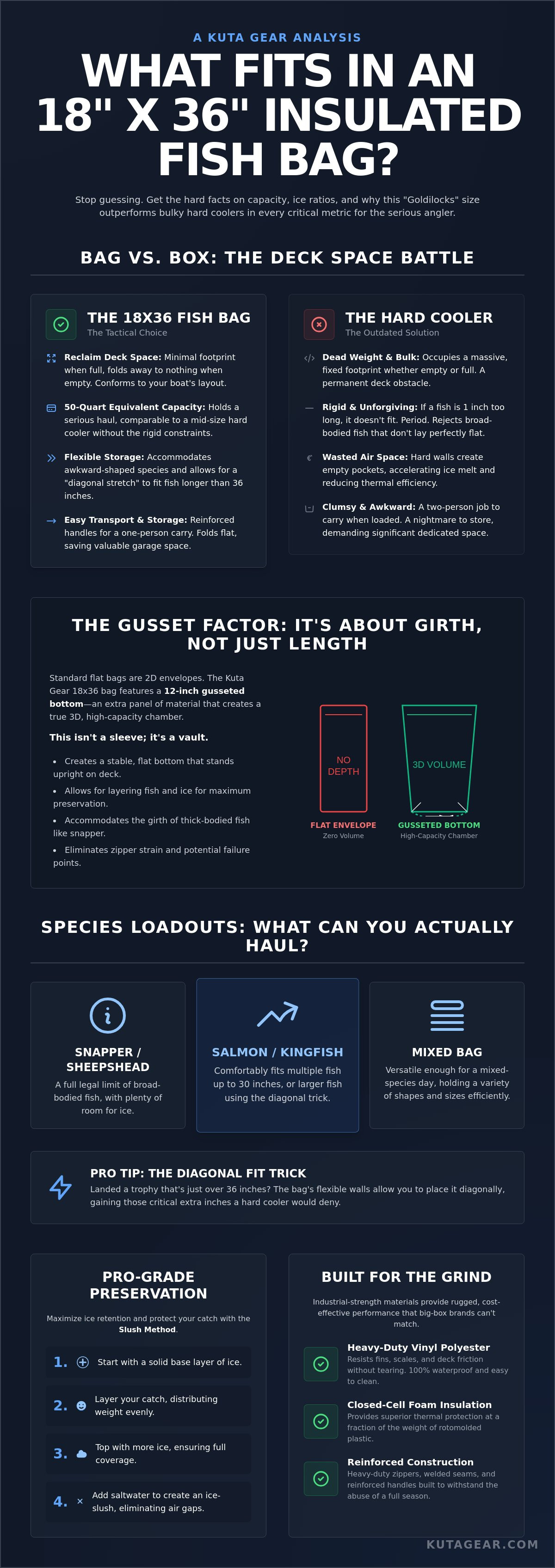
- Reclaim your deck space. Learn how the 18x36 footprint matches the capacity of a 50-quart hard cooler without the unnecessary bulk.
- Get the hard facts on what fits in an 18x36 insulated fish bag. We break down species counts and the diagonal fit trick for catches exceeding three feet.
- Master the 12-inch gusseted bottom. This design feature creates a 3D volume that holds more girth than traditional flat storage envelopes.
- Ensure professional-grade preservation. Discover how the Slush Method maximizes ice retention and protects your haul during long transits.
- Choose industrial-strength materials. Understand why heavy-duty vinyl and closed-cell foam provide a more rugged, cost-effective solution than big-box retail brands.
The 18x36 Footprint: More Than Just Dimensions
The 18x36 insulated fish bag is the "Goldilocks" of marine storage. It isn't just a container. It's a calculated piece of gear. This size bridges the gap between kayak portability and offshore capacity. It sits on the deck with a minimal footprint. When it's empty, it disappears. When it's full, it holds a serious haul. You need to understand what fits in an 18x36 insulated fish bag before you waste money on a bulky plastic box. This category requires industrial-grade materials. We're talking heavy-duty, vinyl-coated polyester. It has to withstand fins, scales, and deck friction. Anything less is a disposable toy.
Why 18x36 is the Tactical Choice for Anglers
Space on a boat is a premium asset. Hard coolers are static. They occupy the same square footage whether they're full of ice or completely empty. An 18x36 bag is dynamic. It conforms to your deck layout. You can tuck it against a gunwale or secure it to a bow rail. Portability is the real win here. Carrying a loaded 50-quart cooler is a two-man job that kills your back. The bag features reinforced handles. You can sling it over a shoulder. Transitioning from boat to truck becomes a one-trip operation. When the day is done, you don't need a dedicated garage shelf for storage. You fold it. You stow it. You move on.
The 50-Quart Benchmark
Industry experts often compare this size to a 50-quart hard cooler. But the math isn't just about liquid volume. A rigid box has fixed walls. If your fish is 37 inches long, it won't fit in a 36-inch box without a saw. The bag is different. It uses a 12-inch gusseted bottom. This transforms a flat envelope into a deep, 3D structure. It expands. It breathes. You can fit awkward, curved species that a hard cooler would reject. This flexibility is vital for effective methods of preserving fish. You need enough room for the catch and the ice to surround it. The gusset provides that depth. It ensures your ice stays in contact with the meat, not just the air inside a half-empty box.
When planning your trip, knowing exactly what fits in an 18x36 insulated fish bag allows you to bring the right amount of ice without over-loading the boat. Consider these capacity advantages over a standard cooler:
- Flexible Walls: Accommodates broader-bodied fish like Snapper or Sheepshead.
- Vertical Expansion: The 12-inch gusset allows for layering fish and ice deep.
- Internal Length: The soft-sided nature allows for a "diagonal stretch" that gains you critical inches for longer species.
You get maximum thermal efficiency without the bulk. It's about being prepared for the grind without fighting your own gear. If you're running a center console or a kayak, this is the footprint that makes sense.
The Math of a Kill Bag: Volume vs. Girth
A flat bag is an envelope. A kill bag is a vault. Most cheap options on the market are just two sheets of vinyl heat-pressed together. They have zero depth. When you drop a thick-bodied snapper inside, the zipper strains. The 18x36 design changes that. It utilizes a 12-inch gusseted bottom. This engineering choice creates a true 3D interior. You aren't just sliding fish into a slot. You're placing them into a structured chamber. Understanding what fits in an 18x36 insulated fish bag starts with this volume calculation. It's about girth, not just length. You need space for the meat and the ice.
Understanding the Gusset Factor
A gusset is an extra panel of material sewn into the base. It allows the bag to expand outward rather than just upward. Think of it as the floor of your storage. Once you add ice and your first few fish, the bag stands upright on its own. It doesn't flop over on the deck like a wet towel. This flat-bottomed stability is critical when you're working in heavy swells. You don't want your catch sliding across the fiberglass every time the boat pitches. Whether you are chasing official trophy fish sizes or just filling the freezer, the gusset ensures the bag maintains its integrity under a full load. It turns a narrow bag into a high-capacity box.
Soft-Sided Physics: Why Flexibility Wins
Rigid coolers are unforgiving. If a fish is too wide or has a sharp dorsal fin, it stays on the deck. High-quality fish bags have an adaptable skin. The soft-sided construction contours around the catch. This creates a tight thermal envelope. There is no wasted air space. Less air means slower ice melt. If you land a fish that pushes the 36-inch limit, you can position it diagonally. The flexible vinyl stretches just enough to accommodate those extra inches without compromising the seal. It’s a weight-to-strength win. You get the thermal protection of a rotomolded plastic chest at a fraction of the weight.
The secret is the closed-cell foam. It provides the insulation of a vault without the bulk of traditional plastic walls. It keeps the bag's shape even when you're hauling a heavy payload. If you want a gear solution that handles the pressure of a real haul, the 18x36 insulated fish bag is built for the professional grind. It doesn't just hold fish. It preserves them. It uses industrial-grade vinyl to resist punctures and UV damage. This isn't a bag you replace every season. It's a tool that stays in your kit for years. When you understand the physics of the gusset and the foam, the capacity limits become a tactical advantage rather than a guessing game.
Species Loadouts: What Can You Actually Catch?
Theory is useless on the water. You need to know exactly what fits in an 18x36 insulated fish bag when the bite is on. This isn't a guessing game. If you miscalculate, you're either dumping ice or leaving expensive meat to rot in the sun. A primary rule for any loadout is the 70/30 split. You must leave 30% of the bag's volume for ice. This ensures total coverage and professional-grade preservation. Without enough ice, the internal temperature spikes. Your catch degrades. You lose the reason you went out in the first place.
Offshore and Pelagic Loadouts
When you're running offshore, space is a tactical resource. The 18x36 bag handles the standard pelagic haul with ease. For Mahi-Mahi, you can comfortably stack four to six "gaffers" in the 20 to 30-inch range. Layer them with ice between each fish. If you hit a school of Skipjack or small Yellowfin Tuna, expect to fit two or three fish depending on their girth. Tuna are dense. They hold heat. Don't skimp on the ice here.
The "diagonal fit" is your secret weapon for longer species. A 40-inch Kingfish smoker will not fit straight across. Position the nose in one bottom corner. Angle the body toward the opposite top corner. The flexible walls and gusseted bottom allow for this stretch. You can secure the zipper on a fish that technically exceeds the bag's length. It's a professional trick that maximizes your gear's utility.
- Mahi-Mahi: 4-6 fish (20-30 inches) plus 20 lbs of ice.
- Tuna: 2-3 skipjack or small yellowfin (under 15 lbs each).
- Kingfish: One 40-inch "smoker" using the diagonal method.
Inshore and Reef Loadouts
Bottom fishing and inshore grinding require a different packing strategy. For Snapper and Grouper, the 18x36 is a workhorse. You can fit a full limit of Mangrove Snapper or two to three decent Red Grouper. Because these species are often broad, the 12-inch gusset is essential. It prevents the bag from bulging and keeps the zipper functional.
Redfish and Speckled Trout anglers can fit an entire day’s limit without issue. Five to eight slot-sized Reds will fit with plenty of room for a heavy ice slush. If you're targeting Salmon in the Northwest, this bag is the industry standard. You can fit three to four Chinook or up to six Coho before the weight becomes a transport challenge.
- Redfish: 5-8 slot-sized fish with room for a 2:1 ice ratio.
- Salmon: 3-4 Chinook (King) or 5-6 Coho (Silver).
- Snapper/Grouper: 10-12 Mangrove Snapper or 3 average Red Grouper.
Don't force the zipper. If you're at capacity, focus on ice contact with the most valuable fillets. A high-quality bag stays cold, but it can't perform miracles if you choke out the ice volume. Pack it right. Stay on the fish.
Maximizing Your 18x36 Capacity: Pro Packing Tips
Space is finite. Don't waste it with poor technique. If you want to maximize your haul, you need a packing system that prioritizes thermal density. Knowing what fits in an 18x36 insulated fish bag is useless if half that space is taken up by air. You need to pack for contact. Every square inch of your catch needs to touch ice. This prevents hot spots that lead to soft meat and off-flavors. It's the difference between a trophy dinner and waste. This isn't a luxury item. It's a tool. Treat it like one.
The Ice-to-Fish Ratio
Your ratio changes with the sun. On high-heat offshore days, stick to a 2:1 ice-to-fish ratio. For shorter inshore runs in cooler weather, 1:1 is acceptable. Use block ice for the foundation. Blocks have less surface area and resist melting for the long haul. Use crushed ice to fill the voids around the gills and fins. Pre-chilling the bag is a pro move. Toss in a few frozen water bottles or a small bag of ice while you're trailering to the ramp. It brings the closed-cell foam down to temperature before the first fish hits the liner. This simple step prevents your primary ice from melting on contact with a hot bag.
Bleeding and Slushing
The drain plug isn't just for cleaning at the house. Use it on the water. Bleeding your fish into the bag keeps the deck clean, but that warm blood raises the internal temperature. Open the plug, flush with a bit of sea water, and drain the waste. Once cleaned, close it up and add sea water to your ice. This creates a slush. A slurry is the fastest way to drop core temperatures. It surrounds the fish entirely. Dry packing with high-density blocks, rather than CO2 dry ice which can damage vinyl, is an alternative for multi-day trips where longevity is the priority. For immediate results, the slush method wins. Just don't forget the maintenance. Salt ruins gear. Scrub those YKK zippers with a soft brush and fresh water after every load to keep the action smooth.
Stack your catch with intent. Place the thickest fish at the bottom to maintain a low center of gravity. Position them back-to-back to protect the delicate belly meat from compression. This also helps you utilize the full 12-inch depth of the gusset. Ready to upgrade your boat's storage? Invest in a rugged 18x36 insulated fish bag that's built for the grind. It provides the industrial-strength performance you need without the retail markup of big-box brands.
Built for the Grind: Why the Kuta Gear 18x36 Stands Alone
Most fishing gear is designed in a boardroom by people who haven't smelled salt air in years. They focus on flashy logos and retail margins. We focus on the deck. A high-priced cooler doesn't catch fish. It just takes up space and drains your wallet. When you look at what fits in an 18x36 insulated fish bag, you aren't just looking at volume. You are looking at the integrity of the materials holding your catch. Kuta Gear is built for the professional grind. It's the no-nonsense alternative for anglers who prioritize performance over prestige. We've stripped away the corporate markup to deliver an industrial-strength tool that outperforms the big-box competition.
Industrial Strength Materials
Durability isn't a suggestion. It's a requirement. The outer shell of this bag is constructed from heavy-duty, vinyl-coated polyester. It's engineered for extreme UV resistance. It won't crack under the 2026 summer sun. The material is naturally mildew resistant. It doesn't hold onto the stench of last week's haul. Inside, we use high-density, closed-cell foam. This isn't the cheap stuff found in grocery store bags. It's professional-grade insulation that holds ice for 24+ hours in real-world conditions.
The hardware is equally rugged. We use reinforced carry straps designed to handle 100lb+ loads without failing. When you're hauling a limit of heavy bottom fish or a massive salmon, you need to trust the handles. We've seen too many bags rip at the seams when the weight gets serious. Ours won't. Every stitch is a commitment to reliability. It's gear that stays in your boat season after season.
The Kuta Gear Mission
We reject the status quo of the outdoor industry. You shouldn't have to pay a premium just to keep your fish cold. Our mission is simple. We provide professional-grade gear at a fair price. We do this by going direct-to-angler. There are no middlemen. There are no retail distributors taking a cut. This means more bag and less markup for you. We prioritize function over flashy marketing every single time.
As you prepare for the 2026 season, don't settle for gear that fails when the bite gets hot. You need a solution that maximizes your deck space and preserves your meat with industrial efficiency. Stop fighting bulky plastic boxes that don't fit your lifestyle. It's time to switch to a system that works as hard as you do. Get the Kuta Gear 18x36 Insulated Fish Bag and stop wasting deck space. Be ready when the schools show up. Be prepared for the haul. Trust the gear built for the grind.
Gear Up for Your Next Limit
You've seen the math. You know the species loadouts. Don't go back to a bulky plastic chest that kills your deck space. You now understand exactly what fits in an 18x36 insulated fish bag and how to pack it like a professional. This bag isn't just about storage. It's about preserving the quality of your meat with industrial-grade efficiency. We build these for the grind. Our bags feature rugged 18oz vinyl construction and heavy-duty YKK non-corrosive zippers. These tools are 5-star rated by offshore and kayak anglers who demand gear that doesn't quit. You want reliability. You want value. You want a product that stands up to the salt and the sun. Stop overpaying for corporate logos. Get the gear that works as hard as you do. It's time to reclaim your boat and protect your catch. Shop the Kuta Gear 18x36 Insulated Fish Bag and stay ready for the bite. Your next haul deserves a vault; not just a container. Get out there and fill it.
Frequently Asked Questions
How much ice does an 18x36 fish bag hold?
An 18x36 fish bag holds approximately 50 to 60 pounds of ice when completely empty. For active fishing trips, you should pack 20 to 30 pounds of ice to leave sufficient room for your catch. This balance maintains the critical 70/30 fish-to-ice ratio needed for professional meat preservation. It provides enough thermal mass for a full day on the water without the bulk of a hard cooler.
Will a 40-inch fish fit in a 36-inch bag?
Yes, a 40-inch fish will fit by utilizing the diagonal packing method. Place the head in one bottom corner and angle the tail toward the opposite top zipper corner. The flexible vinyl walls and 12-inch gusseted bottom allow the bag to stretch and accommodate those extra inches. It is a tactical advantage that rigid plastic boxes cannot match when you land a trophy.
Is the 18x36 fish bag completely leakproof for my truck bed?
The bag is water-resistant and designed to contain meltwater, but it is not a submersible dry bag. If the bag remains upright, the heavy-duty vinyl and heat-sealed seams keep your truck bed dry. Water can seep through the zipper if the bag is tipped on its side or flipped. Always keep the drain plug tightened and secure the bag upright during transport to prevent leaks.
How does an 18x36 bag compare to a 50-quart Yeti or Igloo cooler?
An 18x36 bag provides the same internal volume as a 50-quart hard cooler but occupies significantly less deck space. It conforms to the layout of your boat and folds flat for storage when empty. Hard coolers are static dead weight. When considering what fits in an 18x36 insulated fish bag, you gain the ability to store awkwardly shaped fish that would never clear the rigid walls of a standard ice chest.
What is the best way to clean an insulated fish bag after use?
Clean your bag with mild dish soap, fresh water, and a soft brush after every trip. Focus on the seams and the YKK zippers where salt and scales accumulate. Rinse the interior and exterior thoroughly. Hang the bag upside down with the zipper open to air dry completely. This prevents mildew growth and ensures your gear is ready for the next grind without holding odors.
Can I use this bag for grocery transport or camping?
This bag is an industrial-strength tool that works perfectly for grocery runs or weekend camping. It keeps frozen goods solid during long drives and fits easily in the back of an SUV. The 18oz vinyl construction is puncture-resistant. It handles heavy ice bags and jagged camping gear without failing like a cheap grocery tote. It is a versatile storage solution for any outdoor application.
How long will ice stay frozen in a Kuta Gear bag in direct sun?
Ice will stay frozen for 24 to 48 hours in a Kuta Gear bag, even when exposed to direct sunlight. The high-density closed-cell foam provides a professional-grade thermal barrier. To maximize retention, always pre-chill the bag before loading your catch. Keeping the bag zipped tight and using the drain plug to remove warm air ensures your catch stays at prime temperature for the duration of your trip.
Does the bag come with a shoulder strap for easy carrying?
The bag features reinforced carry straps built for heavy industrial payloads. These handles are engineered for a two-man carry or a single-shoulder sling depending on the total weight. Knowing what fits in an 18x36 insulated fish bag means you might be hauling 80 pounds of fish and ice. These straps are designed to handle that stress without ripping, providing a reliable way to transport your haul from the boat to the truck.

Also in Contact

Portable Fish Storage for Pier Fishing: The Rugged Guide to Catch Preservation

The Best Way to Chill Fish Quickly After Catch: A Professional Guide
