

Why Design Matters: The Benefits of a Gusseted Bottom Fish Bag
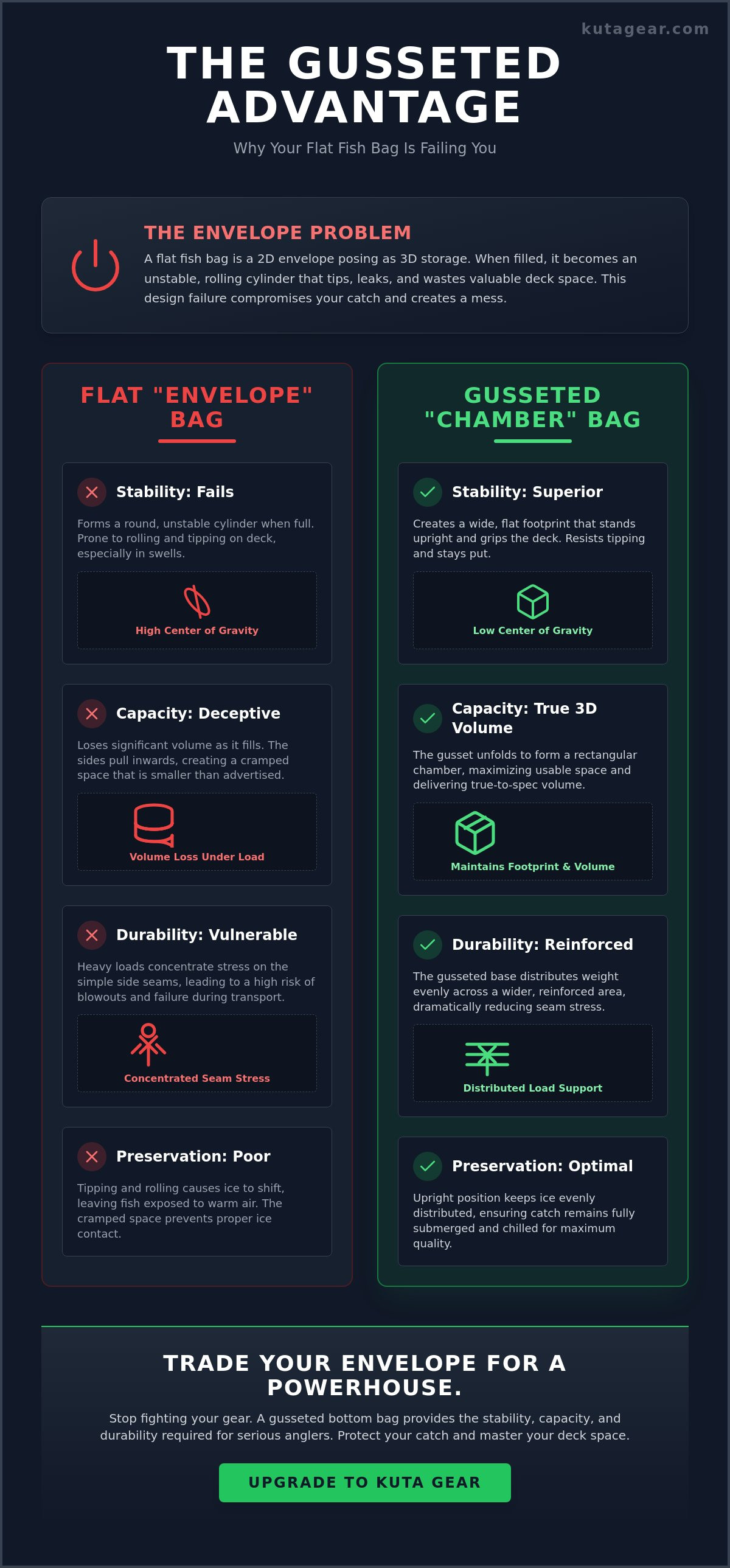
A flat fish bag is just a glorified envelope that fails the second you land a real fish. It tips. It leaks. It wastes the limited deck space you have. Understanding the benefits of a gusseted bottom fish bag is the difference between a secure, professional deck and a bloody mess in your truck bed. You want gear that works as hard as you do. You need a bag that stands up and stays put.
You've seen it happen. A heavy, wide-bodied catch causes a standard bag to fold and slide. It's a logistical failure that ruins the meat. This article reveals how gusseted technology turns a flimsy cooler into a stable, high-capacity cooling chamber. We will explain how this design increases volume for the footprint and strengthens seams under heavy loads. You will learn how proper fish positioning maintains the 32 degree temperature NOAA recommends for food safety. It's time to trade your envelope for a structural powerhouse.
Key Takeaways
- Stop using flat envelopes. Learn how gusseted technology transforms a 2D sleeve into a high-capacity 3D storage chamber.
- Stability is a requirement, not an option. See how a wide, flat footprint anchors your bag to the deck and prevents tipping.
- Protect the meat. Understand the benefits of a gusseted bottom fish bag for keeping catch straight and maximizing ice contact.
- Eliminate seam failure. Discover how structural gussets distribute heavy weight to prevent blowouts during transport.
- Master your deck space. See why the 18" x 36" design provides the maximum volume for the smallest footprint.
What is a Gusseted Bottom and Why Does Your Gear Need It?
A gusseted bottom is the structural foundation of a high-capacity kill bag. It's not a design flourish. It's a functional necessity. Most entry-level bags are constructed like a standard envelope. Two flat pieces of material are joined at the edges. They look large when empty. They fail when full. One of the primary benefits of a gusseted bottom fish bag is the transition from a 2D sleeve to a 3D rectangular storage space. Without this fold, a bag loses volume as it widens. It's a simple law of physics. As the center expands, the edges pull inward. You end up with a bag that's half the size you paid for.
Understanding what is a gusset helps explain why it matters on the water. In manufacturing, a gusset is an extra fold of material integrated into the base or sides of a container. It adds breadth. It reduces stress. For an insulated fish bag, the gusset is the engine that drives capacity. It allows the bag to maintain its footprint while expanding upward and outward. You get a true cooling chamber instead of a cramped pocket.
The Mechanics of the Fold
The engineering is straightforward. When the bag is empty, the gusset remains tucked away. It's low profile. It's easy to store. As you add ice and fish, the material unfolds. This creates a flat, reinforced base. Some manufacturers use side gussets. These allow for width, but they do nothing for stability. Bottom gussets are superior for heavy, wet loads. They ensure the weight of the catch is supported by the base, not just the side seams. When evaluating the benefits of a gusseted bottom fish bag, you have to look at the weight distribution. This structural choice distributes the load evenly. It prevents the bag from becoming a heavy, unmanageable cylinder. You need a bag that holds its shape under pressure.
Transitioning from Flat to Functional
Flat bags suffer from the "envelope problem." They waste space at the corners. The material bunches. It creates tight spots where ice can't reach. A gusseted bottom maximizes every inch of the 18" x 36" footprint. It turns a flat surface into a stable box. This design provides the "stand-up" capability required on a moving deck. Once you dump in your first bag of ice, the bag stays upright. It doesn't collapse. It doesn't roll. You can drop a fish in with one hand while keeping the other on the rail. This is how professional gear should function. It works with you, not against you.
Stability on the Deck: Gusseted vs. Flat Fish Bags
Flat bags are a liability on a moving boat. They are essentially two-dimensional envelopes. When you fill them with ice and a 20-pound catch, they become unmanageable cylinders. They roll. They slide. They end up in the corner of the deck or the back of the truck bed. One of the major benefits of a gusseted bottom fish bag is the wide, flat footprint it creates. This design grips the deck. It stays where you put it. You need gear that remains stationary when the weather turns. A bag that slides is a bag that fails.
Stability isn't just about convenience. It's about proper fish preservation. When a bag tips, the ice shifts. It pools at one end. This leaves the other half of your catch exposed to warm air. A gusseted bag keeps the ice level. It keeps the catch submerged. It ensures the thermal mass stays exactly where it belongs. This is how you protect the quality of the meat. You don't want your hard-earned catch sitting in a hot pocket of air because your bag couldn't hold its ground.
The "Anti-Roll" Advantage
Round-bottomed or flat-seam bags fail in heavy swells. They have no natural center of gravity. A gusseted base acts as a stabilizer. It lowers the center of gravity by keeping the weight spread across the floor. This vertical stability also protects your zipper. When a bag stays upright, the zipper remains at the top. This prevents accidental leaks and spills. You don't want a bloody mess on your deck or in your vehicle. A bag that stands up is a bag that keeps its contents secure. It's a matter of professional organization and cleanliness.
Footprint Efficiency
Deck space is a premium. This is true on a center console, a skiff, or a kayak. You can't afford wasted room. A gusseted bag uses its footprint more effectively. It stands tall and narrow instead of flopping wide. This allows for better organization. You can stack gear or line up multiple bags for different species. The 18" x 36" dimensions are optimized for this specific purpose. It's a professional solution for a crowded boat. If you need a bag that actually holds its ground, consider upgrading to an insulated fish bag designed for the real world. It stays where you put it. It does its job. You focus on the fishing.
Preserving Your Catch: Meat Quality and Ice Retention
Flat bags force your fish into unnatural curves. It's called "C-shaping." Once rigor mortis sets in, that curve becomes permanent. One of the most overlooked benefits of a gusseted bottom fish bag is how it maintains the anatomical integrity of your catch. A flat bag pinches the fish. It forces the spine to bend to accommodate the narrow space. A gusseted bottom provides a flat, wide floor. Your fish lays straight. This isn't about aesthetics. It's about yield. A straight fish is easier to fillet. It produces cleaner cuts. You aren't fighting a curved spine at the cleaning table. Professional results require professional positioning.
Cooling speed is everything on the water. According to research from seafood scientists, rapid temperature reduction is the only way to stop bacterial growth and enzymatic breakdown. A flat base ensures even ice distribution around the thickest part of the fish. In a standard bag, ice falls to the narrow sides while the center stays warm. The gusseted design creates a uniform bed of ice. It maximizes surface area contact across the entire body of the fish. You get better cooling for the same amount of ice. It's a more efficient thermal system.
Optimizing the Ice-to-Fish Ratio
A deeper ice bed is a requirement for long hauls. Flat bags are inefficient. They waste ice by forcing it into narrow points where it can't reach the catch. The benefits of a gusseted bottom fish bag include a squared-off interior that mirrors the shape of your load. This eliminates air pockets. Air is the enemy of ice. By removing these gaps, you slow the melt rate significantly. You get a consistent, freezing environment that locks in freshness. Proper positioning prevents bruising and pressure damage to delicate fillets. You want firm meat, not a waterlogged mess.
Anatomical Fit for Pelagic Species
Wide-bodied fish like tuna and snapper need the extra depth of a gusset. A flat bag squeezes the fish from the sides. This pressure forces internal fluids into the meat. It causes bruising. The gusseted bottom allows the bag to expand around the girth of the fish. You avoid fin damage. You prevent the tail from curling against a narrow seam. This maintains the "market look" of your catch. It's the difference between a trophy and a disaster. Don't let your gear ruin a high-quality catch. Use a bag that respects the anatomy of the fish.
Durability and Seam Integrity in Marine Environments
Seam failure is a gear killer. Most bags fail because they weren't built for the load they're expected to carry. Flat bags put maximum stress on the side and bottom joins the moment you add weight. You're forcing a flat object to become round. This creates massive lateral tension. One of the primary benefits of a gusseted bottom fish bag is how it handles this internal pressure. The weight of the catch is distributed across the entire base. It doesn't rely on the strength of a single thread line to hold the bag together. It's a structural advantage that prevents catastrophic blowouts. You need gear that survives the season, not just the first trip.
Reducing "point loading" is critical in marine environments. Corners are where punctures and leaks start. Sharp fins and heavy ice concentrate force on the smallest surface area in a flat bag. A gusseted design eliminates these tight corners. It provides a broad area for the load to rest. This prevents the bag from stretching to its breaking point. Reinforced materials work better when they aren't being pulled in opposite directions. You need a bag that maintains its integrity under the weight of a full limit. High-density fabrics and heavy-duty coatings only work if the bag's geometry isn't fighting against them.
Stress Distribution Mechanics
The fold isn't just for space. It's an energy absorber. When you drop a heavy fish into the bag, the gusset unfolds to take the shock. This prevents the seams from "popping" under sudden impact. Hydraulic pressure is another factor. As ice melts, the water weight increases. In a flat bag, this water pushes outward on the seams with nowhere to go. A gusseted bag allows the liquid to settle on the flat base. It's more stable and less prone to leaking. Longevity is the result. A bag that isn't constantly strained will last more seasons than a cheap envelope.
Handling Heavy Loads
Lifting a full bag is the ultimate test of construction. A gusseted bag maintains its shape under tension. It doesn't fold or collapse when you grab the handles. This makes transport easier and safer. You won't deal with the bag "bunching" as you move it from the boat to the truck bed. Rugged handles are essential here. They must be integrated into the reinforced structure of the bag to handle the 100+ pounds of a successful day. If you want a bag that stands up to the abuse of a busy season, upgrade to a professional-grade 18" x 36" insulated fish bag. It's built for the load. It's built to last.
The Kuta Gear 18" x 36" Advantage: Built for Performance
Kuta Gear doesn't build equipment for showroom floors. We build it for the deck. Every design choice in our 18" x 36" Insulated Fish Bag is a response to a real world failure. We've seen the cheap envelopes fail. We've seen the seams pop. Our bag is engineered with a heavy duty gusseted bottom for maximum marine utility. This isn't a luxury item. It's a tool for the serious angler who values reliability over brand prestige. You get the structural integrity needed to haul a heavy catch without the unnecessary marketing fluff that inflates the price of corporate alternatives.
Our direct to consumer model is a challenge to the status quo. Higher priced market alternatives rely on massive retail margins and expensive advertising. We don't. We focus on the technical manufacturing details that actually matter. When you experience the benefits of a gusseted bottom fish bag from Kuta Gear, you're paying for industrial strength materials and intentional design. You aren't paying for a logo. This is gear designed by insiders who understand that on the water, performance is the only metric that counts.
Why 18" x 36" is the Sweet Spot
Versatility is the core of this footprint. The 18" x 36" dimensions are optimized for the widest range of applications. It's the perfect size for solo anglers and small crews.
- Accommodates everything from a full limit of large snapper to medium pelagics.
- Easily fits in the back of a truck or a standard boat locker without taking up excessive room.
- Maintains a low profile on the deck while providing maximum internal volume.
Rugged Reliability You Can Trust
Durability is non-negotiable. Our bag features heavy duty insulation that holds ice through the heat of the day. We use technical materials designed for extreme environmental resistance. The seams and zippers are built to withstand the constant assault of salt and sun. We know the professional environment is unforgiving. Your gear shouldn't be the weak link in your setup. If you're ready for a bag that works as hard as you do, it's time to upgrade. Shop the Kuta Gear 18" x 36" Insulated Fish Bag now and see the difference that intentional design makes. We have the stock available and ready for your next trip. Don't settle for gear that fails when the fishing gets good.
Upgrade Your Marine Cooling System Today
Stop settling for equipment that fails under pressure. A flat bag is a liability that compromises your catch and clutters your deck. By choosing a gusseted design, you ensure your bag stands upright, stays where you put it, and keeps your fish in market-ready condition. The benefits of a gusseted bottom fish bag are clear. You get more volume for the footprint, better ice retention through proper positioning, and seams that won't blowout when you're miles from the dock. It's a technical upgrade for serious anglers who prioritize meat quality and deck efficiency. Every inch of this design serves a purpose.
Kuta Gear builds for the real world. Our specialized 18" x 36" design is the authoritative expert choice for catch preservation in demanding marine conditions. We've stripped away the corporate markup to deliver industrial strength gear that actually works. Don't let a poorly designed bag ruin your hard work. Get the rugged 18" x 36" Kuta Gear Insulated Fish Bag and take control of your cold storage. You've done the work to land the fish. Now use the gear that protects them.
Frequently Asked Questions
What is the difference between a side gusset and a bottom gusset?
Side gussets allow for width expansion along the vertical edges while bottom gussets provide a flat base for stability. Side gussets are often found in retail packaging for light items. Bottom gussets are the industrial standard for fish bags because they create a true 3D rectangular space. This design supports the weight of ice and catch from below. It prevents the bag from tipping on a moving deck.
Does a gusseted bottom make the bag harder to clean?
No, a gusseted bottom doesn't make cleaning more difficult if you use the right technique. The extra fold of material can be easily rinsed by turning the bag partially inside out or using a high pressure hose. Focus on the corners where scales and slime can collect. Our heavy duty materials are designed for quick wash downs. Just rinse, scrub with mild soap, and air dry upside down.
Can a gusseted fish bag stand up on its own when empty?
A gusseted bag generally requires some weight or internal pressure to stand fully upright. While the fold provides the structure, the bag's flexibility means it will likely lean or collapse when completely empty. Once you add your first layer of ice, the base expands. It then creates the flat footprint needed for vertical stability on your boat or truck bed. It's built for the load, not the shelf.
How much more can a gusseted bag hold compared to a flat bag of the same size?
A gusseted bag holds significantly more volume than a flat bag of the same dimensions. This is one of the primary benefits of a gusseted bottom fish bag. While a flat bag pinches at the corners and loses usable space, the gusseted design transforms the bag into a 3D chamber. You get a true rectangular cooling area that fits larger, wide bodied fish without straining the seams or wasting space.
Are gusseted seams more likely to leak than flat seams?
Gusseted seams are actually less prone to leaking under heavy loads than flat seams. Flat bags concentrate all hydraulic pressure from melting ice onto the side joins. A gusseted design distributes this weight across the entire base. We use reinforced construction to ensure the bag handles the weight of a full limit. It's a structural advantage that prioritizes longevity and cleanliness in your vehicle or on your deck.
Why is a gusseted bottom better for keeping fish fresh?
The gusseted bottom is superior for freshness because it allows for a uniform ice bed. Flat bags force ice to the edges, leaving the center of the fish exposed to air pockets. The flat base ensures the thickest part of the catch stays in direct contact with the cooling medium. This maximizes the benefits of a gusseted bottom fish bag by maintaining the consistent environment required for high quality meat.
Does the 18" x 36" Kuta Gear bag fit in a standard kayak?
Yes, the 18" x 36" Kuta Gear bag is designed to fit the tank well of most standard fishing kayaks. The gusset allows it to sit flat on the deck rather than rolling or sliding into the water. Its dimensions are optimized for versatility. You get the capacity of a larger cooler without the rigid bulk. It's a practical solution for solo anglers who need to manage limited space effectively.
How should I store my gusseted fish bag when it is not in use?
Store your bag flat or folded once it is completely clean and dry. Avoid leaving it in direct sunlight for long periods when not in use. The gusseted design allows the bag to fold down to a low profile. This makes it easy to slide into a locker or hang on a garage wall. Always ensure the interior is bone dry to prevent mold growth between the folds during the off season.

Also in Contact

Portable Fish Storage for Pier Fishing: The Rugged Guide to Catch Preservation

The Best Way to Chill Fish Quickly After Catch: A Professional Guide
